
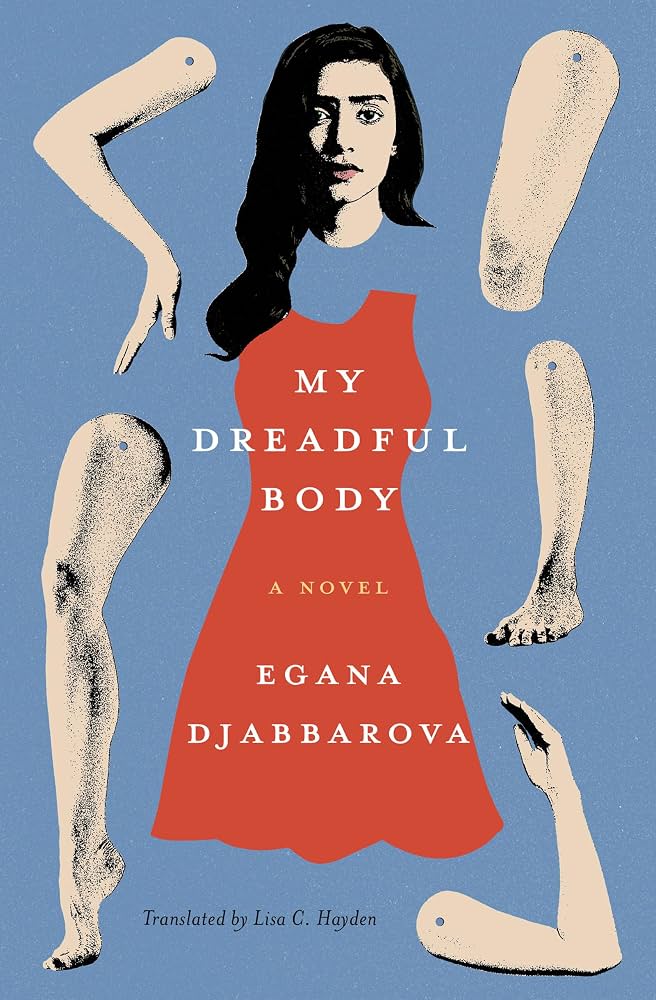
By EGANA DJABBAROVA
Review by BRITTA STROMEYER

Every now and then, a book is spawned that renders you speechless, demanding recognition for its searing vulnerability and astute cultural criticism. Egana Djabbarova’s My Dreadful Body, translated by Lisa C. Hayden, stands as one of those. The novel traces the lacerations of its largely unnamed narrator’s pain and grief bleeding into the suffering of an entire people by mapping a lineage of women—mothers, grandmothers, and aunts—whose identities are confined to roles as wives and caretakers, illustrating how societal expectations shape their lives and the lives of generations that follow.
Set in post-Soviet Yekaterinburg, Russia, the story follows the narrator’s upbringing within an Azerbaijani family, charting the cultural and societal challenges of life in the diaspora: “I don’t remember who it was and I don’t remember how long we ran; the only thing I remember is how much my shoulders ached from the heavy backpack, how the backpack hit my lower back, how I lost my breath, and how terrified I was. That was the first time I felt true primal danger and the proximity of death with my own skin. That was when I realized that being a stranger means being hated, being a vessel for rage.” The narrator’s toil with dystonia, a neurological movement disorder, serves as a visceral metaphor for this history; the illness not only robs her of speech and physical autonomy but mirrors the cultural constraints that have long stifled the women in her family. At its core, My Dreadful Body offers a piercing feminist critique of the systemic silencing and erasure of women’s agency, particularly within the context of the Azerbaijani diaspora.