By ERNESTO PÉREZ ZÚÑIGA
Translated from the Spanish by OLIVIA BAES
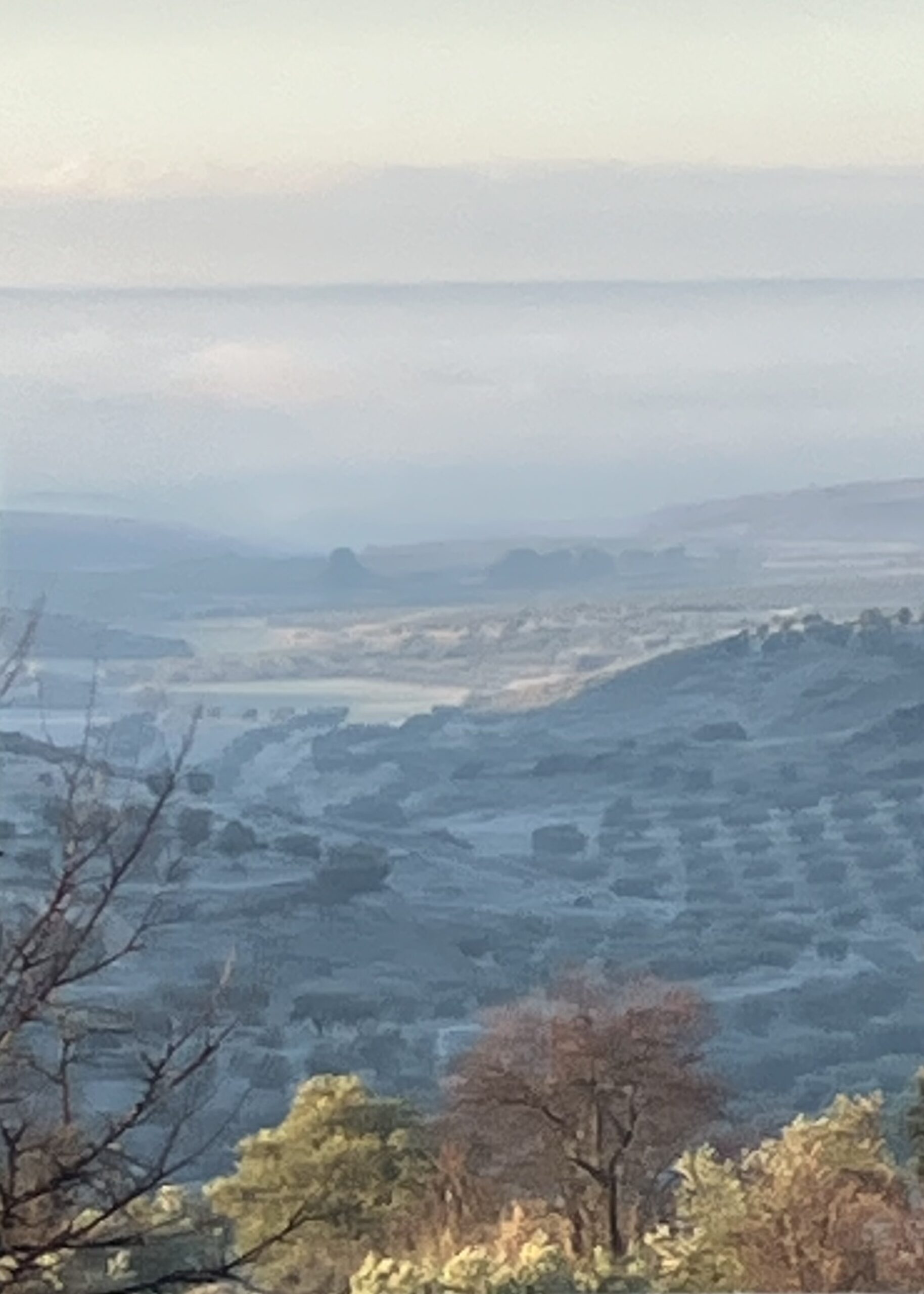
Photo courtesy of the author.
Salceda Valley, Colmenar de Oreja, Madrid
I hear it sing after the solstice. A bird of prey, the little falcon with the beautiful song. A crystal line rising from the tree where it perches to the sky then plunging down abruptly. This is how the kestrel precedes its own flight to the zenith, as if it first needed to trace a path of fierce bells.
I am not the only one to hear it: the small birds flee to faraway trees.
This is the sound of winter, when the year begins in slumber, damp with secret rains in the dawn and combed by the blizzards which wait for the sun to set through a crack in the clouds.
It is during the day that the kestrel attacks the few sparrows cowering from the cold on the roof. Huddled together and silent, as if awaiting an airbus, they disperse in a daze as talons strike from somewhere in the sky.
It came from the tallest cypress tree. I saw it extend its talons towards the slowest of the sparrows as the kestrel broke its fall, wings spread upwards.
I often see it hovering against the wind. Motionless in an impossible point in space until the kestrel insists on tracing its outline. Its own will against the void. A will that dances in a barely perceptible vibration. This is the vertigo of stillness. While its gaze sweeps the ground in search of mice or lizards. A gaze suspended midair, which at some point will dive down.
It must be sleeping in some rocky outcrop near my house, where, tucked away, it recognizes my footsteps.
In the summer, it nested in one of the haystacks the farmers pile up on the steppe. It would take off from there every afternoon to hunt in the lazy twilight until a truck came and began hauling away the piles of compacted straw. Then, once the secret nest was taken away too, the kestrel flew to the tower in search of winter.
How often I identify with you, not because of your flight but because of your song. When I walk on the dry leaves of the elm trees, I suddenly hear you, as if you were inviting me to some strange thing I have yet to discover, some strange thing that may be in the mud mixed with rain or in the cloud that eternally longs for the earth.
It is this vertical song you launch at the zenith like a crystal arrow. As if you were an archer of riddles that whistle through the air, showing me an alphabet that rises and crumbles before my eyes before I have time to decipher it.
This is how I sit down to write. I imagine the words along that ascent. They spring from the hunter’s throat. I claim with my voice what I will hunt in my writing. The meaning I will gut with this beak. The words I will carve with my claws into the clay tiles. Until I sink my talons into warm flesh. Until it finally dawns on me.
As I sing, I pierce the veil of the eye.
And only in the silence do I take flight.
Ernesto Pérez Zúñiga (1971) is a Spanish novelist, poet, and essayist whose work explores the human need for authentic self-realization in tension with civilization. After many years immersed in urban cultural life, he moved to the countryside, where he now writes. He is the author of seven novels, including a trilogy on 20th-century Spain comprising Santo diablo (2004), No cantaremos en tierra de extraños (2016), and Escarcha (2018); as well as La fuga del maestro Tartini (2013) and Veníamos de la noche (2025), works noted for their psychological depth, poetic sensibility, and structural ambition. He has also published several poetry collections, such as Calles para un pez luna (2002), Cuadernos del hábito oscuro (2007), Siete caminos para Beatriz (2014), Lance (2021), and Cóncavo (2024)—a reinterpretation of Federico García Lorca’s El diván del Tamarit—and has received literary awards for his work. He holds a PhD exploring the hidden influence of Dionysus in Valle-Inclán. Additionally, he is the author of essays, chronicles, reflections, and hybrid texts inspired by nature.
Olivia Baes is a French-American multidisciplinary artist based between Paris and Catalonia, where she runs the artistic residency La Rectoria. She has co-translated several works by Marguerite Duras, including Me & Other Writing, The Easy Life, and Six Films, as well as works by Swiss writer Charles-Ferdinand Ramuz. Her first feature film, Je suis fleur, produced by Buffalo Films and Imagic TV, is forthcoming. As curator of the James Baes Foundation, which houses her father’s fashion and erotic photographic archive, she is currently writing The Beholder, a hybrid memoir and biography emerging from this curatorial work.