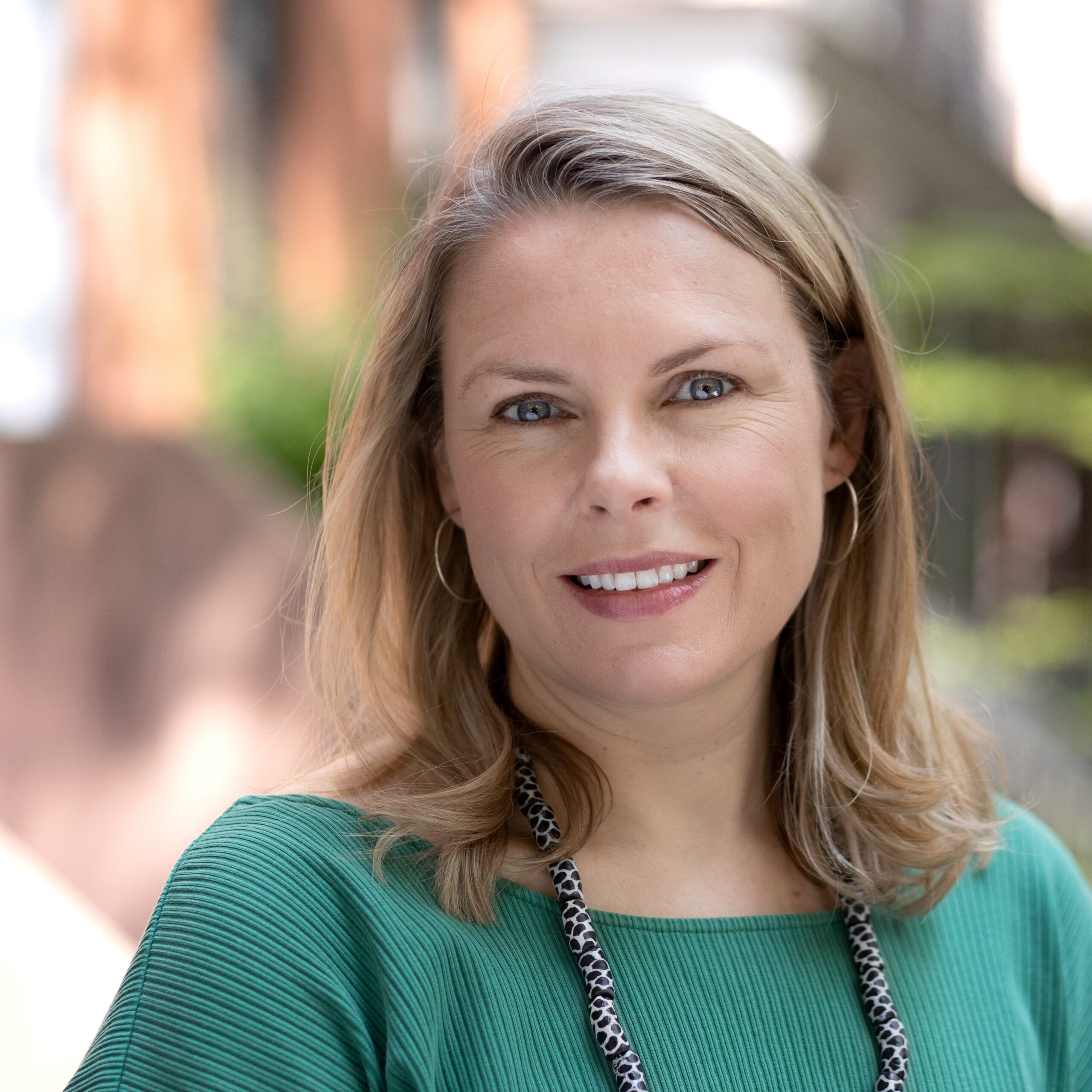
On a rainy morning in late August last year, I stood beneath a wedding-sized tent to observe the Sixth Opening Convocation of the West Virginia School of Home Economics. It was a humid day, and the smell of wet, freshly cut grass mingled with the perfumes of the young women who surrounded me. I was a guest of Sophia Chafin, keynote alumna speaker. She sat on a small wooden stage with her six-year-old daughter, Riley; her two-year-old son, Taylor Jr.; and her husband, Representative Taylor Chafin. Sophia, clad in a floral dress, held Taylor’s hand as the school’s co-founder, Andrea Armstrong, introduced her, describing her as “one of WVSHE’s greatest success stories.”
The Chafins are one of those couples that look as if they could be siblings, both slightly built and of medium height, with light brown hair, blue eyes, and full cheeks. Although new to the political scene—Rep. Chafin is a freshman congressman in Ohio’s sixteenth district—the youthful pair are demi-celebrities at WVSHE. When Sophia stood to make her way to the podium, students whooped and called out her name. Her embarrassed smile was surprising for someone who’d spent 2024 on the campaign trail with her husband, and yet in it I saw the uncertain young woman I had met six years before, in 2019, when Sophia was a college sophomore expecting her first child. At that time, she was deciding whether to transfer to WVSHE, then a new and untested private college that offered just one degree: a B.S. in home economics.
Today WVSHE—whose name students pronounce “W-V-She”—is a busy campus with 1,012 students enrolled, many of them pregnant or new mothers. Childcare is communal and part of the core curriculum. Students must also take courses in housekeeping, budgeting, nutrition, social media, and the Bible. While not affiliated with any one sect of Christianity, its founders, married couple Andrea and Jeff Armstrong, are evangelicals, and designed the curriculum to promote what they characterize as “traditional and commonsense values.”
The structure of Sophia Chafin’s remarks was in the tradition of church testimonials as she described how once she had been lost but had found her calling at WVSHE. She spoke of her decision to attend the college in emotional terms, describing her twenty-year-old self as “beyond desperate.” Her pregnancy was unplanned, and the child’s father had broken up with her, leaving her “heartsick with morning sickness.” She was planning to get an abortion until she stumbled upon WVSHE, an institution that “welcomed her pregnancy instead of trying to make it disappear.” Although she was initially skeptical of the old-fashioned curriculum, Sophia told incoming students, what she learned at WVSHE was ten times more useful than anything she studied during her two years at a “typical liberal arts college.” Toward the end of her remarks, Sophia invited her family to join her on stage.
Sophia took her daughter by the hand, coaxing her to the podium. “This is Miss Riley, who grew up on this campus, just like me. I didn’t even know how to change a diaper when Riley was first born. But my classmates helped me through all of it—pregnancy, postpartum, potty training. We did it together! It went so well that I went ahead and had another baby as soon as I could.” She then stepped away from the podium so that the audience could see her in profile. “And now, I want you, my WVSHE family, to be the first to know: I am blessed to be four months into my third pregnancy.”
This announcement brought the crowd to its feet; Sophia paused and pressed her hand to her heart as she finished her speech.
“I can tell you, unequivocally, this place saved my life. So, I want to say to you who are present here today: Congratulations on listening to that voice inside yourself. And now I’m going to bring my husband up to share another piece of exciting news.”
Taylor put his arm around Sophia and kissed her cheek, pausing ever so slightly for photos before he stepped up to the podium. “I love you, WVSHE!” he said, hyping up the crowd. “You gave me my wife. You gave me my kids. You gave me my life. I love this place so much that I am proud to announce we’ll be opening a second campus just a couple of hours from here in my home state: The Ohio School of Home Economics!”
As Sophia led the crowd in a round of applause, I marveled at how much she’d changed since we’d last been in touch. Although Sophia and I were once in frequent contact, she’d stopped returning my phone calls shortly after she began dating Taylor. I’d witnessed her wedding, the arrival of Taylor Jr., and campaign clips through the window of social media. I’d kept up with her out of curiosity but also disbelief. The Sophia I saw online seemed so different from the young woman I’d once known, an environmental sciences major with pink-tipped braids and a wardrobe of thrift store finds.
I first met Sophia when I was reporting on crisis pregnancy centers, which are fake women’s healthcare clinics run by anti-abortion activists. These activists, who often pose as nurses, offer free pregnancy testing, ultrasounds, and counseling. Their goal is to persuade women not to terminate their pregnancies, but they do not disclose this bias. They are often located near real clinics, a tactic that can confuse women seeking abortions. This is what happened to Sophia in October of 2019, when she traveled alone to a Planned Parenthood in Jasper, West Virginia, hoping to schedule an abortion.
Sophia was a sophomore at Boxelder College, a liberal arts school in central West Virginia. Jasper, which is in the western part of the state near the Ohio border, was a two-hour drive from Sophia’s school. She had come by herself, because she had not yet told anyone that she was pregnant, including her boyfriend, the child’s father. Nervous about the appointment and unfamiliar with Jasper, Sophia parked on the street several blocks from Planned Parenthood. As she walked toward the clinic, she was stopped by a woman in nurse’s scrubs who was standing outside a building that had the anodyne look of a healthcare facility. The woman asked Sophia if she was looking for Planned Parenthood and invited her to come inside. Only in retrospect did Sophia realize that the woman never confirmed that it was, indeed, Planned Parenthood.
Abortion is illegal in West Virginia except in cases of rape or incest (and then only up to fourteen weeks). Sophia was aware of this but assumed a healthcare provider would help her make an appointment in neighboring Ohio, where abortion is legal until the point of fetal viability, about twenty-three weeks. Anti-abortion activists at the crisis pregnancy center told Sophia that Ohio had passed a new law banning abortion when a fetal heartbeat was detected, effectively prohibiting the procedure after six weeks. This information was inaccurate; although Ohio’s Governor Mike DeWine did sign a controversial “heartbeat bill” into law in April 2019, federal courts stopped the law from taking effect in July. Flustered by the activists’ false assertions about Ohio law, Sophia left the crisis center with pamphlets promoting adoption. She was also given a brochure for WVSHE, described to her as a college where young mothers could complete their undergraduate degrees with childcare and healthcare provided. The advertisement promised to transfer any credits and to waive tuition fees for pregnant students.
I first contacted Sophia in November 2019 after she posted a photo of WVSHE’s brochure on a Reddit thread about crisis pregnancy centers. She’d figured out that the clinic she’d visited was phony and wanted to know if the school was also a trick. I had heard rumors of WVSHE’s existence but had never been able to confirm its location. Like Sophia, I initially assumed it was a scam, or perhaps a church falsely advertising itself as a college.
Sophia and I met for the first time in a public park near Boxelder College, because she was suffering from nausea and didn’t want to go to a place where she might encounter food smells or perfume. It was a warm day, and like college students the world over, Sophia was dressed as lightly as could reasonably be allowed, in a short-sleeved baby tee, embroidered jeans, and sandals. She had a neo-hippie vibe, enhanced by her long, brown, pink-tipped hair, which she wore in braids.
By then, Sophia had visited the real Planned Parenthood to get an accurate view of her options. She was nine weeks pregnant, still within the first trimester, when ninety percent of all abortions take place. Her initial resolve to terminate her pregnancy had been complicated by her boyfriend’s response. (Sophia’s boyfriend, whom I will call Justin, did not reply to any of my inquiries.) According to Sophia, Justin was morally opposed to abortion but didn’t want to become a father. He wanted Sophia to put their baby up for adoption and told her that if she terminated her pregnancy, he didn’t see a long-term future with her, because of a lack of shared values. Sophia and Justin had been dating for over a year, and Sophia didn’t want to break up. At the same time, she feared that a pregnancy ending in adoption would be traumatic for her, and she wasn’t sure Justin was ready for the emotional challenges they would face as a couple.
Sophia saw WVSHE as a place where she would be supported unconditionally during her pregnancy, should she decide to go through with it. But she feared it was too good to be true and had arranged for a tour with her mother, who was also skeptical. I tried to join them, but at that time WVSHE screened its visitors and did not allow press inside. The Armstrongs’ strict visitation policy was, in part, a safety measure to protect students escaping abusive relationships. But much of their secrecy had to do with the Armstrongs’ sense of themselves as politically misunderstood and needing to fly under the radar. It wasn’t until President Trump’s second electoral victory that Andrea Armstrong felt confident enough to share her vision for women’s higher education to a wider public.
WVSHE began as a Christian secondary school, founded by Andrea and Jeff Armstrong when their two homeschooled daughters reached their teen years. The Armstrongs wanted to give their girls the opportunity to socialize with other teenagers but were disappointed to find that there were no schools—public or private—that emphasized home economics. “I was looking for classes that went beyond teaching a bit of cooking or sewing,” Andrea told me. “I wanted my girls to learn about child development and nutrition and finances so that they could be in control of their mom life from day one.” Andrea and Jeff also disapproved of their local public school’s health classes, which they felt encouraged premarital sex by providing teenagers with information about birth control and STDs. After sharing their frustration on Facebook, the Armstrongs received replies from dozens of parents who wished to find something similar for their daughters. What surprised them even more were the many enthusiastic replies from young women.
Seeing a hole in the market, Andrea and Jeff opened Armstrong Academy, a high school for girls devoted to the domestic arts. Andrea was principal, dean of faculty, and curriculum director, rolled into one. Jeff, an accountant, signed on as the school’s comptroller and dean of admissions. The Armstrongs rented space from a local junior college with falling enrollment, taking over four classrooms and gaining access to the school’s facilities. They structured their school day very much like a traditional public high school, with students rotating through classes in subjects related to childcare, nutrition and cooking, home maintenance, gardening, and financial planning. The school’s initial enrollment, which was limited to Christian girls between the ages of fourteen and eighteen, was fifty-four students. By the following year it had doubled, with girls bussed in from western Maryland and Pennsylvania. A local blogger dubbed Armstrong Academy “a finishing school for the evangelical set.”
Annual tuition was $6,000, a relatively low fee made possible by a generous grant from The Institute for Family Life, a conservative think tank whose goal is to “encourage Biblical marriage through education and public policy initiatives.” In its first two years, The Institute for Family Life provided Armstrong Academy with eighty percent of its funding, with additional financial assistance coming from local fundraising efforts. In 2017, a visit from Vice President Mike Pence brought federal dollars and a transition into higher education. Implementing a little-used provision in the defense budget, Congress allocated $10 million to renovate Fort Deep Creek, a shuttered military base in Langford, West Virginia, into a campus for a new college helmed by the Armstrongs. It would be called the West Virginia School of Home Economics.
Fort Deep Creek, which included housing, an elementary school, and childcare facilities, was ideal for Andrea Armstrong’s plans to develop a new curriculum for older students, such as her two daughters, who had by then graduated from high school. Armstrong envisioned a work-study program that would allow undergraduates the day-to-day experience of being a mother—of holding, feeding, and diapering babies. To that end, she hoped to bring in students who were pregnant, so their infants could be part of the coursework.
In the spring of 2019, when renovations of Fort Deep Creek were nearly complete and WVSHE was set to welcome its first class of students in the fall, the Armstrongs began to search for pregnant students. Armstrong put the word out to local colleges and high schools, but because of privacy laws, the schools could not share student names with the Armstrongs, nor were guidance counselors eager to advertise or recommend an institution that hadn’t yet opened. The Armstrongs were wary of marketing and PR efforts, fearing the school’s ideals would be pilloried online. In the lead-up to the 2020 election, the #resistance was still going strong and right-wing influencers—tradwives and MAHA moms—were at the fringes. To keep a low profile, Armstrong focused her recruiting efforts at crisis pregnancy centers. This strategy proved to be remarkably effective in identifying emotionally vulnerable and financially strapped young women like Sophia.
When Sophia toured WVSHE in the fall of 2019, the school’s conservative ideology was not so clearly articulated in its public-facing documents. If you squinted, you might even think WVSHE had communitarian ideals, as it seemed committed to creating an educational environment that was supportive to young mothers and enriching to small children. Sophia described the school as having “a cozy ’90s throwback vibe.” She liked how the cafeteria was remodeled to accommodate wooden dining sets, sofas, and coffee tables, so that students could enjoy meals with their children in a homier setting. She also appreciated the friendliness of the students, who, unlike her peers at Boxelder College, were excited to learn of her pregnancy. But she was put off by the homogeneity of the student body. Sophia, who is white, noticed that most of the students she met were also white and tended to dress in what Sophia described as “Christian girl autumn” aesthetic: long hair, tall boots, cardigan sweaters. Everyone seemed to wear makeup. It didn’t feel like a place where an occasionally vegan, thrift-store-loving, indie-rock-listening girl would fit in easily, but Sophia was tempted by the scholarship money on offer. In addition to providing Sophia with tuition, room, and board, WVSHE promised a $2,000 pregnancy bonus with the understanding that Sophia would enroll her baby in the school’s childcare program.
Sophia’s mother, Pam Stover, urged her daughter to consider the long-term cost of raising a child, warning her that it exacted an emotional and intellectual toll as well as a financial one. Meanwhile, WVSHE aggressively recruited Sophia, with students inviting her to wholesome-sounding gatherings centered on crafting and beauty treatments. This occurred during a time when Sophia felt alienated from her Boxelder friend group, whose social life revolved around drinking, partying, and staying up late.
I spoke and texted with Sophia frequently during the two weeks before she decided to transfer to WVSHE. Sophia was still ambivalent about continuing her pregnancy but was warming to the idea of motherhood, partly because Justin was showing renewed interest, but also because WVSHE made it feel less overwhelming. For Sophia, the sticking point was the home economics requirement. She had recently settled on a major in environmental sciences and was reluctant to change it. Growing up in landlocked West Virginia, she’d always been fascinated by the ocean and dreamed of one day visiting Antarctica to study the rapidly changing ice. When it came time to decide, Sophia seemed to give Justin’s opinion the most weight. In a text message sent to me over Thanksgiving weekend, Sophia wrote: Had long talk with J about WVSHE and he is excited to be a dad and says it makes the most sense to transfer and take the $$. He said I can study what I want later in grad school when baby is older and he will fully support me. So I am going to go for it. Feels good to finally know. Like I can move on with my life.
In late December 2019, Sophia enrolled in WVSHE. Her decision put a wedge between her and her mother, who hadn’t realized that Sophia was even close to transferring. In retrospect, Stover feels that Andrea Armstrong took advantage of her daughter at a vulnerable time, manipulating Sophia into making a life-changing decision. She feels that she was seduced by the idea—put forth by Armstrong—that having a baby would give her life structure and meaning that was previously lacking. Stover noticed that, after interactions with Armstrong, Sophia would characterize her life choices in a negative way, describing her liberal arts education as impractical and self-indulgent. Sophia also seemed to feel newly ashamed of her accidental pregnancy, beating herself up for missing doses of her birth control pills.
Stover, who works for the National Park Service as a volunteer coordinator, emphasized that she had never blamed Sophia for her pregnancy. Stover was also insistent that she did not pressure her daughter to get an abortion. Sophia describes that time in her life differently; she felt it was obvious that Stover wanted her to terminate the pregnancy and break up with Justin. She also said that her mother warned her against Andrea Armstrong, saying that she was being used by her to market her school.
“I knew Andrea was more interested in my pregnancy than in me, but I didn’t mind,” Sophia told me. “Everyone else was treating me like this pitiful girl, but she saw me as an opportunity. Which I appreciated. It made me feel like I had something to offer.”
Sophia and her mother have a cordial but distant relationship now, something Stover hopes to mend. Her feelings about WVSHE are more complicated. She regrets not taking the school seriously enough. When she toured with Sophia, it had the feeling of a quirky alternative school with Christian leanings, nothing out of the ordinary for the region. She hadn’t realized the extent of the Armstrongs’ political activities, which Stover now regards as extremist.
“I’m not that much of a political person, and neither is Sophia,” Stover told me in a recent conversation over Zoom. “But now she’s the spokesperson for a lot of ideas that are just kind of out there. And I don’t think that’s her. I feel like the Armstrongs married her off to Taylor to help his campaign. They knew that if he won, they would get a school in Ohio. Andrea denies it, but she’s a very ambitious woman. She wants the government to help her open schools like WVSHE all over the country.”
Home economics instruction has been a part of American life since the nineteenth century, and it has long had ties to the federal government. With the Morrill Act of 1862, Congress encouraged states to establish publicly funded colleges to boost the nation’s agricultural and engineering prowess. Although the Morrill Act did not mandate coeducation, many states admitted women students for teacher training, owing to a shortage of male teachers after the Civil War. Young women could also take science courses, studying alongside men, but upper-level classes were sex-segregated, with men studying advanced theories while women’s coursework applied scientific concepts to caregiving and housekeeping. Chemistry might prove useful in baking; botany in gardening; biology in child-rearing.
Home economics found purchase in the secondary school system with the passage of the Smith-Hughes Act in 1917, which brought federal support to vocational education. There was a consensus that the American education system should be focused on job training, as the country needed skilled workers for its fast-growing industries. As with the Morrill Act, the legislation was passed with the needs of young men in mind, but advocates for home economics were able to smuggle in funding for women’s education.
By the 1970s, home economics had been absorbed into other subjects in higher education. It took longer to leave secondary schools. When I attended public middle school in the early 1990s, it was still a required class for all students. By the time I reached high school, home economics was one of three options for a practical arts credit. The other two were typing and woodworking. I chose typing, along with everyone else who was planning to attend college; the class was mostly girls.
Andrea Armstrong, who is forty-six, had a similar experience in her public school, but she viewed the lack of home economics instruction as a deficit in her knowledge, one that did not come to light until she had her first child and struggled to adjust to motherhood. A second baby brought even more chaos to her home, and she decided to drop out of the workforce. She had been a saleswoman for Procter & Gamble, a job that required frequent travel and made her feel left out of family life. She resented the amount of time her husband, Jeff, a CPA with a more flexible schedule, was able to spend with their two daughters. One day at an airport bar, she had a conversion experience while drinking a preflight Chardonnay. A man sat down next to her and told her how much he missed his wife and children, expressing regret over his mistaken belief that his life’s purpose was “out there” when, actually, meaningful relationships could only be found at home. As he spoke, Andrea became convinced that God was communicating to her through this chance encounter. Two days later, she resigned her position at Procter & Gamble and resolved to homeschool her daughters.
Armstrong shared her story with me during our first interview, in September of last year. She took me on a campus tour, showing me the childcare classrooms, test kitchens, laundry hub, vegetable gardens, and the three recently constructed “practice houses” where students can hone their cleaning and decorating skills. As we walked past dormitories that retained a military aesthetic, I was struck by Armstrong’s enthusiasm. She is a tall woman, around six feet, with an athletic build and loping stride. She stopped throughout our walk to pull stray weeds from perennial beds and knew the name of every mother and child we encountered. She wore a long, navy blue skirt, which she told me she’d made herself. Her T-shirt, which said “WVSHE/her,” was also her own design, and for sale in the campus gift shop.
Another popular item in the school store, also designed by Armstrong, is a baseball cap emblazoned with the words “Professional Wife.” This phrase, Armstrong believes, is the best way to sum up the goal of a WVSHE education, which aims to provide a young woman with the skills that will make her an attractive partner to an ambitious man who wants a big family as well as a big career. Given that less than ten percent of American married couples currently live on one income, the WVSHE education would seem to be a rather exclusive one, best suited to upper-class households, but Armstrong insists that she is not intent on training women to be partners only to wealthy men, pointing out that WVSHE offers classes in both household thrift and staff management.
In addition to providing an education in wifedom, Armstrong offers a matchmaking service to junior and senior students. Armstrong’s dating assistance began informally through her fundraising efforts, when she found herself chatting with prospective bachelors interested in meeting young women eager to be stay-at-home mothers. With the help of her daughters, Armstrong set up a website where men, vetted by Armstrong, could post profiles for a fee. It was through this service that Sophia met Taylor Chafin.
Sophia began her coursework at WVSHE in January 2020. She enrolled as a second-semester sophomore, with WVSHE accepting her previous credits so that she could graduate on time in 2022. Nearly twenty percent of Sophia’s classmates were pregnant, a cohort that made Sophia feel less alone in her decision to become a mother. When COVID hit, she was even more grateful to be at WVSHE. Although the college closed for several weeks in March and April of 2020, pregnant students were allowed to remain. Midwives and obstetricians came to the school for scheduled checkups and examinations, and the Armstrongs converted classrooms to accommodate an infant nursery.
Shortly before lockdowns began, Sophia and Justin decided to give their relationship another chance. Justin promised to attend birthing classes, and he helped Sophia, who’d opted not to know Riley’s sex in advance, choose a gender-neutral baby name. When WVSHE closed at the start of the pandemic, Justin stayed in close touch, texting throughout the day and calling every night. But as Sophia’s delivery date approached, he began to communicate less and did not show up for online birthing classes. Sophia hoped that he would still be allowed in the delivery room at the hospital, but unmarried partners were prohibited without special permission, which Justin did not obtain. He did not see Riley until two days after she was born, a lapse that Sophia found unforgivable. She broke up with him when she returned to WVSHE, where she boarded for the summer.
Sophia enjoyed the early months of motherhood. She had a lot of support from the school in the form of childcare and healthcare, as well as the camaraderie of fellow student-mothers, with whom she took daily stroller walks. Behind the scenes, the Armstrongs were scrambling to get the school opened at full capacity by September 2020. They had to protect a new group of pregnant students, as well as the babies born in the previous semester and over the summer. With two vulnerable populations, the Armstrongs implemented strict testing and contact-tracing policies. Students could not leave campus without permission and had to quarantine upon returning. Teachers were subject to the same restrictions. The school was essentially a closed campus until the vaccine rollout in spring 2021, and yet it was during this time that WVSHE’s applications began to soar.
COVID was a boon to WVSHE’s domestic curriculum. Nearly three million women dropped out of the workforce in 2020, and there was a new appetite for advice about cooking, cleaning, and homeschooling. Armstrong registered the change in the zeitgeist and encouraged students to post short instructional videos on domestic activities such as baking bread, preparing child-friendly dinners, and home organization. Students initially labeled their videos as educational content produced by college students but discovered that the posts were more successful if they pretended to be wives and mothers in real domestic settings. To create an illusion of domestic coziness, students cordoned off areas on the WVSHE campus for filming, teaching themselves the basics of lighting, set design, and broadcasting.
If you’ve followed any tradwife influencers in the past five years, you’ve probably seen a student production from WVSHE—that is, what you thought was a glimpse of an unusually young wife’s tidy home was actually a dorm room or a corner of the WVSHE dining hall. Many popular tradwife influencers, including Evie Braley, Lola Q, and Cara Lidell are WVSHE graduates who honed their personas as students.
Armstrong is unbothered by the way influencer culture has made its way into her school’s curriculum. “A big part of a mom’s life is online communications, whether it’s text messages to other mothers, logging into a school portal, or planning a trip. And, let’s face it, you have to be on social media. So you need to develop an aesthetic and an ethics of using it.”
When I asked Armstrong about the ethics of posting under false pretenses, she described the student productions as playful, “a way for girls to experiment with the kind of wives they would like to be. Do they want to be a pretty, stay-at-home kind of wife? A wife who loves baking? An outdoorsy wife who raises chickens and lets the kids run around barefoot? Different kinds of men want different kinds of wives, and our goal is to prepare students to support their future husbands.”
Sophia was not involved with COVID-era tradwife productions, though Riley was sometimes recruited for shoots. Sophia told me she wasn’t in the mood to playact at that time in her life. After her sunny summer with infant Riley, she found winter with a teething baby and a full course load a lot harder to bear.
Sophia and I were in frequent contact in early 2021, which turned out to be a difficult time for both of us. These were the months before the release of the vaccines, when it seemed that life might be forever marred by stretches of virulent illness and quarantine. Many schools were closed or only partly in session, leaving parents in work-from-home limbo. In my household, my husband’s salaried job took precedent over my freelance one, and so I moved into his home office after he was done for the day, working from 7 to 11 p.m. Sophia was doing homework at the same time, and we texted every few days, exchanging playlists and YouTube links. I was lonely in a way that was hard to pinpoint, since I was technically surrounded by my family all day long. Sophia felt the same way: isolated in a crowd of students. She and Justin had attempted to reconcile a second time, but WVSHE’s strict visitation policies made it feel impossible.
Sophia also had the sense that Andrea Armstrong disapproved of Justin, who had dropped out of college to take a job at a storage center. She remembers Armstrong stopping to chat with her one day, outside the childcare center, and seeming disappointed when she learned Sophia was still in communication with the father of her child. She advised Sophia to be practical about her financial needs when choosing a life partner, hinting that she had someone in mind for her, a man who would appreciate that she had already experienced pregnancy and motherhood.
In the fall of 2021, Sophia’s senior year, Sophia and I saw each other in person for the first time since the pandemic. We arranged to meet in Flour Power, a bakery café in downtown Langford within walking distance of WVSHE. Sophia and I sat at a sidewalk table and shared a pot of herbal tea. She had not yet become Sophia Chafin, tidily dressed politician’s wife, but she was no longer the college sophomore in braids and a baby tee.
She wore dark jeans, a short-sleeved white turtleneck sweater, and small gold hoop earrings. Her light brown hair was parted in the middle and pulled into a low ponytail, and her nails were painted pale pink. She had on a minimal but noticeable amount of makeup, something shimmery on her eyelids and cheekbones. When I commented on her refined appearance, she told me that she had recently attended a weekend-long aesthetic health fair hosted by the school. Sophia had attended the event with some skepticism, assuming it would be a lot of sponcon, and was surprised when she found it useful. “That’s kind of my whole WVSHE experience in a nutshell. I’ve always gotten so much more than I expected.”
Sophia’s affect, I noticed, was more polished, too. She spoke in full sentences and with a pleasant smile that struck me as slightly coached, though no less sincere. It was the bearing of someone with media training, which I later learned had become a requirement for all WVSHE graduates.
Sophia had a busy senior year ahead. She was writing a thesis about the importance of unstructured play, inspired by her observations of children at WVSHE. She was looking into teaching jobs and considering graduate study in early childhood education. When I asked about her earlier plans to study oceanography, she answered quickly: “Teaching makes more sense for me right now.”
In addition to making career plans, Sophia had signed up for WVSHE’s matchmaking service. She was also meeting people through Togetherforever, a Christian dating app recommended by the school, but noted that the men she met on the app were not vetted by Armstrong. Sophia described Armstrong’s picks as intent on marriage and generally more ambitious and well educated. There was a special category of men who professed interest in dating women who already had children of their own; Taylor Chafin, Sophia’s future husband, turned out to be one of these types.
When I met with Sophia in October, she had not yet met Taylor in person but had arranged to go apple picking with him at a local orchard. She sent the following text a few hours after their first date: Had a good time, he’s better looking than his photo. He’s much more political than I am. Not sure if that’s a dealbreaker for me. He doesn’t drink or play video games, I guess that’s good idk. We’re going out again tomorrow.
I didn’t hear from Sophia after her second date. In fact, she was not in touch with me again until the spring of 2022, when she sent a brief message to tell me she was engaged. She was married in the summer of that year, and in the fall of 2022, Pam Stover called to tell me that her daughter was pregnant again. I sent Sophia a note of congratulations but received no reply.
Stover told me that she’d also had difficulty staying in touch with Sophia during her courtship with Chafin and was alarmed by how quickly everything proceeded. She believes that Taylor Chafin was Armstrong’s pet project, an up-and-coming politician whose campaign image was burnished by Sophia and Riley’s presence. Stover claims that Chafin specifically told Sophia he was looking to marry a single mother, because he believed it was “the epitome of masculinity” to raise another man’s child. He also hoped to find someone who would be willing to have a second child immediately, because “pregnancies play so well on social media.” Stover had the sense that Sophia was put off by these statements and was surprised when the two continued to date. She suspects her daughter was pressured by Andrea Armstrong to marry Chafin on an accelerated timeline because Armstrong was trying to gain political allies in Washington.
Armstrong’s matchmaking service is an open secret on Capitol Hill, where Armstrong is known for cornering Republican congressional aides at social events to show them photos of WVSHE students. Generally, Armstrong’s approach is regarded as bizarre, but the idea of meeting women who want a traditional lifestyle is not unwelcome. Armstrong told me she’s had more takers since the re-election of Donald Trump and believes increased interest is related to the administration’s open embrace of traditional gender roles.
When I asked Armstrong if her recruiting in Washington was a kind of soft lobbying for the school, she insisted that she went to D.C. simply because it was the closest big city, a place where she could find lots of young men. I also wanted to know if Sophia’s marriage to Chafin had been brokered with an eye to securing federal funding for an Ohio School of Home Economics. Armstrong denied this, saying she’d set up Sophia with Chafin for one reason: he was open to dating a single mother.
“There aren’t a lot of men who check that box. So, when I saw him, I told Sophia. Believe it or not, I’m not that political of a person.”
Despite this self-description, Armstrong is currently working with the Trump Administration to restructure the Department of Education to create a new government agency: the Department of Home Economics. The department’s first big project is to facilitate construction of WVSHE-style colleges in all fifty states.
I didn’t have the chance to talk to Sophia one-on-one until several weeks after her convocation speech. I met her at her home in Beechwood, Ohio, where she lives in a restored farmhouse that Taylor inherited from his grandparents. She showed me around the historic house, and we peeked in on Taylor Jr., who was napping in his nursery. Riley was still at school; she attends a private Christian academy in town. Homeschooling, Sophia said, was not practical with the amount of traveling she did to support Taylor’s campaign. She also employs a part-time nanny who comes every morning to care for Taylor Jr., so that she can catch up on emails and phone calls.
We talked in Sophia’s sunny kitchen, sitting at a round wooden table that was scuffed and nicked by three generations of Chafin children. We drank decaffeinated iced tea mixed with lemonade, the only beverage Sophia can stomach these days. As with her previous pregnancies, she has frequent bouts of morning sickness.
“It basically lasts the whole pregnancy for me. I wish I could be one of those glowy pregnant girls instead of the pukey kind.” Sophia took a wincing sip of her drink. “It’s all worth it, of course. Babies are amazing.”
There was something glib about the phrase babies are amazing that made me feel I was still getting the PR-polished version of Sophia. I wanted to talk again with the young woman I’d texted during those long pandemic winter nights. I decided to approach the delicate question of why we’d fallen out of touch. I told her that I’d noticed that she had stopped replying to my texts after she began dating Taylor, and that I had always wondered if the two things were related.
After some hesitation, Sophia explained that when she and Taylor first started seeing each other, he was in the midst of a vetting process for his candidacy. He’d asked her, as a courtesy, to let him know if any press contacted her. When Sophia told him about her ongoing conversations with me, he was alarmed by the looseness of our connection. Sophia agreed to stop communicating with me, mainly because she did not think she and Taylor would continue dating. But then things moved faster than she expected.
“He was the polar opposite of Justin,” Sophia said. “Not that Taylor is a rebound, but I liked that he was a serious person—and that he saw me as a serious person. Justin identified me with the girl I was before. He didn’t get the magnitude of what happened between us. I had to ask him to give up parental rights when I married Taylor, and he just did it. No problem. It was like Riley wasn’t real to him. My mom thinks that’s why Justin didn’t visit me—because he wanted to pretend Riley didn’t exist. That’s not something I could do.”
I asked Sophia if she ever wondered what her life would be like if she hadn’t had Riley.
Sophia seemed offended. “Do you ever wonder what your life would be like if you hadn’t had your children?”
I told her that I believed that every mother entertains occasional fantasies of life without her children, but that, for me personally, the pandemic provoked almost daily reveries of what my days would be like if I had lots of time at home without any commitments. In my imaginary quarantine, I learned new languages, read all of Shakespeare, trained for a marathon.
Sophia seemed to sympathize with this, saying that the pandemic made her question motherhood, too. She realized that, despite everything she’d learned at WVSHE, she didn’t feel prepared.
I asked her what lessons were missing.
“Relationships, I guess. I knew how to organize my day with Riley but not how to get over Justin. Or how to talk to my mom about what happened. She was so disappointed when I transferred to WVSHE. She wanted to blame Justin, and that didn’t help. I mean, I did think to myself, sometimes: What if I’d never met him?”
When I asked Sophia to imagine what her life would look like in that alternate universe, I was met with a shrug. “I guess, working at a nonprofit? Graduate school? I don’t know, because I was just starting to figure it out when I got pregnant with Riley. It’s not what I planned, but I guess it’s what God had in store for me.”
I was curious about the role of religion in Sophia’s life. She told me she had grown up going to a Methodist church, but it was more of a social place for her than a spiritual one. During lockdown, feeling adrift, she read the Bible. It wasn’t a magic cure, but she began to have “a more spacious feeling inside.” Sophia is now a member of Good Shepherd Church in Beechwood, a branch of the evangelical church that her husband, Taylor, grew up attending. She enjoys the close-knit community but doesn’t feel attached to any one denomination. “I don’t like labels, whether it’s politics or religion.”
Sophia sounded a lot like Andrea Armstrong when she explained her relationship to national politics, describing herself as a mother and wife whose primary job is to support her husband in his endeavors. “If Taylor had been a doctor or starting his own business, I would have supported that. He’s in politics, so I go along with it. But just because I campaign for Taylor doesn’t mean I agree with him one hundred percent.”
When I asked about areas of disagreement, she declined to answer. She grew frustrated when I wanted to know what she thought about her husband’s support for a national ban on abortion, telling me she had been warned by Taylor not to speak about the issue to me. I then asked about her decision to discuss abortion in her convocation speech.
“What do you mean?” she asked.
“You said you were considering getting an abortion before you discovered WVSHE. You could have just not mentioned it. No one would have been the wiser.”
“Well, I knew you were going to write about me.”
“You’ve mentioned it in other speeches, though. Ones I’ve seen online. I’m wondering why you’ve made it part of your story when you didn’t have to. You could have downplayed it. Were you advised to do so?”
Sophia nodded. “But I also feel like I need to be honest about my life. The story I’m telling is not of someone who always thought abortion was wrong. Now I feel that way, but at the time, I didn’t. So, I’m not going to pretend like I did. But the truth is, I made the right decision. And I take pride in that.”
“You’re saying you’re glad you had a choice in the matter?”
“Yes, exactly.” She smiled knowingly. “I can see you’re trying to get me to say I’m ‘pro-choice.’ But it’s more complicated than that. I don’t think abortions should be encouraged the way that they are.”
“Did you feel pressured to get an abortion?”
“By my mother, a little. By my friends. They were like, ‘What do you want, Sophia? Think about yourself.’ With my mom, she really didn’t like Justin. So, I knew she didn’t want to be stuck with him. My friends were telling me to think about my career goals and things like that. But, I don’t know, I didn’t have that many goals when I was twenty years old.”
“You wanted to study oceanography,” I said. “You wanted to go to Antarctica with a team of scientists to see how the ice was changing. You told me about that the first day we met.”
“I did?” Sophia seemed skeptical. “How did that come up?”
“It was hot that day, very warm for November. We talked about how the summers are longer and you told me you wanted to study ocean currents and ice floes. You’d just seen a documentary about it in one of your classes.”
Our conversation was interrupted by the sound of Taylor Jr. on the portable monitor, waking from his nap. Sophia excused herself and came back a few minutes later with her son, whom she held on her hip as she got a bottle of milk from the refrigerator.
“I remember that day now,” she said, sitting down. “It was hot. I remember worrying at the last minute that the little T-shirt I wore was too casual. That you wouldn’t take me seriously. I was probably trying to impress you, talking about ocean currents and Antarctica.”
“Do you think you’d still like to go?”
“To Antarctica? Sure, when the kids are older. I wouldn’t want to go as a tourist, though. I’d want to be helping in some way or learning something—because the ice is changing so fast. It’s not the same place it was, even five years ago. I know every landscape changes, but it would have been something to see it when I was younger and then again now—and then later, in the future. To compare how things were versus how they are. Like how kids change so much, so fast.” Sophia paused to adjust Taylor Jr.’s bottle before finishing her thought. “It would have been like being a parent. Sort of.”
A few hours after Sophia and I spoke at her house, I received a text from Taylor Chafin’s publicist: Sophia Chafin fully supports all her husband’s policies and is looking forward to her role in helping to create the Ohio School of Home Economics.
Hannah Gersen is the author of two novels, Home Field and We Were Pretending. She lives in Brunswick, Maine.