By NAGHAM ASAL
At the Checkpoint, Palestine
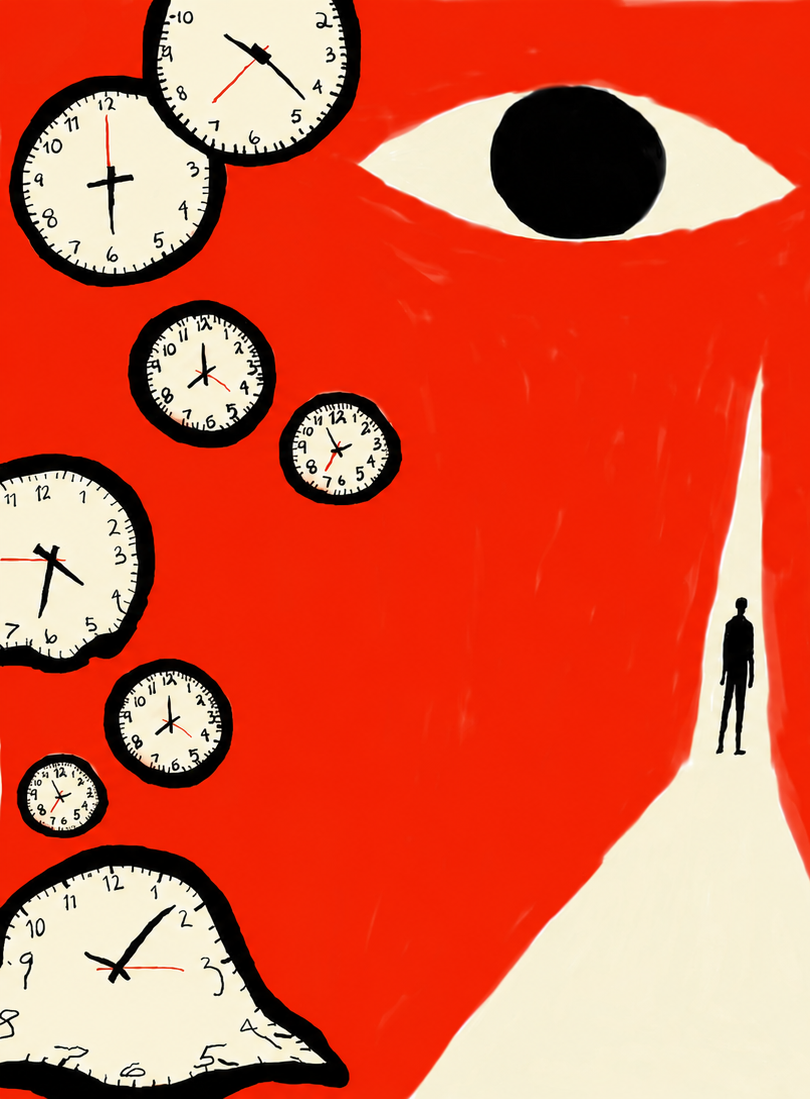
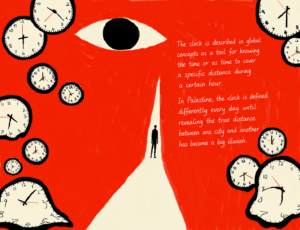
There is a place I return to every day, though I never stay there long. It is not marked on any map, not officially named, and yet everyone knows it. It is the space between where I am allowed to be and where I need to go. A checkpoint, yes, but also something more. A waiting room without walls. A pause stretched into routine. A place where time doesn’t move forward so much as it thickens.
This is where the day often begins.
I stand in line with others; students, workers, women carrying bags heavier than they look. The line moves forward a few meters and then stops again. Cars stretch ahead of us, their engines humming in the hot air. I can smell exhaust through the open window, mixed with dust from the road and the faint smell of coffee from a driver’s paper cup. People check their phones, look toward the soldiers, then look back at the line, as if trying to measure how much longer the wait will be. The air inside the car feels warmer with every minute, and no one knows exactly when the line will move again.
We do not speak much. There is a shared understanding here, a quiet recognition that we are all suspended in the same condition: not yet there, no longer here. The checkpoint is a place where time feels different. A few minutes can become an hour, and an ordinary journey can become a period of waiting with no clear end. It is a place of liminality, though we do not call it that.
We call it delay.
We call it life.
And yet, life continues through it.
I think about what it means to live in a place that is always “in-between”. Not fully accessible, not fully denied. Something else, something harder to name. This is what shapes our sense of place, not just the cities we come from, but the interruptions between them. The geography is fragmented, but so is time. A ten-minute drive becomes an hour. A plan becomes a question. A future becomes conditional.
Still, we move.
There is something stubborn in this movement. Something that refuses to collapse into waiting entirely. I remember reading Tobias Kelly and feeling, for the first time, that someone had found language for this rhythm. He writes about the search for an “ordinary life” under conditions where nothing is ordinary. And I recognize it immediately. The attempt to attend a lecture, to meet a friend, to arrive somewhere on time; these are not small things. They are negotiations. They are decisions made against a structure that quietly insists you should not arrive at all.
I have tried to explain this to others before, but it is difficult. How do you describe a life where even the simplest actions carry weight? Where leaving your house is not just leaving your house, but entering a system designed to slow you down, redirect you, remind you of your limits?
But maybe the better question is not how to explain it, but how we continue anyway.
Because we do.
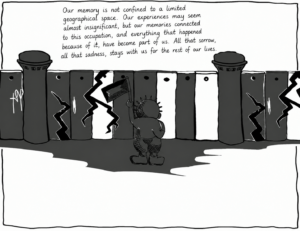
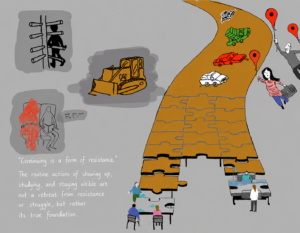
There is a kind of knowledge that forms in these spaces. You learn which hours are safer, which routes might open, how to read the mood of a soldier from a distance. You learn how to adjust your expectations without giving them up completely. This is not freedom, but it is not passivity either. It is something else; something closer to what we call sumud. Not just endurance, but a deliberate staying. A refusal to disappear.
Liminality is often described as a transitional state, a threshold between what was and what will be. But in my experience, it is not temporary. It stretches. It settles. It becomes a condition of everyday life. Under Israeli settler colonialism, we are not simply moving from one state to another—we are held in suspension. Not fully free, not entirely immobile. Not included, not excluded. Always in negotiation with space, time, and permission.
I recognize myself in this. The attempt to arrive somewhere becomes a quiet form of insistence. Each successful crossing, each completed day, feels like a small claim: I am still here.
What feels like chaos, like randomness, is not random at all. The fragmentation of our cities into isolated enclaves, the constant interruptions, the bureaucratic barriers; these are not accidents of conflict. They are part of a system that organizes space in order to control it, producing separation not merely as a side effect, but as a condition of life.
It is a process of accumulation through dispossession. At first, the phrase feels abstract. But then you look around, and it becomes visible. In the roads that suddenly end. In the lands you can no longer reach. In the way cities become smaller without physically shrinking; cut off from one another and folded inward.
Place, in this sense, is no longer stable. It is something that shifts depending on what is allowed.
And so we live in fragments.
But fragments do not mean absence.
Within this in-between, something else emerges. A kind of agency that is not loud, not always visible, but persistent. The decision to show up. To remain. To build a routine in a place that resists routine.
I begin to see that what we call “ordinary life” is not ordinary at all. It is structured by forces much larger than us, but it is also shaped by our response to those forces. The act of going to university, visiting family, or planning for the future takes place within a system that seeks to regulate movement, fragment space, and make continuity difficult.
So to continue.
Not in a dramatic way. Not always in a visible way. But in a way that accumulates over time.
A quiet insistence that life will go on, even here.
Maybe that is what “place” means to me now. Not just a location, but a condition. Not just where I am, but how I am allowed to be there. I have learned to navigate places by uncertainty: which road might be open, how early I need to leave, whether the line of cars ahead of me will move or remain still. Sometimes I leave home knowing that a journey that should take twenty minutes might take an hour, or longer. I watch the road ahead through the windshield, looking for any sign that the traffic is moving. When I finally reach the checkpoint, I am already thinking about the time I have lost and whether I will make it to class. Even after I arrive, part of me is still thinking about the journey back.
This is what makes “place” feel different here. A road is never only a road. A university is never only a university. Home is never simply home. Each place carries the possibility of being difficult to reach, difficult to leave, or suddenly inaccessible. I have learned to move through these places by adjusting, waiting, rerouting, and sometimes simply hoping that the road will remain open long enough for me to get where I need to go.
The checkpoint is still there. It has not disappeared. Tomorrow, I will likely pass through it again. I will stand in line, wait, adjust, move forward.
But I will also arrive somewhere.
And that arrival, no matter how delayed, how uncertain, is its own kind of claim.
Not just that I made it through, but that I am still here.
Nagham Asal is a Palestinian writer. Her work explores place, memory, environment, and the stories shaped by life in Palestine.