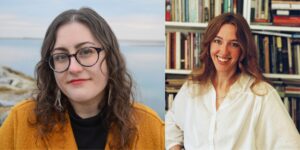
Laura Cresté (left) and Victoria Kornick (right)
LAURA CRESTÉ and VICTORIA KORNICK met a decade ago in NYU’s Creative Writing MFA, where they connected over writing long poems. They’ve been friends and readers of each other’s work ever since, including the manuscripts of what would become their first books. They exchanged questions over email about Laura’s debut collection, In the Good Years, and discussed how place, nonhuman animals, time, family history, and the unknown shaped the book.
Victoria Kornick (VK): In the Good Years is beautifully grounded in landscapes—the ocean, so central to the speaker’s adolescence, the mountains, where she and her partner spend the pandemic, and the gardens of childhood and adulthood. I know many of these poems were written or revised in Provincetown, and I wondered about how that return to the ocean shaped your writing of these landscapes.
Laura Cresté (LC): Despite happily ending up in landlocked western Massachusetts, I feel most at home on the coast. Summers on eastern Long Island are the landscape of many of my childhood memories, and much of the book came together during the nearly two years I spent in Provincetown, first as a Fine Arts Work Center Fellow and then as an employee. I appreciate how the ocean puts things in your path. In a winter’s worth of walks along Herring Cove, I found the wreckage of a small boat, a loveseat, and, more than once, storm-battered lobster traps. And then there’s the more pernicious litter: Mylar balloons, tampon applicators, and bottle caps—so many bottle caps—at the wrack line, tangled up with the seaweed and mermaid’s purses, a tangling which for me disproves the possibility of escaping into nature. It’s all human now.
Walks are important to my process, if for no other reason than that they keep me from my phone. But they also have a way of punctuating the familiar with surprise, like the times we’ve found seals resting in banana-pose. I think you need that sort of reminder while engaged in a long writing project: that you might keep unearthing something new.
I can’t help being fascinated by the creatures we live alongside, especially in the liminal spaces between the wild and the domestic: the deer on the front lawn, mice in the walls, and bats in the attic.”
VK: As I read these poems, I found myself thinking of one of Joy Williams’s “Essential Attributes of the Short Story”: “An animal within to give its blessing.” Of course, these are poems, not stories, but as in Williams’s advice, your poems hold animals as much more than metaphor or decoration. There are horses carrying ancestors, a sometimes-vicious dog nuzzling the speaker’s cheek, a curious, visiting bear, penned-in goats, and a beached baby whale (among others). In a book deeply attuned to climate change, you draw our attention to the interconnections among species through nuanced portraits of nonhuman animals. How did these animals come into the poems, and what did they offer you as a writer once they arrived?
LC: I love this question. It was strange when putting my collection together to notice how many animals there are, especially for someone who has never considered myself a pet person. (The poet Tracy Fuad inspired a necessary culling when she showed me that the word “dog” was appearing over seventy times in the manuscript.) I’m not terribly sentimental about animals; I’m not even, to my shame, a vegetarian. But I can’t help being fascinated by the creatures we live alongside, especially in the liminal spaces between the wild and the domestic: the deer on the front lawn, mice in the walls, and bats in the attic. I try not to include animals in my poems as symbols because they operate according to their own logic, living this parallel, self-possessed, alien experience alongside us.
That’s also why I’m drawn to writing about very young children. I often don’t know what they’ll do next. I can at least delude myself into believing that I understand the inner lives of the people closest to me, grasping their motivations and habits. Then, within that context of predictability, enters the toddler careening through the room, or the untrustworthy family dog skulking around the edges.
I don’t think my poems begin in the unknown; they begin most often in an image, or with some old story I can’t stop telling myself. But then they make detours into the unknown, and come home ankle-twisted or bloody-kneed.”
As for climate change, I want to acknowledge in my poems that no place on earth is untouched by industry. There are microplastics in the depths of the Mariana Trench and in the snowflakes atop Mount Everest. Extreme weather is the rare experience we’re sharing with animal and plant life, and while I don’t mean for every poem to become a dirge, or to anthropomorphize every animal that crosses my path, I can’t talk for very long about the whale that wanders into my orbit without talking about capitalism and the degradation of our oceans. I can’t talk about the deer in my yard without talking about the explosion of Lyme disease or the hollowing out of natural predators. I do see us as very interconnected, if not in a cozy, familial way, then certainly in the way our fates are intertwined.
VK: I am so interested in all of this. But perhaps most of all, I’d like to know more about your relationship with uncertainty, particularly in poems like “An Incomplete List of What I Can’t Tell You” or “At the Lighthouse,” which circle questions without answers. I thought of Keats and negative capability throughout the book, and I’m curious about how you navigate mystery as a force in your writing. Is the unknown a place where poems begin for you, or do poems lead you to a place beyond what’s known?
LC: I struggle with uncertainty, and it comes out in the writing. I’d much prefer to have my questions answered than to have the poems themselves. For the most part, I don’t think my poems begin in the unknown; they begin most often in an image, or with some old story I can’t stop telling myself. But then they make detours into the unknown, and come home ankle-twisted or bloody-kneed. Many of my poems are obsessed with the inevitability of death. Oftentimes the mystery for me is how to think about anything else, how not to dwell.
Teenage Sylvia Plath wrote in her diary that she wanted to be omniscient. She was “the girl who wanted to be god.” By 35, I’ve mostly accepted that I can’t be god, but I still find it horrible to consider that my time is finite and I won’t get to see how every story ends.
VK: There’s a wonderful poem, “Self-Portraits,” early in the book, and it’s evident how those portraits are relational: “Laura Ingalls, my namesake, / whenever industrious and doughy, / cutting biscuit rounds with a water glass” or “Vacant reflection / in the pupil of a whale, gaze unreturned as the back of a spoon, eye no longer an eye.” As the book goes on, other poems create their own kinds of self-portraits, and these, too, constellate the self within other forces of the book—family, history, climate, animals, place (among others). Could you speak to how you conceptualized self-portraiture in a book that’s centered on relationships and interconnectedness?
LC: “Self-Portraits” was a late addition and an attempt to corral the manuscript into coherence. I often worried that the poems were otherwise trying to cover too much ground: pages given over to childhood and adolescence, its immediate postscript, the COVID years, and then years that predate my existence.
I’d previously attempted a similar move in a poem, ultimately abandoned, that included one line from diary entries covering each year of my life, from 1996 when I started journaling until, say, 2018 or whenever I tried this. I’d wanted to find evidence of cyclical thinking and to see whether my child voice, adult voice, and everything in between could be sewn together in interesting ways. As I said, it didn’t work out. But years later I was taken with Sheila Heti’s book, Alphabetical Diaries, that orders sentences from years of diaries achronologically.
“Self-Portraits” resists my usual comfort in extended narrative. What remains, ideally, from seeing my speaker refracted across different contexts and life stages, is an elemental continuity. A sensibility or voice that carries me through it all.
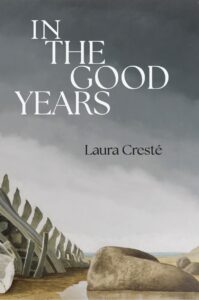
VK: In the Good Years is a terrific title, and one that made me consider the many other kinds of years in this book: “the wasted years” as a secretary, “One Year Off Generic Zoloft,” the “long breath between years” of deaths that don’t align “with war or with plague” in a cemetery, how “our children’s lives would get worse every year” in the Sixth Extinction. I’d love to hear more about the title and how you think about time in the book.
LC: Thank you! “In the good years” first appeared for me as a phrase within a poem from maybe 2017. Years later, Ocean Vuong, who you and I were both classmates with at NYU, suggested it as a title for the collection. That replaced Gentle or Not, which I think gestured at the same feeling. Life is gentle, except when it isn’t. “The good years” insists on the bad years, as well.
I’ve always liked the words “good” and “bad.” A bad man, a bad dog, a good sense. Some of the poems in In the Good Years had appeared in my chapbook, You Should Feel Bad. The real world is often too messy for these sorts of judgments, so it becomes a satisfying experiment to name something plainly good or bad. Sometimes there’s a pleasure in dispensing with nuance in favor of being declarative.
For all the struggles with anxiety and depression that the book catalogs, it was written during a pretty fortunate stretch. The bad years are the not-too-distant past, when my family fled state-sponsored terror during Argentina’s dictatorship of the 1970s and 80s. Then there’s the anxious peering ahead, my fear of the bad years still to come and anticipatory grief for all that I’m afraid of losing. “The good years” are, I hope, an attempt at humility, or thankfulness: most of the people I love are still alive.
VK: Humility and thankfulness feel important in the book, and in how you positioned your speaker while considering the large-scale horrors of the past and future. I’d love to hear about how family history and Argentina entered the book, and how those poems evolved within the manuscript as you worked on it. What was your experience writing these poems in conversation with family members, both living and dead?
LC: For a long time I was aware that I’d obliquely referenced that family history in my poems, but I hadn’t felt capable of writing about it directly or at length. It’s likely I wouldn’t have written those family poems (or else that they would look very different) if not for my fellowship at the Fine Arts Work Center, where I had a long winter to research Argentine history and mull over how best to express my experience of it. It was the most difficult part of the book to write.
The story, briefly, is that my grandfather, the leftist playwright Alberto Adellach (a pen name; his real name was Carlos Creste), was blacklisted during the Argentine military dictatorship that began in 1976 and is popularly known as the “Dirty War.” Adellach left for Spain, along with his wife and two of his children (including my father, age 12), allowing his other two children (ages 16 and 25) to remain behind, as they wished. Within months, those children were kidnapped by the paramilitary force that came to the family home looking for my grandfather. They were sent to a secret detention center, where they were tortured and did not expect to survive—but were, after a week, released. My grandfather never returned to his homeland. His four children have, or had, complicated relationships to the country; my father didn’t return to visit until many decades later.
I wanted to write about that history and those fractures to make sense of my family to myself, but I was dogged by a persistent sense of trespass. I felt unclear on the ethics of telling a story that wasn’t mine, and conscious of my disconnect from Argentine culture. Where I landed, ultimately, was that understanding more about this violent era provided a context for certain fraught family dynamics I’d grown up around—silences and distances between siblings, between parents and children—and that made it my concern.
After I told my father that I was learning more about the dictatorship, reading the Nunca Más Report, and considering writing about our family, he helped answer my questions and pointed me in a few useful directions. There was more writing to discover than I’d expected, and more answers than I’d ever heard said aloud. My deceased aunt, Alicia Crest(e), was a poet and singer-songwriter. I quote extensively from her book, Calle Sin Cielo (Street Without Sky), which is unfortunately now out of print. I also cite an interview with my grandfather conducted in 1995—the year before he died—that wasn’t published until 2017. In the interview, he reflected on his role in the family’s splintering.
Most chilling, however, was the testimony my uncle Enrique gave to his father, after he’d been released from the detention center and reunited with his family in Spain. He was sixteen years old, newly arrived, still badly beaten. His father turned on the tape recorder and later typed up the transcript. While I absorbed the details of his torture, recognizing glimpses of my uncle’s voice—his manner of speaking, even in translation and across the many years, changed only so much from his teenage years—felt unbelievable.
The end result of all this thinking, during a damp Cape Cod winter while on a fellowship where I had nothing but time, was two rather long poems. One, “Categories of Guilt,” tries to consider the events systematically, rather than through a personal lens. It’s the rare poem for me that begins directly in mystery, by looking at the violences of the dictatorship and asking how a formerly democratic state, in the late twentieth century, could torture and slaughter so many of its citizens. Where can we apportion blame, and who is in fact capable of experiencing guilt? The poem hazards a few answers by borrowing categories that philosopher Karl Jaspers used when writing about German society after the Holocaust in The Question of German Guilt.
The second piece, “Calle Sin Cielo,” more essay than poem, tells the family story and attempts a conversation with my aunt, Alicia, who died when I was a teenager and whom I didn’t know well in life. When I discovered that she’d published a book of poetry at 31—only a few years removed from the dictatorship and living in Spain—I began translating the poems and was taken with the spareness of her surrealism. The essay explores a tension I was feeling then between reading the poems for the glimpses they might offer into Alicia’s life or my family’s history, and approaching the book on its own terms. All of which was complicated by my relationship to the language; I’m not a fluent Spanish speaker, and running translations by my father also gave me the opportunity to ask questions I’d always wondered but never voiced. His narrative, told from the other end of repeated phone calls, also braids its way through the essay.
I struggled with whether these two long pieces fit within the rest of my manuscript, but for a number of reasons I didn’t want to pursue the “Argentina poems” as a separate, full-length project. Claiming authority on the subject felt presumptuous, first of all, but I especially didn’t want to keep coming up with new ways to engage poetically with gruesome material for the sake of page count. I settled for connecting the foundational facts of my birth with the life I knew better; as José Ortega y Gasset wrote (and I encountered by way of Annie Ernaux): “All we have is our history, and it does not belong to us.”
Victoria Kornick is the author of Relief, selected by Diane Seuss as the winner of the 2025 Kathryn A. Morton Prize in Poetry from Sarabande Books. Her writing appears in Electric Literature, The Yale Review, and The Best American Poetry series. She teaches creative writing at Emory University.
Laura Cresté is the author of In the Good Years, which was named an Honors title by the Massachusetts Book Awards, and You Should Feel Bad, winner of a 2019 Chapbook Fellowship from the Poetry Society of America.