It was March 2023, and I was alone in Wellington. The creative writing class I’d traveled there to teach had ended. Antipodean summer was ending too, night falling earlier, rain dripping from the lemonwood trees, the gray surface of the harbor whipped and wrinkled by a wind that roared ceaselessly through the Cook Strait.
I spent my final week in the country grading papers for an American business professor. The assignment: a one-page memo explaining the adoption of keyboard-tracking software to the employees of a small accounting firm. I was to read the eighty-three submissions, score them against a five-point rubric, and offer positively framed comments explaining each deduction.
The shift to employee monitoring will demonstrate the contributions our employees make to the company. It eliminates the possibility of human bias and uncertainty. The development of AI technology is inevitable for the world we live in. Therefore, we’ve decided to embrace the innovations. Comment: This is a bit too absolute. Humans will still be interpreting the findings of the software and using them to make decisions.
At night, I wandered the deracinated streets, talking to no one, looking no one in the eyes, dining alone at restaurants and in bars, holding my paperback of The Life of Samuel Johnson like a shield to ward off conversation. After Pavlina went home to Germany, I gave up our short-term rental on Mount Vic, and though probably one of the students from my course or a member of the faculty would have put me up if I’d asked, I opted instead for a kind of hermitude, vagabonding between Airbnbs, then hopping a ferry out to Somes Island to tent in a sheepcote.
At the end of that long, nomadic week, sitting once again in the glow of my computer screen, I succumbed to the promptings of the algorithm. A YouTube thumbnail had been haunting my feed for some time: a black-and-white illustration of the moon pendant over a mountain keep. It bore the kind of visual degradation suggestive of early Xerox machines, the paper creased as if it had been pulled from a cassette case and spread flat. On the right side was a numbered list of what might have been song titles; on the other, two words in medieval blackletter: Depressive Silence.
I clicked.
While the image remained static, my laptop speakers swelled. Across an orchestral shimmer of strings, a melody was being picked out in a high octave, quizzical, yearning. There was something else too, deeper down, a motive that began to stir and quaver ominously. The sounds layered and built, urged on by cymbal crashes and the clangor of bells. This was music. To my untutored ear it sounded classical, but it also recalled the soundtrack of a film I couldn’t quite remember, a video game I’d played long ago. As my office window darkened, I resumed my grading and let it play.
Many listeners, like me, seemed to have been strangely moved.
@GordonFrenchman: This is more than music. It’s diving into a whole universe.
@wilfir2697: Forest of Eternity touches me in such a certain way its indescribable.
@peterheke credited the album with motivating a nine-day solo hike of the King’s Trail in Sweden: The only reason I even did it was this album; it inspired me to wander through a strange, lonely world. Whoever made this music, you have my undying gratitude.
What I’d stumbled on that day in Wellington was one of the foundational works of a genre known as dungeon synth.
Dungeon synth emanated like a miasma from the Scandinavian black metal scene of the 1990s. Distinct from other strains of extreme metal, black metal often featured tone-setting synth interludes, the musical equivalent of fog covering a viscera-strewn battlefield. Some black-metallers composed entire albums in this register: Håvard Ellefsen of Emperor created the synth-based solo project Mortiis; Burzum’s Varg Vikernes recorded two albums on a Casio keyboard while in prison for murder. Separately, in England, Jim Kirkwood created the Tolkien-inspired synth fantasias Master of Dragons (1991) and Uruk-Hai (1992). Soon the style drifted across the Atlantic, showing up in the Secret Stairways projects of Matthew P. Davis.
I initially resisted the pull of dungeon synth with the glance-over-the-shoulder embarrassment one feels indulging any niche interest online. I’d outgrown my childhood love of the fantastic, I thought, left Middle-Earth and The Legend of Zelda behind, but I had to admit I dug it: the boneheaded minimalism, the surprising intricacy of the compositions, the absolute commitment to the aesthetic. Plus, slow, lyricless, and ostentatiously grim, it proved an ideal accompaniment to grading business papers.
Jonathan Carbon, moderator of Reddit’s r/DungeonSynth forum, describes the genre to non-initiates as “a style of at-home fantasy ambient made for a small internet scene” or, alternately, “dorky synth music made for 100 people.” The genre’s name was coined in March 2011 in the initial post of the Dungeon Synth Blog:
Dungeon synth is the sound of the ancient crypt. The breath of the tomb, that can only be properly conveyed in music that is primitive, necro, lo-fi, forgotten, obscure, and ignored by all of mainstream society. When you listen to dungeon synth you are making a conscious choice to spend your time in a graveyard, to stare, by candle-light, into an obscure tome that holds subtle secrets about places that all sane men avoid.
From New Zealand, I flew home to Michigan and moved in with my parents. Four days a week I tended bar in the coastal town of Saugatuck, and spent my off hours in the basement, grading papers and hunting teaching jobs to a soundtrack increasingly dominated by dungeon synth.
I’d made the homeward move before. After the failure of my first marriage, which I’d bailed out of at twenty-five, having made it three years, I threw my clothes and some boxes of books into the trunk of my Honda Fit and drove to Mom and Dad’s. Now here I was again, thirty-three years old, in another interlude between what my life had been and what it might become.
Pavlina and I had been dating two years by then. We’d met in grad school, but now grad school was over, New Zealand was over, and we were living on separate continents. I faced a decision: Stay in the U.S. and look for adjunct jobs, or move to Germany and embark upon a brand-new life with her.
“Come,” she said. “You’ll get a job so easily.”
I dithered. I made excuses. I was overcome by that same dragging feeling grinding into pure animal resistance I’d felt that summer on the youth diving team when, on back-dive day, I found my feet cemented to the board.
I’d left the path of gainful employment after the breakup of my marriage, when I quit my marketing job to work on a farm. For four growing seasons, I gathered material for what would become (I hoped) my first published novel. I had the notion that, if I paid my dues as an adjunct long enough, then when it was finally published, a department chair at a college of sturdy if unflashy reputation might stoop down to offer me a tenure-track position. Quitting now to move to Germany might derail my career.
“You don’t have a career,” my friend Matt informed me.
I started running again. Leaving my parents’ neighborhood, going west through the blueberry fields and pinewoods of West Michigan, I went farther than before: three and a half miles out to the lake, where I’d toe off my running shoes and wade into the water; seven, eight miles in an ever-widening circuit. Once I nearly made it to twelve, flopping onto my back on the front lawn, grievously tired but victorious, Moth Tower’s Sharpen Thy Knife, Curse the Sky droning in my earbuds.
“You say you can’t. But why can’t you?” Pavlina asked. “What are you afraid of?”
“I don’t know,” I admitted, holding the image of her face in my hands as I sat at the kitchen island. I had no good arguments. Here was a woman who loved me. I’d never been freer in my life. Yet when a small college in Central Pennsylvania offered me a one-year contract, I took it.
Back then even brief exposure to undergraduate writing was enough to learn the tells: the break points in the grammar, the usage errors, the impression of an adult ethos sitting baggily on their teenage frames like an uncle’s borrowed suit, but also the irruptions of real wit and vulnerability.
Early on I kept a log of favorite sentences:
“We believe our decision says many words about the university’s character and values.”
“Dear Lauren,” a peer feedback letter began, “I hope this letter is kinder to you than yours was to me.”
One assignment weighing the ethics of installing facial recognition software on campus contained a phrase so perfect I wanted to have it engraved somewhere: “I believe that installation of the system is only necessary in the stadium to preserve the rightful solitude of our fans.”
I reached that line and sat back in my chair. “The rightful solitude of our fans. The rightful solitude.”
When I started teaching in 2020, Grammarly was a slightly more sophisticated version of spell-check, and ChatGPT’s big public debut was two years away. If a student wanted to shirk an assignment, they could take the F, plagiarize, or do as God intended and pay a more industrious classmate to write it for them. That changed over the course of my year in Pennsylvania.
An early warning came when I was asked to sub in a “Science Fiction and Worldbuilding” seminar. As a first assignment, the professor sent his class to ChatGPT to source ideas. The day I sat in, one of his students proudly described her fungal-borne zombie apocalypse scenario, seemingly unaware she had reproduced the premise of The Last of Us. In my own composition class, I began to notice a certain laminated sheen on the papers, a new uniformity to sentence construction, a suddenly perfect grasp of hyphenation and comma placement.
In November, one of my students used AI to draft his personal essay. This student was from Afghanistan. His family had left the country after the U.S. withdrawal. By then I’d come to know his voice reasonably well, understood its halting, hesitant character, so it was notable now to find him offering up sentences like: Life, with its unpredictable turns, thrust me into a journey that transcended geographical boundaries, testing my resilience and redefining the meaning of home.
On workshop day I invited him into an adjoining room. I asked him to describe his writing process. He explained how he’d written a few bullet points in Google Docs and pasted them into ChatGPT along with the prompt, then re-pasted the resulting text back into Google Docs, where he did a final cleanup with Grammarly.
I thanked him for his candor, though, as he seemed totally unembarrassed by this recitation, maybe candor is the wrong word. I told him I didn’t care about proficiency. You experienced something, I said. Only you know what it was like. This essay isn’t about smoothness or even style. It’s a chance for you to look at your life and say something real about it. He told me he understood and would try again. But as we rejoined the rest of the students, some of them chattering and offering each other pointers, many sitting in silence, every single one locked into their computer screens, the feeling in my gut told me the battle was already over.
I began to suffer intestinally. My dreams were increasingly troubled. After class I labored in the gym beneath the Kennedy Sports and Rec Center, squatting in the racks and trying to avoid eye contact with my students, then walking home to my building on Church Street, where I’d climb the rickety wooden stairs and cook dinner for myself. Once or twice a month I’d meet two junior librarians and the college archivist for a drink. More frequently, I ended the nights alone with pours from a bottle of Evan Williams purchased at the state-run liquor store on US-22. I read Men Without Women, The Killer Inside Me, When We Cease to Understand the World. I consumed days’ worth of content on YouTube: a four-hour debunking of Graham Hancock’s archaeological theories, every episode of Caravan of Garbage and Half in the Bag. I found an ASMR channel where a matronly Ecuadorian woman swatted people with flowers while murmuring invocations to Espíritu Santo. I watched Mishima: A Life in Four Chapters and mailed a fan letter in care of Paul Schrader’s agent—the first and only such letter I’d ever written. The fact that he’d come, like me, from the Dutch Reformed world of West Michigan and gone on to create such shattering work had always moved me, and I wanted finally to tell him. A week later the letter reappeared in my mailbox marked UNDELIVERABLE.
When Pavlina visited, I showed her the trails I’d found in Rothrock State Forest. We drove to Altoona and State College. We spent a weekend in Philadelphia with friends from grad school (“Drunkadelphia,” she called it) and drove to NYC to stay in the Greenpoint apartment of friends who’d gone home for Christmas.
One night in Pennsylvania, I leapt out of bed and pulled her after me. Standing barefoot on the wood floor, holding her back with my arm, I searched the wrinkles of the fitted sheet. “What is it?” she asked. “Baby, what’s going on?” It was some time before I realized there was no snake, no black adder slithering in our sheets.
Before my lease ended in May, I hiked a forty-three-mile loop in Pennsylvania’s Black Forest—so named, they say, because before it was felled for timber the forest was so dense you had to carry a lantern at midday. I brought The Fellowship of the Ring, reading it for the first time since high school. Maybe my resistance had been softened by my newfound enthusiasm for dungeon synth; maybe I’d been on a long-distance migration for years without realizing it, one that would always return me to the nest where I’d fledged. Either way, I found in it all the joy and pain that first enthralled me as a high schooler. Three days I climbed and plunged through a labyrinth of ridges. I knelt at creek sides to filter water. I made camp in the green dusk beneath immense trees. I nodded off in my hammock with the book spread on my chest. By the time I limped back to my car, the nails of my big toes were already blackening. “I feel like my sins have been forgiven,” my friend Chad said once after summiting South Sister in the Oregon Cascades. Yeah, that was the feeling.
There was an opportunity now. I had no attachments here, no reason not to set out on a new life with Pavlina in Germany.
Instead I went back to Michigan and took a one-year appointment at my alma mater.
Through all these moves, I continued grading business papers. The professor I’d originally worked for left the university. Her replacement told me over Zoom that I didn’t need to leave comments for the students anymore: The rubric was pre-loaded with its own explanations, which they would see when I assigned their scores.
To maintain a sense of integrity, I continued recording the rationale for my grades in a private Excel spreadsheet and, in certain exceptional cases, shared them with the instructor. Occasionally a Got it, thanks! would flit back into my inbox after a day or two, but there were no follow-up questions, no relayed protests from students. Gradually the instructor stopped acknowledging my emails at all.
I wondered who these students imagined was reading their papers. They still appended personal notes to their submissions at times, implying a belief in some reader:
If this form of submission is not what you want, please let me know and I will be happy to try a different way. Thanks!
I understand this is late, I left to drive 4 hours home and forgot to turn my homework in before my drive and remembered now. Have a great break.
By spring 2024, as near as I could tell, seventy percent of students’ submissions were machine-generated. Paper after paper was indistinguishable in worldview, argument, sentence structure, and tone—relentlessly chipper, fanatically on-message. Virtually every analysis of Nike, say, included the same anecdote about the waffle iron, the same nod to the mission statement: To bring inspiration and innovation to every athlete* in the world, followed immediately by the same jocular addendum: *If you have a body, you are an athlete.
One giveaway was the use of tricolon, a sturdy enough rhetorical device (see “life, liberty, and the pursuit of happiness”; “rum, sodomy, and the lash”) but which ChatGPT had taken to maniacal extremes:
“A way of living centered on balance, mindfulness, and community”
“Leading the way in sports footwear, clothing, and equipment”
“A worldwide name that blends performance, wellness, and fashion”
There was an airlessness to the prose, a trompe l’oeil two-dimensionality. Read it aloud and you’ll realize there are no natural rests built in, nowhere to breathe. Read about sixty such papers in a row and the impression is of a vast, irradiated landscape perfectly cleansed of thought. No one had written these papers, and with the exception of myself, probably no one, including the students whose names they bear, had read them. I wondered how long graders like myself would be employed in this capacity. It seemed the systems that produced these texts could just as easily evaluate them, a perfect closed system of text written by no one, for no one.
It wasn’t just the business college. The same thing was happening at my alma mater, a Christian liberal arts college of 3,700. At the close of spring semester 2025, I asked my class to offer a defense of human writing in the age of AI.
Inevitably, many used AI to do it (emphasis mine):
Writing strengthens our thinking, empowers civic action, and fosters emotional resilience. It allows us to connect, to remember, and to resist. Rather than outsourcing our voices to machines or reducing ideas to bite-sized clips, we should reclaim writing as a daily, deliberate practice.
“Is somebody really saying those words?” June Jordan demanded of the talking heads on her TV in 1982. “Is any real life affected by those words?”
Dungeon synth artwork often features monks or monk-like figures toiling in a cluttered study or benighted in a dark wood, stumbling along stony paths far from human habitation. This iconography suits the fantasy aesthetic, but I think the kinship runs deeper. For one thing, the synth artist, like the monastic, pursues his calling in solitude, alone at a KORG or computer. A disciplining of the senses is also at work; a choice is made to turn away from the gratification of the easy hook toward something more demanding. Works like Vinkaldr’s Ambient I, Nocmar’s Torn Out Roots, or Monastery’s Peculiar Storms color with an extremely minimal palette. Tracks can stretch beyond ten minutes and sometimes dispense with melody entirely.
The monastic influence is most literally realized in Steeped Sky, Stained Light, the 2022 offering from DIM, one of the many personas of Josiah Wilkinson, a composer of “sacred medievalist electronics” from Nova Scotia. In a 2024 AMA with r/DungeonSynth, Wilkinson describes his recording process as “sitting on my computer in a dark room ripping apart samples.” From DIM’s third album onward, he writes, “i did a lot of recording, sampling, resampling, granulator, just really skeletal chopping up and tearing samples until something’s made out of it.”
Unusual for dungeon synth, Steeped Sky features real vocals—choral recordings from Abbaye Notre-Dame de-Fidélité in Provence. “The recordings were originally just 2 or 3 minute vespers,” he says. “I cut them up until they worked for me.”
One user told Wilkinson his album “made my darkest hours much lighter”: “Your genre now transcends Dungeon Synth and RPG atmosphere to me, it’s come closer to religious chants of hope and strength.”
Asked if he would ever consider collaborating with other musicians, Wilkinson was direct: “no. i don’t like working on music with other people in this particular sphere. it is a very solitary thing.”
And yet: Three years later, the new DIM album credited four musicians by name, including his wife, Hannah.
In Fort Wayne, Indiana, where we lived until I was fourteen, my fantasy world was shared. A copy of The Hobbit was first put into my hands by a friend in the school library when I was in second grade. It was Ballantine’s 1981 mass-market paperback edition, the edges of its pages oxidized to orpimentine yellow. I read it obsessively, eight, nine times through the end of grade school. I was in sixth grade when the first of Jackson’s Rings adaptations came out. My neighborhood friends and I pored over promotional stills and leaked set photos on TheOneRing.net, enacted our own battles of Amon Hen in the woods behind our houses. We got our parents to take us to the Fort Wayne Country Club to meet Sean Astin when he played a charity golf tournament there, and to the Regal Cinema at Coldwater Crossing for midnight screenings of The Two Towers and The Return of the King.
My family’s uprooting from Fort Wayne and that shared childhood world coincided for me with the full flush of puberty, with all its isolating and embarrassing new drives. We moved to Michigan, where I was a total stranger. My taste in books began to trend ever more esoteric. I graduated to The Silmarillion and the ever-growing catalog of posthumous material published by Tolkien’s son. I got into Edgar Allan Poe, H. G. Wells, Mervyn Peake. I found my way to A Voyage to Arcturus and the Eddas, Seamus Heaney’s Beowulf. I discovered George MacDonald, whose nineteenth-century faerie romances I read as seriously as theology.
The woods behind our new house were large. I spent many summer days, many afternoons after school learning its paths, the regions of its trees, following its dry creek beds and crossing its meadows of dune grass where the blades lay down and silvered in the wind. I loved particularly the haunted cathedral-like stand of red pines planted in parallel rows beyond the wild growth. I would hike there by the sandy path I had come to know, go in deep enough that the view of pillared trunks extended in all directions. I’d lie on my back on the springy bed of needles and watch the wind stir the pine crowns overhead in a kind of alveolar motion, as if the trees comprised the surface of a vast lung.
I brought a book sometimes, but generally I didn’t need one: I was working out my own fantasy narrative. This world needed a name. I tried out different combinations of syllables until I landed on one whose shape felt right in my mouth: Kamarni. It was going to be a multi-volume work, naturally. Its sweep would be as great as Tolkien’s, but its landscapes would be broader. It would have teeming, corrupted cities with ropeways for streets. It would have oceans whose shores, like the shores of my own Lake Michigan, would be long, lonely, and pine-fenced. It would have vast territories of ice, grasslands, dune fields, crag-deserts, blighted regions where the sun never shone. My world would have girls in it too, beautiful and vulnerable and sharp-tongued, and my heroes wouldn’t be chaste bachelors like Bilbo and Frodo but would fall ecstatically in love. Lying under the pines, I’d try to get the mythology straight in my mind, sequencing its creation and fall, its world-devouring wars, but often these loftier musings would give way to a simple playing-out of scenes, not much different from what I’d done with my friends back in Fort Wayne, except now I was alone, a lanky teenage boy swinging a stick around in the woods by himself.
Eventually I did find friends who shared both my interest in writing and my particular interest in fantasy. Even so, fantasy and the world of writing it opened for me remained fundamentally solitary pursuits. I found it difficult to describe to anyone else the keen pain the tales of these other worlds evoked in me, a desire to shed this life and enter another, which was in no way intellectual but as physical as the pain in my lengthening femurs, the pain of a necessary and inevitable metamorphosis but which, unlike my growth spurt, could never actually be accomplished outside the covers of a book.
“One doesn’t travel here, one breaks and arrives here,” synth artist and poet Åsa Boström writes in The Bone House. “There were no maps, but then, there were my maps.”
Married at twenty-one and divorced by twenty-five, I crashed into a brand-new life. Suddenly I was free. I hyperventilated on this freedom. I quit a stable job with matching retirement contributions to work for $10 an hour on a failing farm. I took up smoking, dropped acid, drove drunk. I hurt people I should have been more careful with. I broke up one relationship and immediately got entangled in a new one. And late one winter night, when it all seemed so failed and so unbearable, I left my apartment on Lafayette Avenue, trudged through the snow to the Monroe Center Parking Ramp, climbed the stairs to the sixth level, and stared down at the icy street, searching for the courage to throw myself off. I didn’t find it. Instead I went to grad school, hopped states, then countries, running, running all the time.
When all this running led me back to Grand Rapids, where I lived once again in an apartment on Lafayette Avenue, teaching at the same college I’d once gone to, watching my students disappear beneath the anonymizing waves of machine-writing as I waited for the tenure-track position that would never come, I finally understood that I had not been pursuing a career. I was only camping in the ruins of my life.
Dungeon synth, in some strange way, helped me see this. DIM and Depressive Silence and Aindulmedir and even Burzum, caged up with his hate, showed the way to take one’s guilt and fear and make something with it. Their music for me had been both companion and confessor. It offered no false comfort. It showed me only that the path I thought I’d been on was in truth no path at all. Somehow I’d have to start anew. But how? Where?
Solitude had been my home for so long. It was comfortable in that hermit cave. There was a fire, books to read. It was nice to lie back against the lime-slicked wall with my knees toward the fire, listening to the water dripping in the trees outside. I was difficult to find in there. But I’d made a mistake, gotten a little lonely, gone into town, drawn water at the public well, and someone had followed me back.
She saw the tumult beneath my youth-pastorish exterior and wasn’t alarmed. She tolerated my grim moods, my uncertainties, my general lack of aptitude for making money. She wanted, I understood, to get married.
Initially I was immobilized by this knowledge. It crushed my head like deep-sea pressure. This pressure built until it seemed I couldn’t possibly endure it. But I did endure it. The crisis passed. I lifted my head and, for the first time in a long time, saw things clearly. I went to see my old roommate’s father at the jewelry store downtown. I pushed both my credit cards forward. When Pavlina visited from Germany, I took her up the Lake Michigan coast to my grandparents’ old cottage. On the third morning, I rose early and walked a stretch of the beach until I found a suitable place to bury the ring in the sand. I stood there for a while, looking out at the smooth surface of the lake, which has no visible shore and whose water that morning was a full translucent green. I understood that this world in some way was coming to an end.
I went back to the cottage, woke her up, and brought her to the spot. Together we dug up the ring. I told my department chair I wouldn’t be back next year. I booked a flight to Germany, into a new, uncertain life where the only thing I knew for sure was that I wouldn’t be alone.
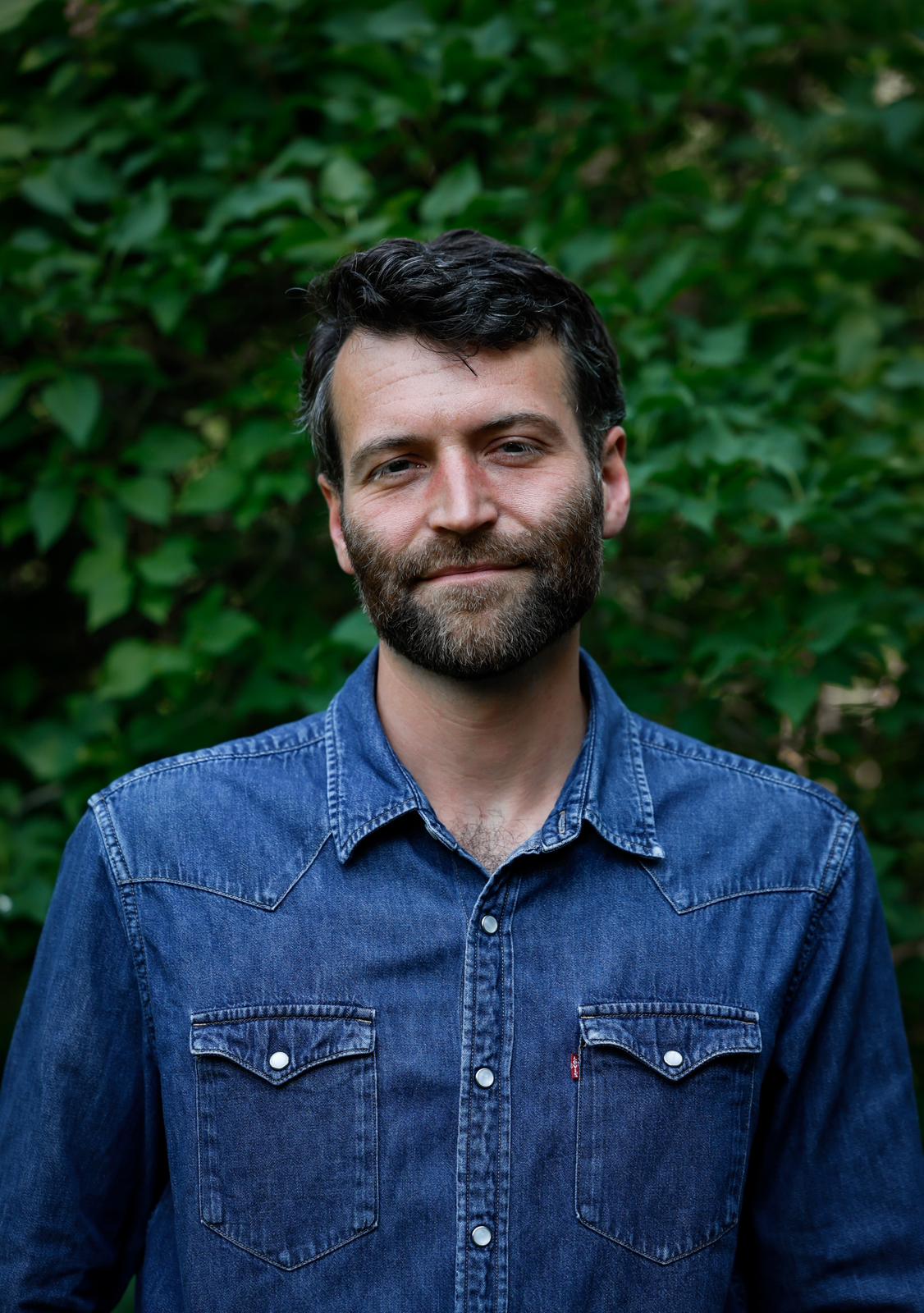
Andrew Steiner was born in Grand Rapids, Michigan. His work has been featured in Narrative, Grain, EPOCH, and other publications. He received an MFA from the Iowa Writers’ Workshop in 2022 and lives in Germany with his wife.