| We said a prayer for the rats and fleas as the plague abated. We laid a wreath for Justinian. The streets of London were no longer smoke-choked, just smoking, and Rome started to smell more like Rome. At least whoever remembered “before” said as much. In the last days of the plague, the days that followed the days that had been called “last,” we made a sport of showing up at restaurants where we had never been beautiful enough to get a table, just to see if people still ate at tables, or if the food tasted like anything. We appeared at the homes of our favorite people to see if they were around, too, or if they had changed, or if they could be unchanged. We moved slowly through the halls of near-empty museums, each of us indistinguishable from the art, to be touched only with the eyes from a safe Kantian distance. As the plague’s grip on our lives slackened, we slackened too, like a body pretending it can will itself back into sleep. We prepared for travel, arranged our documents, scheduled shots. We packed—clothes, books—and packed—the spider plant with all its apostles, anything that might spoil in our absence—and kept on packing. It didn’t matter that we had no idea where we were going. This time we would be more careful to leave none of ourselves behind. |

All posts tagged: Benjamin Paloff
April 2026 Poetry Feature #1: Carson Wolfe, Benjamin Paloff, and Jehanne Dubrow
April is poetry month! To kick it off, we have new poems by our contributors, CARSON WOLFE, BENJAMIN PALOFF, and JEHANNE DUBROW!

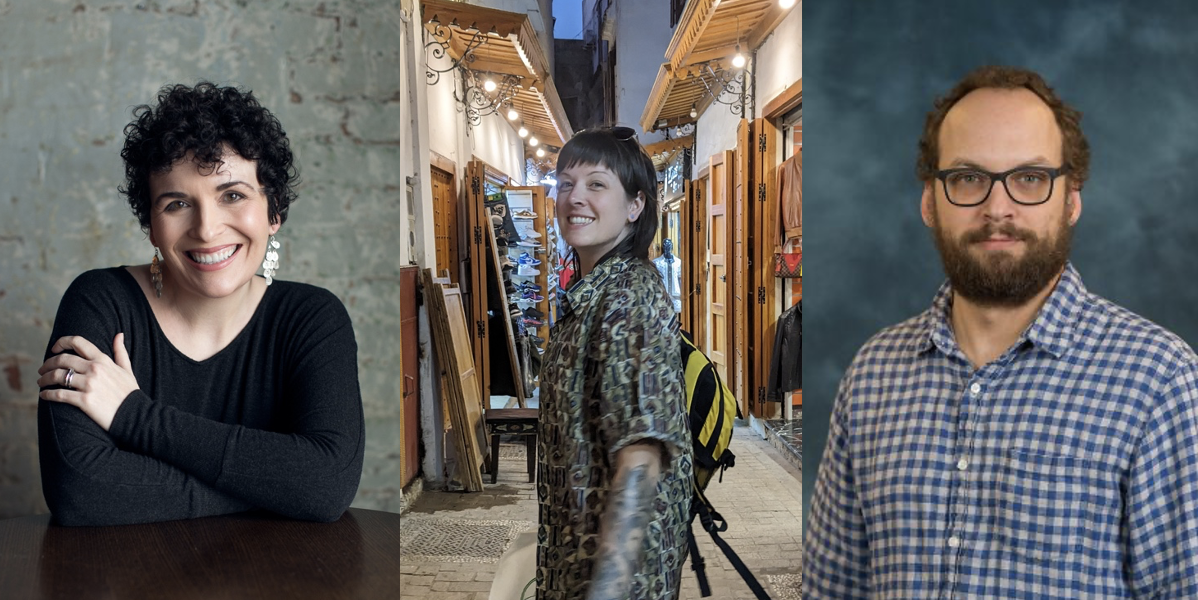
Jehanne Dubrow (left), Carson Wolfe (center), and Benjamin Paloff (right)
Table of Contents:
—Jehanne Dubrow, “Encounter” and “Winter Rye”
—Benjamin Paloff, “Of the Art of Conferring”
—Carson Wolfe, “I Rank Places by How Much They Charge for Pringles”
Of Prayers and Orisons
| It has become the first ritual of morning to throw the door open, welcoming the breeze now free of evening’s biting insects, another in a long line of self-justifications: it will arrive whether it’s welcome or not. As will the birds, who know when you breakfast and on what, who are generous with suggestions, whether here, in your dishabille, or at the seasonal cafe, in not much else. There is a three-sided varnished pine box with a plexiglass front, like a bird feeder or diorama or, in traditions less eager to let go or get rid, a coffin, scale being trivial to all species but those least likely to accept it, though the slot on top and slips of paper on display suggest a raffle or ballot, a variation on a theme performed in a tiny theater, and the blanks and golf pencil at the side are, in combination and without need to announce itself with embossed lettering or miniature reply envelope—scale, again—an invitation. At this suggestion, you suggest: The history of our times betrays the stupid arrogance of this and so many other definite articles, symptomatic of these times and others. It might be noticed and echoed and yet go unchallenged on social media, but here it could ignite a sudden change, a contemplative pleasure, and be forgotten all in the span of a few moments, like rain in the green season. It means something to us, this refusal to admit our visceral understanding of the unity of space and time, when, honestly, we know them in no other way. Whereas your ruminations on what memory means to the birds have proven inconclusive. Like you, they’re as routinized in their offices as offices. Like you, they celebrate the light that breaks the rain, throughout the day and without memory, as the arrival of a god. |
March 2022 Poetry Feature
New poems from our contributors JORDAN HONEYBLUE, ROBERT WOOD LYNN, BENJAMIN PALOFF, and LYNNE THOMPSON.
Table of Contents:
Jordan Honeyblue | free it.
Robert Wood Lynn | Peepers in February
Benjamin Paloff | Of Vanity
Lynne Thompson | Paradise: 579