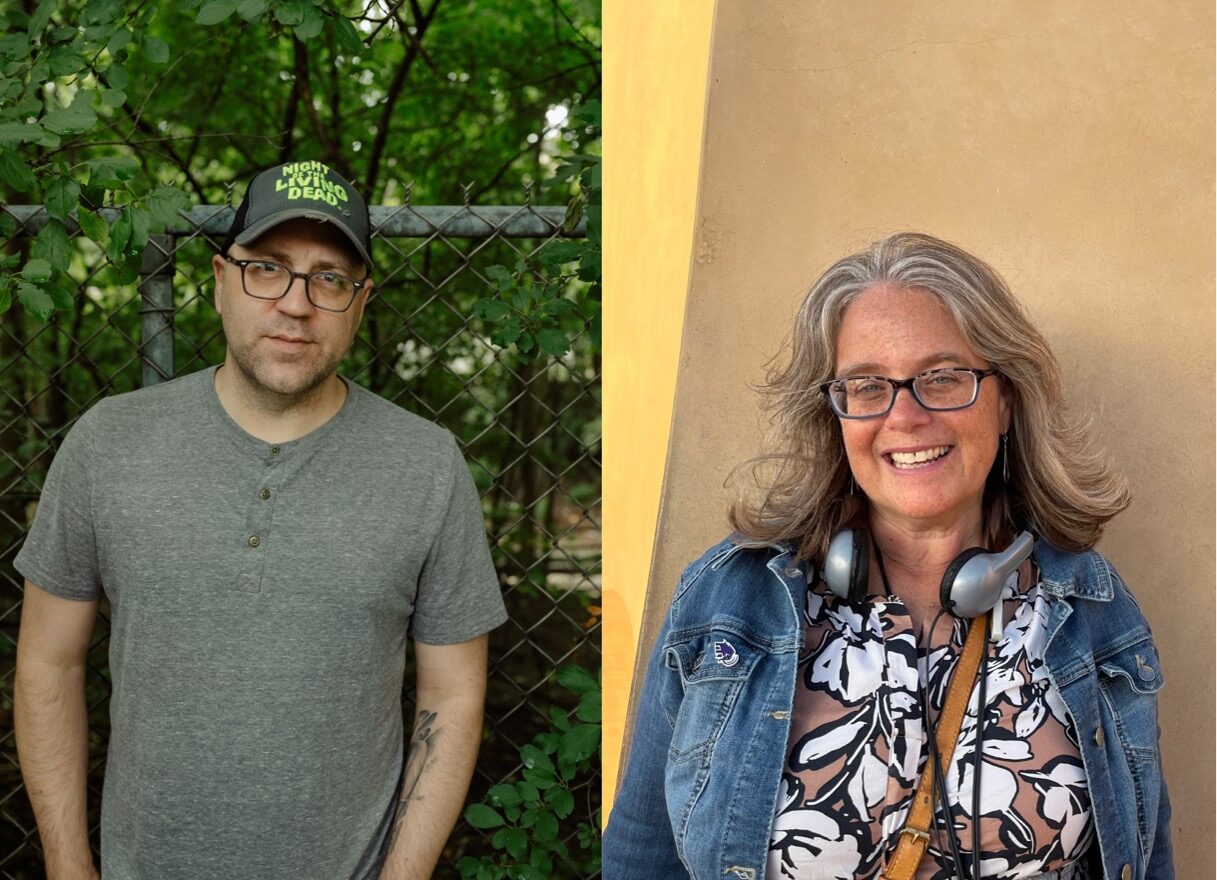
Daniel Kraus (left) and Becky Spratford (right)
DANIEL KRAUS sat down with longtime friend and colleague BECKY SIEGEL SPRATFORD to discuss his recent Pulitzer Prize for Angel Down, reflect on an unorthodox writing career, and share his experiences adapting novels for Hollywood.
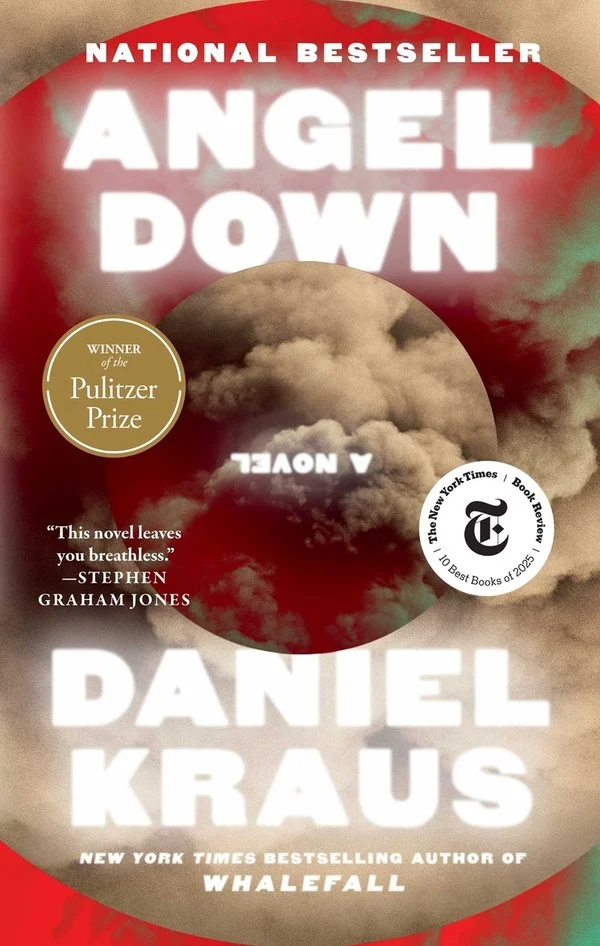
We can’t bury the lede here, Daniel: you won the Pulitzer Prize this past spring! As strange as it was to see my friend win this award, I know the entire process was stranger and more surreal for you. I remember you told me that this was to be your most ambitious novel yet and—while you thought you pulled it off and your editor was excited—you were still very nervous. What it is like to have your book singled out for such a prestigious honor?
It’s all a bit surreal. I don’t expect it all to sink in until the post-Pulitzer rush of work dies down in — well, I’m not sure when it will die down. I’m hoping spring 2027, maybe? Not only is this sort of recognition not what I expected for Angel Down, it wasn’t anything I’d ever considered for any project. Although of course I knew what they were, I hadn’t given the Pulitzer Prizes a single serious thought once in my life. It’s just not where my brain goes. That’s probably a symptom of my tendency to always, always, look ahead. By the time I have a book come out, I’m usually three books farther down the road. I’m pretty divorced from any book’s reception.
But this is one reception I can’t escape! It’s been an interesting experience to engage this heavily with a book for this long. It’s been my favorite of my books since I finished it, so that helps. It’s a book I really like. I certainly never expected this many other people to like it, or at least find it worth contending with.
Could you share a little about the novel’s genesis?
That’s a bit of a mystery to me. The WWI part of it I understand; I have a lot of thoughts about that war. But why an angel? I’m not entirely sure. I do like to introduce catalysts into stories that are, to some degree, red herrings. What matters to me is how people respond to them.
The breadth of your writing is remarkable: Rotters, a book you wrote for teens, is considered a modern classic; you won the Bram Stoker Award for the second book in your middle grade Teddies Saga, They Stole Our Hearts. The list of genres goes on, from graphic novels to nonfiction. What joys and challenges have you encountered writing across genres throughout your career? Has that changed since the Pulitzer?
If I could do it all over again, would I choose the same path? I honestly don’t know. Refusing to stick to any one genre or style has continually been a struggle for me, my editors, my publishers, my readers, everyone. All anyone ever wanted me to do after Rotters was to keep writing straightforward horror novels. But I just couldn’t, so I had to keep proving myself. When sales flagged, I’d simply have to write myself out of author jail. I’d have to write something so good that the publishers would be like, “yeah, we can’t *not* give this guy a chance in this new genre.” In a way, making things harder for myself forced me to work harder and be better. But, sheesh, it was rough. Does that change as a Pulitzer winner? I’ll have to let you know! In the short run, anyway, I see a lot of book people, and movie people, too, looking at me in a slightly different way. There’s more trust, maybe. “Let’s give this guy a little bit of extra rope and see what he can lasso.”
In a way, making things harder for myself forced me to work harder and be better.
The film based on your dark fantasy novel, The Shape of Water, won Best Picture in 2017. You have a major motion picture release of your novel Whalefall set to come out this fall, a film for which you co-wrote the screenplay and with which you were involved on set. What was that like?
I’ve been honest about not having had the greatest experiences in Hollywood. Whalefall really changed that. I loved writing with Brian Duffield. I loved the producers. I loved the crew. I loved the actors. I couldn’t turn around on set without finding someone doing something fascinating. Maybe it was just luck, or maybe the project drew a certain kind of person, but I don’t remember the last time I made so many friends so quickly. College, maybe? It just doesn’t happen often as an adult. I found the whole thing inspiring. I take my writing very, very seriously—most would argue too seriously—and on this set, I found so many people working so hard and at such a high level. As the co-writer, you shouldn’t trust me, but I think the movie is fantastic— the best possible version that a film adaptation of it could be.
Can you share some details about the planned Angel Down movie as well?
There’s not a ton I can say about Angel Down yet, except that I wrote the screenplay and it’s had a nice reception. How’s that for vague?
You and I worked together for years at Booklist Magazine, where we often had to battle over who got to review certain titles. When Angel Down first came out in May 2025, I reviewed it in Booklist, calling it “[a] brilliant novel that will encourage its readers to live their best lives, despite the horrors that surround them.” As a veteran book reviewer, what is it like to now be on the other end of things?
It’s interesting, because I used to review so many books, but as an author, I barely ever read reviews! I think that’s an important distinction. Reviews are for readers, book sellers, librarians: pretty much anyone except the authors. I know some writers will say that they learn important things from reviews, but that hasn’t been my experience. As a novelist, I want to keep my mind unaffected by doubts. I also don’t want to start thinking I’ve got everything figured out either. When I write a book that receives nothing but rave reviews, I get a little suspicious— does this mean I’ve lost my edge? Part of me will always believe I’m not doing my job to the fullest unless I’m alienating some readers. For the other aforementioned groups—librarians and so forth—there will always be a need for professional reviewers who, while they have their own preferences, also consider what people out in the world will like. I used to read books all the time that didn’t move me at all, but I knew they were going to excite a lot of other people, and someone needed to get that word out. Maybe authors aren’t the target audience for reviews of their books, but they are, whether they realize it or not, depending on those reviews to exist.
Becky Siegel Spratford (Amherst ’97) is a Readers’ Advisory Specialist in Illinois. She trains library staff all over the world on how to match books with readers through the local public library. She runs the critically acclaimed RA training blog RA for All, writes reviews for Booklist and a horror review column for Library Journal. Becky is the author of three textbooks for library workers and the Bram Stoker Award-winning Why I Love Horror. Becky was named one of the Chicago Tribune’s “Chicagoans of the Year” in 2025.
Daniel Kraus is a New York Times best-selling writer of novels, TV, and film. His novel Angel Down was the 2026 Pulitzer Prize for Fiction winner, a New York Times “Top 10 Book of 2025,” and a national bestseller. His novel Whalefall received a front-cover review in the New York Times Book Review, won the Alex Award, was an L.A. Times Book Prize Finalist, and was a “Best Book of 2023” from NPR, the New York Times, Amazon, Chicago Tribune, and more.