We wanted to say goodbye to the world we knew
so we drove the coastline north from Miami
as far as we could go. It was a farewell tour,
sure, but farewell to what? Not the ocean,
looming daily out the right-hand window,
not the water but what the water would erase.
Farewell to Florida, nipped in the bud, cheeky
and self-satisfied as a sun-worshipping infant—
goodbye, little baby Florida, goodbye!
Goodbye to Ocracoke and old Saint Simon,
Virginia Beach and Fire Island, goodbye
to all those literal-minded municipalities—
Surf and Ocean and Atlantic Cities—tossed up
like flotsam along that waterlogged littoral.
Six weeks and thousands of meandering miles later
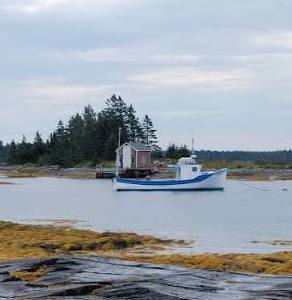
we found ourselves at a picnic table outside
the Chowder Hut in Meat Cove, Nova Scotia,
where the final stretch of tire-rutted gravel
gives up the ghost: end of the road, folks.
Nothing beyond that pine-clad headland
but deep blue water and pilot whales and rocks
acrawl with crustaceans bound for market
or the chowder pot. End of the line, lobsters.
Cape Breton Island is a ringer for its beautiful sisters
in Dingle, Donegal, and the west of Scotland,
redoubt of stout cliffs, sour bogs and cobbles
clawed back to the surf with banshee wails.
It howls, culture does, across a Celtic sea.
From here you’d have to hopscotch across the pond—
empty Labrador, icy Greenland, thermal Iceland,
Faroes, Shetlands, Orkneys—stepping stone by
stepping stone. First up would be Newfoundland,
where the accents are Irish and the pubs a delight,
we’re told—next time we’ll take the ferry,
wend our way north to L’Anse aux Meadows
where Snorri Thorfinnsson was born a thousand years ago,
first European native to the Americas.
His mother, Gudrid, thrice-married, far-wandering,
gave birth in a sod-roofed house in the muddy cove
where they hauled up longboats built in Norway
or Dublin—you can tour their ruined boat shed,
iron works, byres for cows and the black bull
that so astonished the locals, the natives,
trackers of caribou, hunters of seals from skin boats,
Beothuk, Inuit—people lived there already!
But where had they come from? West,
across the Bering Sea during the Ice Age
that littered the place with shallow silver lakes.
Vikings sailed from the east, so when they met
humanity’s great voyage was complete,
the global circumnavigation of the species,
out of Africa to wherever legs and wind
and ingenuity could take us, thousands of centuries
of wandering with only the Atlantic unbridged
until those human tides met on that shore.
In truth, it was neither New nor Found
but it was Land and thus an excuse for trouble.
Before long cooperation between alien cultures
became recrimination, bloodshed, slaughter.
Before long the Norse fled their settlements
and Gudrid sailed back to Greenland,
later to Norway, and eventually, incredibly,
as a pilgrim in the new faith, all the way to Rome.
She died in 1019, passing her final years
in seclusion at a chapel built by her son, Snorri,
at the family homestead, Glaumbær,
in Skagafjörður, on Iceland’s northern coast.
Twenty years ago, en route to Akureyri,
Elizabeth and I visited the little museum there
with its turf barrows and bronze statue
on vivid green grass beside the grey sea
depicting illustrious Gudrid, the Far-Traveled.
In Húsavík we boarded a bright red boat
and set out to catch a glimpse of the largest
in the miraculous bestiary of creatures
ever to inhabit this earth, the great blue whale,
though in the end we saw nothing but
horizonless waves proceeding and receding
in dream-like silvery Arctic light, punctuated,
at the last, by a golden summer moon.
We flow in a thousand branching streams
but we rise from a single spring, we are one
among uncountable generations that have been
and the many—should we be so lucky—
to follow our wake across moonlit waters.
None of which was on our mind in Meat Cove.
Elizabeth was taking pictures on her phone
and saying we could have camped right there
if we’d brought a tent. I was just thankful
for the chowder and the pale sunlight warming
the hillside and a chance to stretch my legs
before we turned around and headed home.
Campbell McGrath is the author of twelve books of poems. He lives in Miami Beach.