It’s minus forty outside, and on Baba Lena’s glassed-in balcony the towels have dried stiff and I stand them up on the couch like snow cranes flying north and breathe in their frozen freshness. On a warm winter day of minus twenty Celsius, we could go buy ice cream. Rita wanted to come to Baba Lena’s too, but she is in the hospital. When we have a cold, mama makes us breathe hot steam from boiled potatoes, but Rita leaned too close and scalded her throat and her voice is gone and it hurts so much she can’t even swallow.
I would happily trade places with her if I could have Aleksey as my best friend.
Boys are friends with boys. Girls with girls. Aleksey and Rita should not be friends, but they are. All the girls in her sixth grade are jealous too. Other boys yank their braids, throw their hats in the air and won’t give them back, call them by rude nicknames. To make themselves feel better, other girls whisper that he looks at everyone funny, but Rita says he doesn’t mean anything by it and I believe my sister. Before Rita started school and met him, she and I covered two chairs with a sheet and camped in a tent, performed surgery, set afloat at sea. Now, every time she could have said Natasha, she says Aleksey instead.
Now I’m hunting for a scrap of white silk to ask Baba Lena to make a new collar and cuffs for my uniform. They have to be white, so I might get away with it. All the girls have the ugly thick lace ones, machine-made, nothing but holes. But mine will shimmer in the light. Aleksey will see me next to Rita with my polished silk cuffs—the iridescence will mesmerize him, he’ll notice the shine of my hair and my eyes—and he won’t be able to look away. He’ll pick up my book bag, and say, “May I walk you to class, Natasha?” As he reaches to take my hand, I’ll glance over my shoulder and Rita will be looking at us, after the boy who used to be her best friend, but is now mine.
Baba Lena’s doorbell rings. For a second I hope our mother brought Rita and I’ll see her before it’s 1990, a whole new year. The outer metal door clangs, then the indoor one shuts with familiar clicks of the locks. I check that my basket of cloth scraps is hidden under a couch pillow before peeking down the hallway. But it’s some lady I don’t know.
I rub the hem of my dress, soft with use. Faded blue with flowers, it’s a hand-me-down from Rita, like all the things I wear. This dress was her best one, but when I said I wished it was mine, she pulled it right over her head and told me to keep it, though she has only two dresses and I have five. But it was almost too short for her anyway.
“Alisa Vasilyevna, I hope you didn’t have to wait too long for the bus?” Baba Lena takes the visitor’s dingy coat and shakes the snow off with a practiced snap. “How are you? You look so rosy from the frost.”
The visitor leaves her scarf and her hat on, pulled down lower than flatters her.
“Is this Natasha?” She gasps and brings her hand to her lips.
I tuck my hair behind my ears. Maybe I have chocolate on my mouth or my hair looks bad. Mama narrows her eyes if we look bad, but it’s usually something we can fix, although mama squints at Rita no matter what she does. She squints at Rita so much that sometimes I smudge something on my face and saunter past her till she notices.
The unpleasant guest follows Baba Lena into her bedroom. “I haven’t seen her since last year, but look at her…”
I wince.
“…she’s really growing into herself—such large gray eyes, so mysterious. She’ll be beautiful, you’ll see.”
Baba Lena bites her lip to keep from saying I’m already beautiful, but she would never offend her guest. Unlike mama, she never says anything bad about how I look, except that I’m too skinny and should eat, because during the war they boiled weeds and leather shoes into broth, so now to feed someone is to love them. But this impartial stranger thinks I’m beautiful. I clamp my hands to my face, but my cheeks spread under my fingers anyway. Dearest Alisa Vasilyevna! I skip to the living room.
Baba Lena calls me back. Alisa Vasilyevna brought honeycomb, because some of Baba Lena’s clients have access to food that we don’t. Her last client lugged in a bucket of sunflower seeds, which Baba Lena pan-roasts in their own oil and my mouth waters thinking of cracking the salty seeds between my front teeth and working the kernel out with my tongue.
“Here you go, dearie. The last bit I’ve saved since summer. You spit the wax out, and collect it with your grandmother. We’ll give it back to the bees to use.”
The honeycomb floods my mouth with sugar. My teeth stick and pop in the wax. I imagine this is how American gum tastes. I’ve only had one piece of gum, which Aleksey shared with Rita and Rita shared with me and I allowed myself tiny pieces at a time, the size of a rice grain, savoring the foreign orange flavor. Thinking of Aleksey with my mouth full of chewy sweetness makes me forget I wasn’t supposed to swallow and I almost choke.
I wonder if Alisa Vasilyevna is here for a holiday dress—too late—or a hemming. With my basket of cloth scraps as cover, I duck into the corner of Baba Lena’s bedroom. I like when these strangers undress. Good clothing means you’re respectable, and they drop it voluntarily, more comfortable in their ugliness as they unbutton tight skirt waists with a grunt and relax into smiles. They lose all dignity, exposing fat rolls beneath their bras, clusters of moles and ugly tan lines on their backs. Their scars make me cringe, wrinkly zigzags where an unimaginable void struggled to close. Their bras yoke their breasts against gravity, and I would surely tip and fall on my face if one morning I found myself with such unwieldy weights stuck to my chest. Rita and I filled balloons with water once to drop from our ninth-floor balcony, and I wonder if that’s how my breasts will one day feel in my hands, except smoother and warm.
The visitor reaches for the coat Baba Lena hung up.
That’s not how it works, I want to tell her. Baba Lena makes new coats at the atelier. At home, she makes clothes out of lighter fabrics her sewing machine can handle. But not silk either. It’s too slippery and a special machine is better.
They murmur over the coat.
Well, I’m busy too. I go looking for my birthday gift, a plastic doll with shiny hair. So pretty. Not like the ugly puppet Baba Lena made for Rita. A linty brown body, creepy mink paws for hands, topped with the mink’s actual head with steely metal eyes. Rita slept with it under her pillow and she had never liked any toys before. She would put her hand inside and wiggle its arms, nod its head, and ignore me. Baba Lena has made me countless doll clothes but never something I loved as much as Rita loves that ugly thing. Years later, it’s still the only possession she cares about. One day, she came back from Aleksey’s and it wouldn’t turn up. She searched for hours, and I know she is still sad about it and hopes to find it.
My pretty doll sits on the coffee table, leaning over the faded color photographs in my library book. I already know everything about silkworms, so we go back together to spy on the visitor. Their voices are hushed, and I glide up the linoleum hallway in my socks.
“I was almost home, could see my podyezd through the arch from the bus stop,” the visitor says, her hat still low over her ears. “You know how dark those arched tunnels are in the winter.”
Heavy with nine floors of flats over my head and unlit, they make me feel crushable. Every woman I’ve seen hurries through them.
Baba Lena murmurs her agreement. She’ll probably tell Alisa Vasilyevna to pray to the Guardian Angel, like she tells me—All. The. Time.—but she bites her lip and bends over the sewing.
“They threw a brick at me as I was running away.” Her voice cracks, and my skin tightens on my back like a carapace. “Thank the God-bearer I had a hat on.” Adults don’t cry. Well, mama cries, which scares me and I go to an echoey place deep inside where I can’t hear.
“I prayed, Elena Victorovna. What else could I do?” she says.
Baba Lena offers the third time, “Please have another pirozhok. I make the dough so thin, just to hold the filling.” The visitor finally takes one and bites, sighs, and closes her eyes as she chews. The comfort of chopped boiled eggs, butter, and salt, spiked with the freshness of scallions. Baba Lena’s pirozhki make you feel everything is alright even when it’s not.
Baba Lena lifts the teapot. “I picked zveroboy in the fresh air far from the city last summer. Ritochka helped me, Natashenka’s sister. Beast-slayer is so good for the nerves and all kinds of healing.” She pours more golden-yellow brew into the guest’s cup.
Alisa Vasilyevna sips, sighs, and reaches for her plastic bag.
Perhaps she brought some white silk for a blouse. I edge closer on Baba Lena’s spotless linoleum and peek again. The visitor’s hat is off. All women have pierced ears and wear small golden earrings with tiny garnets or amethysts, but her ears look wrong and raw, like ground meat.
“I brought this,” says Alisa Vasilyevna and rustles her bag, but I don’t want to see anything else she brought.
I hide under my blanket until she leaves, so I don’t have to say goodbye. Hand in my basket, I roll the knobby raspberry button between my fingertips, stroke the slippery silk. At the very bottom, the silky-smooth fur, three knobs of metal eyes and nose. I work my hand inside it and imagine it is my sister’s hand. If Rita walks down the school hallway, Aleksey is next to her. If she veers off the school porch to buy a bublik or a nineteen-kopek ice cream stakanchik before heading home, he goes with her. When Aleksey stares into space in the cafeteria, she nudges him with her elbow, the smallest of movements, and he smiles at her and picks up his glass of brown compote. If someone speaks to either of them, they respond, but turn back to each other as soon as they can, and in the cold corridors of our school it’s as if they are invincible. I thought that when I started school someone would choose me too, but no one did, and I can only imagine how good it must feel.
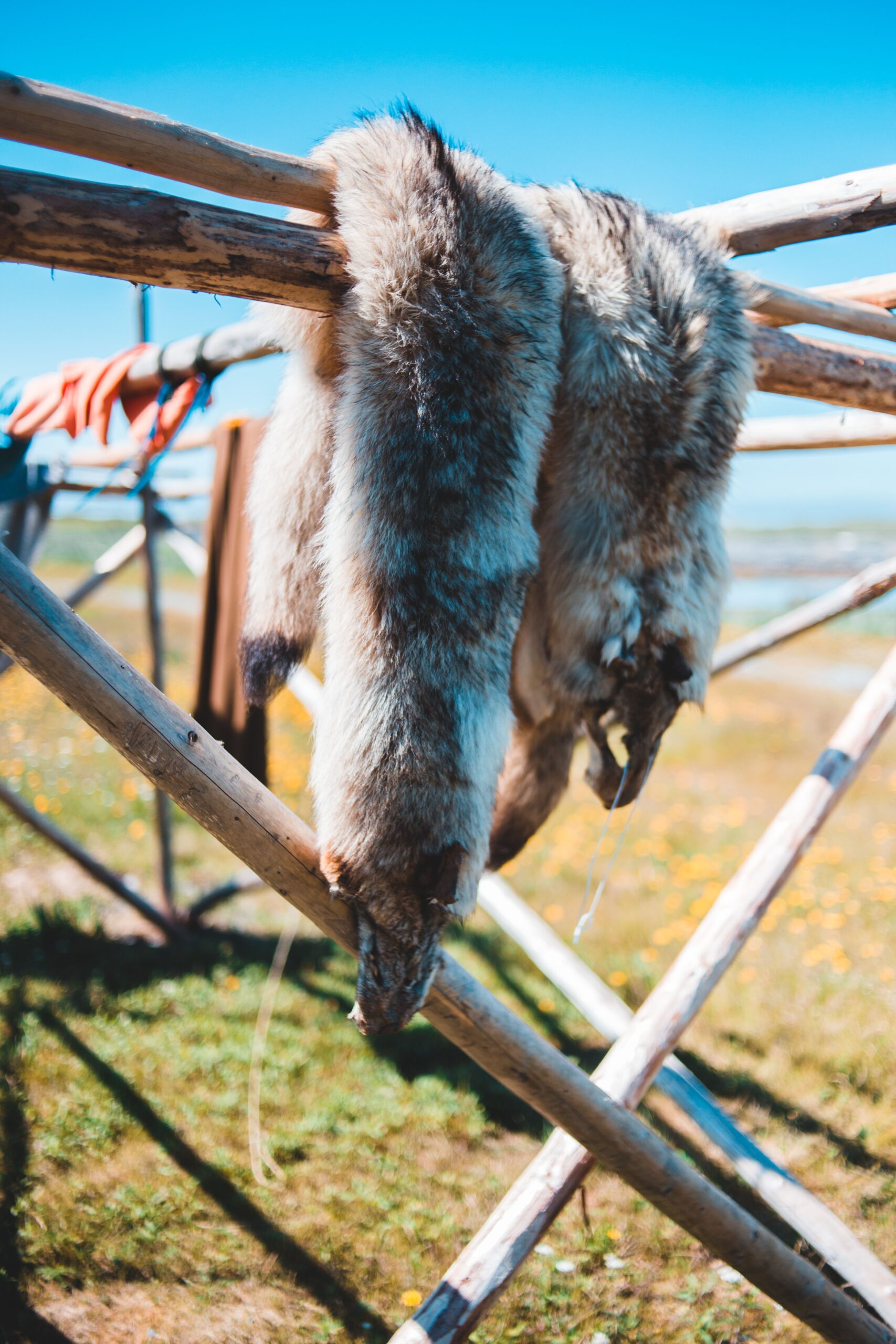
After the visitor leaves in an old coat of Grandpa’s, Baba Lena stays bowed, tsk-tsks over the coat. I come closer, hoping she’ll talk. Like silkworms, adult women require careful study. Out of the rustling bag, Baba Lena takes out a thick orange pelt. A fox. I sink my fingers into it, and they disappear into the plush.
“This’ll be a nice new collar for Alisa Vasilyevna’s coat. It just needs a little work.”
From under her bed, Baba Lena brings out a board the size of a tabletop and a box of tiny nails. She leans the board sideways against her bedroom door. The pelt’s grayish underside darkens as she wets it with water.
“They cut the little fox along the belly,” she explains as she works. “Sometimes they ruin the pelt, and as soon as you wet it, it falls apart in your hands. This one is good.” She strokes the fur. “Thank you, lisichka.”
She shakes the fur to restore its direction, then presses it against the board, and begins to stud the edges, one nail at a time. She pulls it taut. She nails it in. Tuk-tuk, says the hammer. Tuk-tuk. At least a hundred nails, evenly spaced. She picks up a bent nail and straightens it with her teeth before using it too. She taps with ease, and I’m itching to try. When she gets up off her knees to check on the second batch of pirozhki in the oven, I pick up a nail and crouch next to the board.
The hammer weighs more than I thought. I push the nail’s point into the moist underside of the pelt, but it spits the nail back out. I lift the hammer, and I’m afraid to hit my fingers, and my arm shakes and I put it all back.
Baba Lena comes back, lines up nail after nail, tuk-tuk, tuk-tuk. I want to be strong like her, able to make delicious foods and beautiful things. Rita likes weeds and scrappy broken things. In this way, we divide Baba Lena’s strengths between us.
“We stretch it so it lays well, or the collar won’t look nice or luxurious, won’t keep Alisa Vasilyevna’s neck warm.”
The knuckle of Baba Lena’s index finger bulges where it meets the iron thimble. She bends over the gash in the coat.
“We need these folded edges to make a seam that’ll hold. See here, Natashenka? Here the fabric is sliced open and there’s nothing to hold it together.” The felted wool gapes.
“Why are you not cutting this one new?” Bolts of thick fabric wait on top of her wardrobe.
“Oh, I did make it new, six years ago,” she says, biting the thread. “But someone slit her pocket in a crowded trolleybus, so I’m going to fix it.”
I sit my doll among the cloth remnants on the floor, drape a scrap of burgundy satin around her.
“Very pretty,” says Baba Lena. “The color suits her.” She gives me a smile that beams onto all that is best in me.
I nudge my cloth scrap basket under my chair with my foot. I was just keeping the ugly puppet safe for Rita. I was going to give the puppet back and almost brought it to the hospital for Rita, so she’d have her favorite thing for comfort, but mama only brought me there once. When mama brings me back, I will walk into my sister’s hospital room, not looking at Aleksey by her bedside, and I’ll bend to adjust my sister’s blanket. Mute, she will blink at me, and I’ll bring out the puppet, and she will ugly-cry with relief, her face scrunching, and from her bedside Aleksey will gaze at me with adoration. “Oh, hi. I didn’t see you there,” I will say, lowering my eyelashes, and he’ll notice my eyes, large and mysterious.
Baba Lena’s sewing machine stutters awake, finishing a job she had started that morning. As I hoped, she talks while she works. “They cut her purse first, but didn’t find her wallet. Such a nice, polite woman, Alisa Vasilyevna, a doctor. Every woman should have a profession. You never know what might happen, Natashenka.”
“Anyway, she said they followed her, angry, looking for money, but she’s a doctor—of course she doesn’t have any. The government hasn’t paid them in months. So they pushed her around until they ripped the collar off. It was a beautiful mink.” She pauses, bites off a thread, adds quietly, “Then they ripped the earrings out of her ears.”
My hand flits to my earlobe.
“She kept her wallet, though.” With a sly smile, Baba Lena shows me a hidden pocket in the lining seam. “That’s why I put them in.”
I’d never noticed my ears before. They are tiny and soft.
We’d better put the silk on the underside of my collar. When Aleksey comes over to talk to Rita, I’ll lift my collar with my thumb and only he will notice its hidden iridescence. Dumb silkworms flaunt what they have, weave the cocoons, and people kill them for it. Rita cried when I told her. Cried in her quiet way, chin tucked to hide in her hair, because our mother hates to see us cry. She can’t bear it and mocks us to make us stop. The silkworms go from wanting to live to excruciating pain as they die, I’m sure of it, but I didn’t tell my sister. Sometimes you have to lie to protect the people you love. Rita doesn’t know how to lie even to make someone feel better.
“She’s lucky it wasn’t worse.” Baba Lena crosses herself, muttering.
The teapot is still there, and I top up her cup.
“We all have to be careful, Natashenka,” Baba Lena says. “Always say a prayer to the Guardian Angel when you leave the house. Do you remember it? Angel moy, poydem so mnoy, ty idi vperedi, a ya za toboy.”
Baba Lena whispers the prayer every time she leaves her flat, then goes back to check if she locked the door, then goes back again to check if she turned off the stove. She comes and goes so many times I wonder if the Guardian Angel plays tricks at her expense.
“She’ll return tomorrow for the coat, but the collar won’t be ready yet.” She shakes her head. “I won’t charge her for this. She’s a good client.”
“She can wear a scarf?” I wear a scarf. I’m not sure, I realize, how old a girl has to be to get gold earrings and a fur-trimmed coat.
Baba Lena nods. “She could, but I’m hoping a nice fox will make the coat seem new and help her forget how she got hurt in it. She can’t afford a fur coat, like some, you know. The bosses at the steel plant, the members of the Party, those types can afford it. Well, maybe a sheep one she could afford, but this one is still in good shape.” She talks on about a synthetic jacket that someone brought from abroad, and how she hadn’t seen what it’s stuffed with and doesn’t know if they can keep you as warm.
Baba Lena’s clients come by bus, step out of sensible shoes in mended socks. They are not like a beautiful young woman I once saw from a crosswalk, gazing at the city through the rolled-up window of a Japanese car safely driven by her husband, her entire coat made of sable fur, not just the collar. That woman wouldn’t be caught unawares with a brick to the head.
All of the mothers in my class are comfortingly lumpy except one. When I first saw her, in a light green skirt suit with a slim, tan thigh slithering out like a muscular animal, someone whispered, Divorced, and I tasted danger like a new flavor. She wore a silky scarf around her neck and when mama later scoffed, Polyester, I saw that beauty could also assault. Properly cultivated, it could be a weapon. Except only against women, and from the way mama pulls me close on crowded buses, I know there are different kinds of threat.
The day I have to go home, Baba Lena begins to remove the nails. “What a good little fox it was,” she says and thanks her again.
I pack my library book. When I found it, I hid it from Rita. It thrilled me to know something she did not. She sees silkworms as tender victims, but they are creatures so driven by hunger, so gluttonous, they shed their skin every few days as it becomes too small. When they’ve eaten enough mulberry leaves, they make a strand long enough to circle our block. Foolishly feeling themselves safe, they close the cocoon to shed their skin once more, liquefying to remake themselves from a greedy worm into a creature with wings—except the woman who’s fed them and kept them safe drops them in boiling water. In the hospital, both of us watched our mother fretting about how Rita should not have inhaled the steam so deep. A mother could mean well and still hurt you.
The morning before mama told Rita to lean closer to the steam and she burned her throat, Rita told me she would never get married, but we only know one spinster and everyone pities her loneliness and lack of children, so I had never imagined anyone might not want marriage, and didn’t believe Rita knew what she said. I study my reflection in the dim hallway mirror and try to see my eyes as mysterious. I want Aleksey to look at me the way he looks at my sister, like she’s the best thing on Earth, and not just some freckled girl with poufy hair. Once, wearing the dress I wear now, Rita smiled at me, and left to meet Aleksey by the river. Her dress fits as if she broke it in just for me and though I only get to wear Rita’s hand-me-downs, I usually get to keep them.
In Baba Lena’s bedroom, the pelt hangs halfway off the board. My fingers sink into the fur. It’s too bad they couldn’t both share it, Alisa Vasilyevna and the fox. I close my eyes and imagine the animal slinking through the taiga’s undergrowth. A chase, fear, so much fear it cinches my throat. I see Alisa Vasilyevna running through the arch tunnel in her practical shoes. No matter how little you have, the skin on your back, somebody wants it and will think nothing of hurting you to take it. I yank my hand away from the fur, sharply scratching it on a nail head.
I sit on the couch with my basket, press my finger to my lips, tasting watery metal. I don’t want to be predator or prey. Perhaps I can be a third thing, something cunning and quietly rebellious, like Baba Lena’s pocket hidden in the lining. Baba Lena clangs pots in the kitchen, no doubt fretting about Alisa Vasilyevna’s misfortune. A grown woman, Alisa Vasilyevna was weeping like a baby. It weakens one, to have something taken. A metal eye on shiny brown fur peeks from the scraps. After two weeks in the hospital, Rita’s almost healed anyway and I bet Aleksey visited her there, or is waiting to visit her at home. I stand on the couch and stuff Rita’s puppet between the sofa back and the wall. The mink’s head is silky under my fingers, and I can’t help but stroke its snout once, before I leave it where she will never find it.
The gash swells with blood. Maybe the sable-coat woman feels safe, driven around by her husband, but not any woman I know. Baba Lena slips a prayer over herself like an invisible cloak. She prays, though it has been forbidden as “the opium of the people,” and yet somehow she kept her faith in the Mother-of-God alive, like a little light. She prays to the God-bearer, but it’s the Guardian Angel she turns to when she undoes the three locks on her front door, as if she doesn’t expect another woman, even the Mother-of-God, to be able to protect her.
I wish my mouth would stop feeling the skin on my finger, so I could know what my lips would feel like to Aleksey when he kisses me. When Aleksey becomes a doctor like his parents, I would look out the windows of his father’s Zaporozhets, and even if my coat is made from sheep and not from mink, I would be snug in the little old car with him, returning to our studio flat where we never fight like my parents, and maybe even a one-bedroom later on, and with him this city could not touch me.
Karolina Letunova grew up in Western Siberia. Her work appears in The Kenyon Review, The Threepenny Review, The Cincinnati Review, AGNI, and The Sun. She has an MFA from the Helen Zell Writers’ Program at the University of Michigan. She is at work on a novel. More at KarolinaLetunova.com.