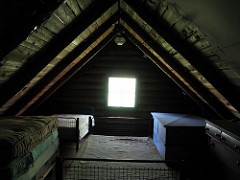
Swingin in the Attic

By RACHEL HADAS


In Richard’s attic, I
swung on a swing suspended from a rafter
and listened to two fables
read by my host in a voice that sometimes broke.


His son’s train sets occupied the floor.
His family was elsewhere, as was mine.
Or did I have a family any more?
We each inhabited our lives alone,
I want to say, although it isn’t so.

This sounds like allegory, but it’s true.
If we are lucky, this is what we do
at some point: listen, swinging to and fro,
to old stories a fresh voice makes new.
As to their morals we weren’t of one mind,
but we agreed about the ever after.


Rachel Hadas is Board of Governors Professor of English at the Newark Campus of Rutgers University.

Click here to purchase Issue 03

From the beginning, The Common has brought you transportive writing and exciting new voices. We are committed to supporting writers and maintaining free, unrestricted access to our website, but we can’t do it without you. Become an integral part of our global community of readers and writers by donating today. No amount is too small. Thank you!

Swingin in the Attic

Related Posts

Caribbean picture

Self-Portrait in The Caribbean

PAOLA ASSAD BARBARINO
Sometimes I am emboldened, / I decide to stand in the people’s balcony / I decide it is Maundy Thursday I decide to place a priest behind me that can speak to the people behind / my back / I decide to put out the fire and light my throat / scream

Feltspade

ELIAS SADAQ
I serve out my conscription / sleep in a bunk bed / for four cold months / in the engineer regiment at Skive Garrison / in a room with three other men / I fuck the colonel / the only sign that time is passing / is a pile of snow outside the window / that grows smaller

Book cover of Fifty Mothers

Mother is a Kind of Holding: Jenny Qi interviews Preeti Vangani

PREETI VANGANI
With vignettes, I could plumb its narrative arc to become a force propelling the book forward. It also felt haunting yet warm that the mothers kept reappearing throughout the life of this grief. That repetition created a chorus of voices that angers and despairs, yet cradles the speaker.