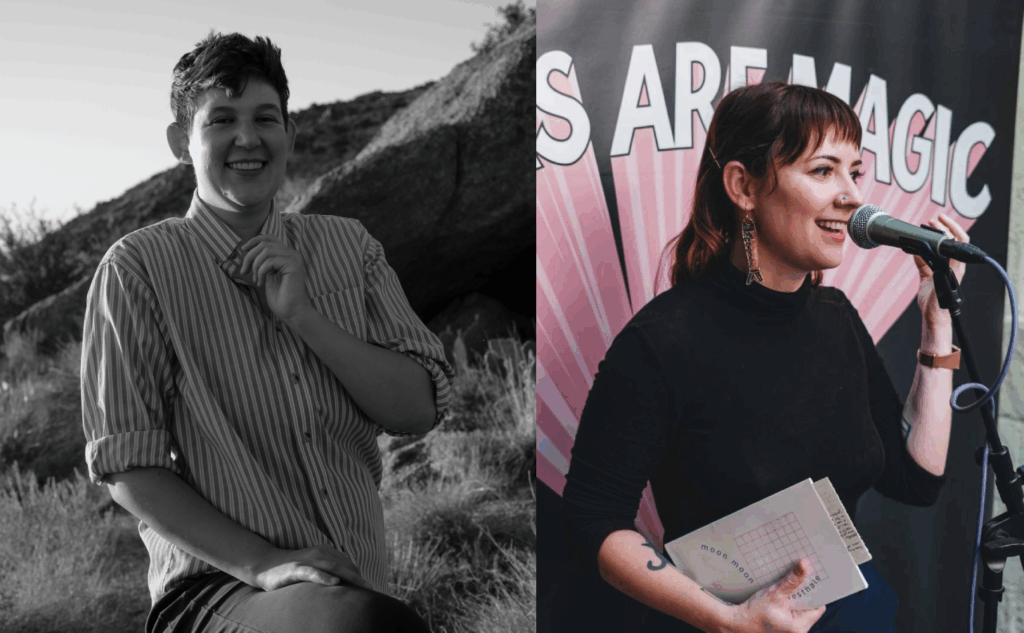
Daisy Atterbury (left) and July Westhale (right)
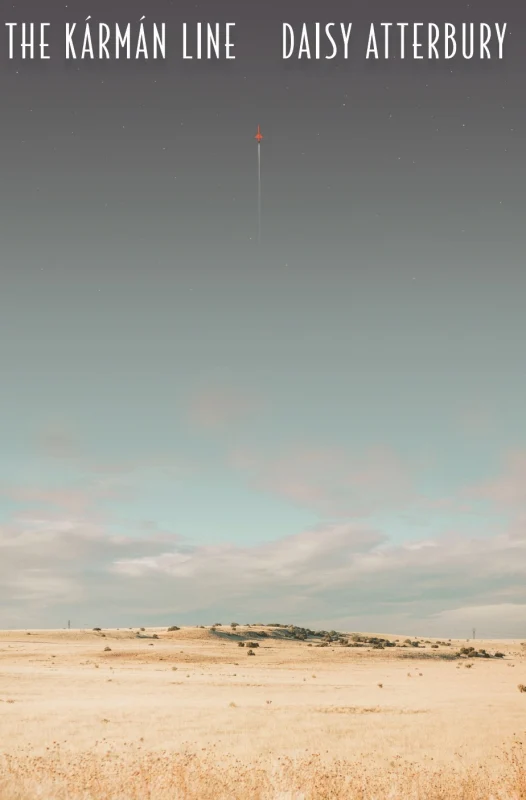
DAISY ATTERBURY’s book The Kármán Line poses a question about speculative futures, queerness and space, and ‘a hope for a shared present.’ The Kármán line is defined by Atterbury as “the altitude at which the Earth’s atmosphere ends and outer space begins. The Kármán line is the edge of space, as opposed to near space, the high altitude region of the atmosphere. When they say altitude, they’re thinking in terms of the human. What is measurable from the ground. Beyond the Kármán line, the Earth’s atmosphere is too thin to support an object in flight.”
Using this metric as a measurement of the immeasurable, this hybrid epic tells the tale of a heartsick narrator traversing the American Southwest to the commercial rocket launch site, Spaceport America. Launching the reader from the desert to space and back again, this is the hero’s journey our world desperately needs.
This interview was conducted asynchronously over several months, while JULY WESTHALE was on the road touring their book, moon moon—in the moments of quiet on trains, planes, and subway platforms, far from home. The desert landscapes of Atterbury’s work were, in this way, a solace and offering of home.
July Westhale (JW): You write, “Because of the difficulty in determining the exact point at which the boundary occurs, there is still no legal definition of the line between a country’s airspace and outer space.” This is sort of like the South Pole, isn’t it? How it is divided into the boundaries of many countries. Or maybe heaven, which is supposed to be somewhere in the sky geographically, but not in space. How are you considering space outside geographic boundaries and boundedness?
Daisy Atterbury (DA): I’m thinking about the instability of boundaries more broadly. How the authority to define a line in the sand is always a political act disguised as a bureaucratic one, or even disguised as a normative and “natural” act. The Kármán line itself is a kind of mythic convenience. It’s an imaginary border retrofitted onto a gradient, a place where the atmosphere thins but doesn’t resolve into a clear threshold. I grew up in a landscape where the act of naming was always a form of jurisdiction, as you might deduce if you grew up around the use of conflicting terms like “reservation” or “nation.” So when I think about space outside geographic boundaries, I think of the violence of definition: in that a boundary claims emptiness, and emptiness then becomes available for extraction, speculation, militarization. So the question of space outside a boundary is also a question of what we refuse to see as already occupied, or already narrativized.
JW: You ask, “How might I be mistaken in my assumption that I was never on the moon?” and note that a kind of knowing you employ follows the dictum, “Leave my knowing/to unreasonable doubt,” which is a line from the book’s title poem. Are we talking here about a variety of liminalities, all of them significant? Or, to put this in the logic of this book-world, are you thinking of the “known,” like space is “known,” non-reciprocally? This is not unlike an Ars poetica, or the ecstatic. Could you speak to this sense of knowing, to your fear of being “reduced to math,” and to the line, “word being both / administration / against memory / and the means”?
DA: The line, “Leave my knowing / to unreasonable doubt,” echoes one of the points in Ludwig Wittgenstein’s Philosophical Investigations, which I was reading at the time, where he turns to the question of belief and the limits of justification. In that passage, Wittgenstein suggests that some doubts fall outside the ordinary language-games of giving reasons; “unreasonable doubt” marks the point where skepticism becomes unmoored from the practices that give doubt its sense. I take this less as a rebuke than as a reminder that knowledge is always entangled with forms of life rather than secured by abstract certainty. Philosophical Investigations as a whole works through this terrain, thinking about how meaning arises from use, how thinking is embedded in practice, and how our assumptions about the world fray at their edges. I’m drawn to those edges. I think about instances in which “knowing” is felt rather than verified, or where an epistemic vibration refuses the single, polished answer. When I ask, “How might I be mistaken in my assumption that I was never on the moon?” I’m not trying to indulge the surreal; I’m acknowledging how easily boundaries between lived reality, inherited narrative, and desire blur. Growing up in the Southwest, the landscape already felt informed by projection, the language used to describe it extraterrestrial. It’s not that I imagine I’ve literally been to the moon, but that I came of age in a place where the imaginary and the material continually displaced one another. So in a sense, I have. I have been to the moon.
The fear of being “reduced to math” is really a fear of being read only through the state’s logics of measurement, categorization, and extractive legibility. Math isn’t the problem (actually, math is beautiful!); the problem is administration-as-ontology. Thus, the line: “word being both / administration / against memory / and the means.” Language is how we’re managed, yes, but also how we resist management. It is both the bureaucratic imposition and the counter-archive.
I’m not trying to indulge the surreal; I’m acknowledging how easily boundaries between lived reality, inherited narrative, and desire blur.
JW: You write of the Southwest as a lunar or alien landscape, and surely you must get this a lot (as do I, another Southwestern poet): is there a difficulty in drawing similarity between the desert landscape and others, except to compare it to, what you refer to as, Not the world? Yet you emphasize that these are also the places where nuclear testing happens. As if they are not actual places, where consequences happen.
DA: Yes! As a writer dealing with similar territory, you get it. The Southwest is constantly compared to other planets, and while I understand the impulse, in the sense that there is a starkness, a luminosity, and a sense of exposure here, it also troubles me. I play with this a lot. Comparing the desert to Not the world, as you say, is precisely how this land becomes available for nuclear testing, military experiments, spaceports, and extractive industries. The metaphor produces the material condition in a self-reinforcing cycle. When we say “it looks like the moon,” or like a “wasteland,” to quote Traci Brynne Voyles, or like the “regime of emptiness,” to quote Samia Henni, we invite the treatment of the land as uninhabited, unowned, unprotected. But these are inhabited places, including by the non-human. They are systems with consequences, where maps of radioactive fallout (like that from the 1945 Trinity Test in Alamogordo, NM) intersect with family trees and groundwater tables. The comparisons risk stripping the desert of its social and ecological specificity and turning it into a backdrop for the next colonial fantasy. When I say I play with this, I mean everything I do with space-language somehow revolves around this point and quandary.
JW: I love how you noted: “the southwestern US is constructed in layers. These layers are histories of here, of elsewhere, of colonial inheritances— names, dates, stories, treaties, contracts, coordinates, signs. This desert basin, here, or volcano crater, there, exist outside language—yet they’ve become places narrated by discourses of nation, produced through imaginaries of space.” Can you talk more about this?
DA: I think of the Southwest as a kind of palimpsest, or a place where the languages of governance, extraction, mapping, militarization, and belonging sediment over one another to produce the hyperreal. I began to think about place in this way as I was reading Jean Baudrillard’s strange road-trip book, America, in which the theorist drives through the key places in America, especially in the Southwestern US, Las Vegas being a standout. He’s interested in how America is neither a dream nor a reality, but a kind of “hyperreality.” Which, when you think about Vegas, kind of gels as a thought.
One student recently asked me about deserts: why deserts? Why not forests, where pipelines hide, and bodies are also buried? I can say that I don’t know forests. I may have been meant to know forests in some other lifetime, I don’t know. Surely my ancestors came from forests. We are radically dislocated and have to wear a lot of sunscreen. Even so, I know deserts a little, and the layers of meaning that accumulate around them in the form of treaties, surveys, mining claims, missile testing ranges, and highways built to move nuclear waste. Outside of this administration of the desert, to use the violent word we discussed earlier (“word being both/administration”), the land itself somehow exceeds all of that noise, that of description, projection, and appropriation of use. A volcanic caldera does not care about the coordinates assigned to it. A basin is indifferent to the story that’s placed upon it. What is Las Vegas underneath Las Vegas? My work tries to learn from this tension, and I hope to come to understand the desert as discursively produced and materially “unknown.”
Digital life is a soft void, a place where desire flickers in and out of specificity. That can feel bleak, but it can also be clarifying.
JW: I love thinking about the idea of ‘Las Vegas underneath Las Vegas.’ Contrarily, in your section, “zones of avoidance,” there is a meditation on the human language used to describe space (again, a parallel to the human word “altitude”), e.g., beehives for stars (from the New York Times), or a curtain arcing. You write, “Is the language of science a zone of contagion, where metaphor bleeds into metaphor, because reality is so far outside the language we’ve reserved for it, we almost glitch?”
DA: Yes! Science is full of metaphor; it can’t help it. Terms like “escape velocity,” “event horizon,” or “beehives” for stars carry metaphorical charge even when we claim they’re precise. Does anyone claim these descriptions are precise, or are they artful analogies? I think physicists are the best poets. When I write that scientific language is a “zone of contagion,” I mean that science, as a methodological approach, drawing on observation, theory, and hypothesis to produce “the scientific,” is unstable in ways scientists often disavow. I really enjoy reading writers like Chanda Prescod-Weinstein, who wrote The Disordered Cosmos: A Journey Into Dark Matter, Spacetime, and Dreams Deferred and Karen Barad, who wrote Meeting the Universe Halfway: Quantum Physics and the Entanglement of Matter and Meaning—writers who are writing science, as in writing in and through observation of the material world in nuanced, respected ways in their respective fields, while making use of social and cultural theory. The closer we get to the limits of human comprehension (I’m thinking about anything from problems of scale, to dark matter, to what happens inside a black hole), the more our language glitches, or requires inventiveness and play. Scientists borrow metaphors from everyday life to describe things far outside it. And those metaphors bleed into our imaginative life, shaping how we see the world, and how we treat both the Earth and the cosmos. As a language scholar will tell you, metaphor becomes policy. Metaphor facilitates jurisdiction. Jurisdiction becomes (social) fallout.
JW: There are so many great examples of liminal time. The first that comes to mind is this: if you’re on Mars, you are not beholden to time. Indeed, with a character “on Mars,” you’ve situated us in the idea of the liminal and our human attempts to put boundaries on it—borders, taxonomies, the failure of language. You write: “Sometimes I think these things matter: whom I’ve loved, who I talk to, where I see myself in five years. Then I wake up and understand that culture is adjunct to the world, that it lives and dies in the present…” How does this liminal time compare to, say, the similar usage of the internet (DMs, Tinder, email) in your book, which is another liminal space?
DA: Time on the “Mars” of this book, which I put in quotes because it is implied that one of the characters, the former love interest of the narrator, is doing a residency on a Mars simulation in Hawaii or Nevada, where two real Mars Simulations have existed. If we imagine ourselves there, time is unmoored from the rhythms that structure life, like the commutes, emails, lunch hours, and the day-to-day intimacies that make up a social life. I became attached to this idea after seeing the writer Kate Greene, writer of Once Upon a Time I Lived on Mars: Space, Exploration and Life on Earth, speak in Santa Fe at a Space Convention run by the Santa Fe Institute. I then read Kate’s book, and I was fascinated by the non-time of the simulation, the chance to live in speculative time, ungoverned by the office clock or constrained by daily realities. But what happens if you’re trapped in the governed, in love with someone who lives in this ethereal, liminal zone? It felt like the perfect storm of attachment issues, similar to the human feeling of knowing and encountering a person you know doesn’t quite exist, someone you only know through DMs, the Twitter (or X—ugh) feed. I wanted the narrator to explore love within that dislocated temporality where a person is absent, primarily disembodied, and holding sway. There’s a suspension of narrative coherence for this relationship to exist, a willful suspension of reality and consequence. In the book, the internet threads through intimate and erotic exchanges precisely because it mirrors the spatial-temporal disorientation of the desert and of space itself. Digital life is a soft void, a place where desire flickers in and out of specificity. That can feel bleak, but it can also be clarifying. In the end, I wanted to leave that reality, but it was a productive place to enter.
JW: A thought: there is a bit of a logical fallacy—which one? False dichotomy?—about messaging that posits ‘science’ as the opposite of ‘feeling’ or ‘speculation.’ Right? I mean, the scientific method begins with speculation, and when the path to discovery goes sideways or fails, it is taken back to speculation. And science is also a field, like history, where we are made to assume that outcomes equal a truth already dead, when in reality, like ‘culture’ (see above), it is ‘adjunct to the world.’
DA: Yes, it’s a false dichotomy. I love how you put that. Science is speculative, but it is not understood in public discourse as such; it is understood as truth. Although maybe in this political climate, basic understandings about the observable world are subject to questioning, without grounded observable hypotheses proposed as replacements, creating a very unstable social experience and contributing to political instability. Basic norms are being questioned according to premises that look quite a bit like they’re emerging from feeling, rather than observation. At the same time, every experiment begins with a desire to know what does not yet exist as fact. The public framing of science as anti-feeling serves to discipline what kinds of inquiry we consider legitimate. What I resist is the idea that science delivers finality, an answer that is no longer contingent and subject to further theorization and interpretation. Even observable and calculatable, as in quantitative, knowledge is provisional, iterative, and historically situated. If we admit this, we might begin by asking what structures of feeling are informing the ways normativity is being posited, established, or questioned at this moment in the political landscape. These would be very useful questions.
JW: Okay, also memory, memory is like the Kármán line, isn’t it? And I guess the big question: what does this mean for poetry? Except everything.
DA: Memory may be like the Kármán line, as in a threshold with no clean demarcation. Where does memory begin, and where does it become myth, projection, or inherited narrative? Where does it become something the body carries even when the mind refuses it? Collective memory is like an atmospheric boundary, as in, it is culturally negotiated. Our collective memory has legal implications, emotional implications. And like the Kármán line, it is defined according to this or that priority.
Poetry is the form most comfortable with uncertainty, contradiction, and irresolution. It is a genre that allows for simultaneity of thoughts, because its linearity is not given. Poetry is not stuck in a rigid linearity and progression, like a sentence. Its construction, like a painting, invites readings of the overview and the detail. There’s a flexibility and a generative potentiality in its mechanism and function. It’s good intimacy and estrangement. Go read poets!
Daisy Atterbury is a scholar, essayist, and experimental writer based in New Mexico. Their interdisciplinary work addresses social and cultural issues in the American Southwest—and outer space. Atterbury’s debut book, The Kármán Line, a 2025 New Mexico Book Award Finalist, has been described as “a new cosmology” (Lucy Lippard) and “a cerebral altar to the desert” (Raquel Gutiérrez). https://daisyatterbury.com
Poet and translator July Westhale was born in the American Southwest. Their books include moon moon, Trailer Trash, Unmade Hearts, and Via Negativa, which Publishers Weekly called “stunning” in a starred review. They were the 2018 University of Arizona Poetry Center Fellow and live in Tucson. www.julywesthale.com