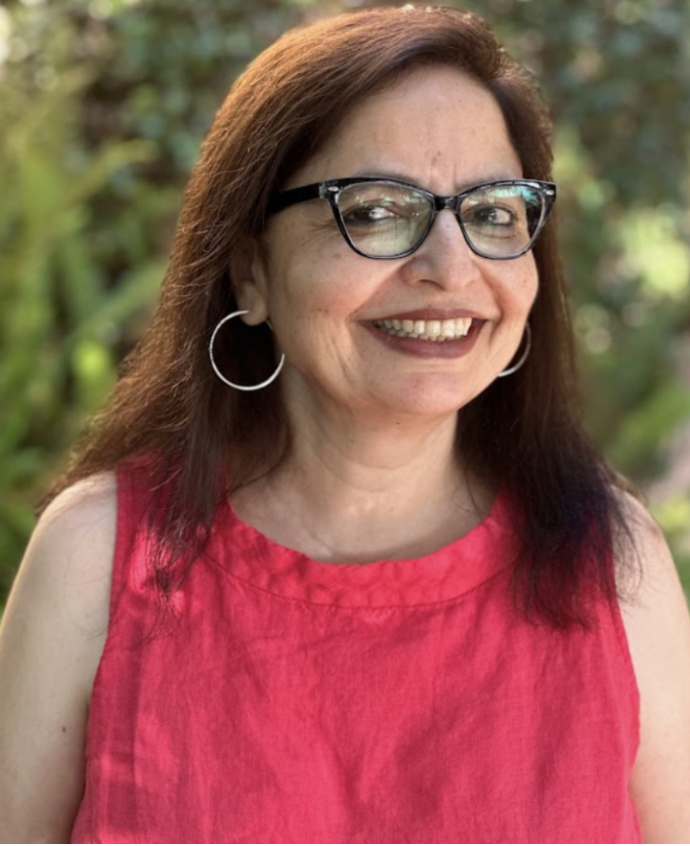

Talia Lakshmi Kolluri (left) and Samina Najmi (right)
SAMINA NAJMI and TALIA LAKSHMI KOLLURI first met in 2022 after Najmi read Kolluri’s short story collection What We Fed to the Manticore and conducted her own interview for The Normal School. In that conversation, they found that not only are they practically neighbors, but they share a tremendous amount of common ground. Thus, a friendship was born. This conversation unfolded over email during Najmi’s book tour for her electric memoir-in-essays, Sing Me a Circle: Love, Loss, and a Home in Time, which spans her childhood in Pakistan and England, her first foray into the US in Boston, her family and professorial life, and Fresno, the place she now calls home. In this conversation, Kolluri and Najmi explore memory, return, the meaning of home, and the way we tell our stories.
Talia Lakshmi Kolluri (TLK): Samina, it’s so wonderful to interview you about your captivating essay collection, Sing Me a Circle: Love, Loss, and a Home in Time. You and I first met during an interview when our roles were reversed, which led to the delightful discovery that we really should be friends. So, we are beginning this interview at a full circle moment of its own!
Samina Najmi (SN): We are, Talia! I’m delighted and honored to be talking with you in this space.
TLK: We’ve both come to the writing life from somewhat non-traditional careers. Can you talk about the relationship between your academic and creative careers, and when you first understood that creative essays were becoming important to you?
SN: I used to regret that I didn’t come to creative writing earlier, but now I think I’ve been preparing for it for decades. We know that to write, one must read; as a literature professor, my educational and professional paths have centered on reading. In the classroom, my students and I look closely and critically at the form and content of literary works. So that was a habit of mind that I was able to bring to my own writing. In 2011, just as I got tenure at Fresno State, I took a two-week California State University Summer Arts course in creative writing. It was focused on flash fiction, but I found myself writing my life experiences as fiction. That’s how I knew that creative nonfiction was my genre.
TLK: Summer Arts is such a legendary program! I find that plugging into my literary community, both locally and long-distance, is such an important part of my writing life. Can you talk a bit about what the literary community means to you?
SN: It’s one of the many reasons I’m glad I moved to Fresno. The literary community here is extraordinary in its collective accomplishments, especially in poetry—it boasts two US Poet Laureates, and a California Poet Laureate—but the contemporary prose scene is lively, too, and you and I are contributing to it! To me, literary community means kinship; it is responsible give-and-take, as in any relationship. It has to be mutually nurturing: writers, indie bookstores, indie presses, literature festivals, and other events included. Fresno’s literary community is also very down-to-earth. The literary life is about art and heart; all the rest we take in stride.
TLK: I think your collection is perfectly in line with The Common’s mission to deepen our individual and collective sense of place, so I’d like to ask a place-based question early on. For readers who have not yet read Sing Me a Circle, what places in this collection are the most important touchstones for you?
SN: You’re right that place is at the heart of many of my essays. My earliest recollections are of London, but I came of age in Karachi, Pakistan. My American life has been divided between Boston and Fresno, California. Other places appear in the collection that are tied to my familial and personal relationships—India, my ancestral homeland; Gaza, Italy, Bangladesh. All of these places matter, but as touchstones in the collection, I’d say Karachi and Fresno, in particular.
TLK: That’s interesting. Those places feel like geographical bookends. As I was reading your book, I got the sense that the transition between continents and cultures existed as a place of its own. There was a palpable sense of longing for one place when you were in another in some of these essays. (I’m thinking in particular of the scene where you and your family were in Karachi, and you were teaching your sister songs you had learned in Greenford). Was this something you intentionally thought about as you were writing?
SN: Funny you say that, because just yesterday I was telling someone that growing up, I always wanted to be wherever I wasn’t. Some landscape, and the people in it, were always missing. In recent years, I have learned to embrace that transitional space as “a place of its own,” as you so eloquently put it. And I’m sure this has happened precisely because I can now inhabit all those different places simultaneously on the page.
TLK: Can you talk about the very beginnings of this book? What were the earliest themes you wrote about? When did you know you wanted to write a whole body of work around them?
SN: I wrote about my family, what I knew of their history, and about growing up in Karachi. The essays began to see publication early on, and I kept writing what I thought would be a memoir of coming of age under a dictatorship in Pakistan. Meanwhile, I was writing other essays focused on my parenting and teaching life in Fresno. It was a good nine years or so before I realized that they belonged together in a memoir-in-essays.
TLK: Early in the collection, you introduce the theme of a circle and write about asking your students what circles mean to them. As I was reading your essays, what emerged for me was the concept of return. It shows up so much in these essays, both in returning to a place, returning to people, and in people returning to versions of themselves. Does that theme resonate with you? Can you talk a bit about what return means to you in these essays?
SN: Such a great question. It makes me wonder: do we ever return? Places and people move on without us, and even if they didn’t, we wouldn’t be returning to them as the same person we used to be. But I think in some ways we never leave a place. And people never leave us, even when they die. Perhaps that’s why—paradoxically—my essays return to the same themes: place, family, grief, love, and time. The returns you’re identifying are part of one unbroken circle.
TLK: So many of your essays delve into your personal connection to a place and the complex history of how that place has evolved, before your arrival and after your departure. How did you approach situating yourself within that history as you crafted your essays?
SN: I began with memory—my own, followed by the memories of family members and friends. I’ll always be grateful to have written “Greenford’s Gift” and “Abdul” in my father’s lifetime because I was able to interview him in long-distance calls between Fresno and Karachi. Those essays wouldn’t have been the same without his input. Similarly, for “Ring In the New,” I interviewed my mother and my aunt. And then came the research, which I love —and this returns us to your earlier question about the connection between my academic and creative careers. Most of my essays, but especially the place-based ones, are grounded in research. Also, as your question suggests, place and history are intertwined, and the history of a place is inevitably political. So again, the many political threads in the collection—colonial and postcolonial contexts, war, and state violence among them—begin with memory but are steeped in research. A place has longevity that we humans lack, and it’s fascinating to think about what this place has seen. I’m curious about who it has been before my arrival, and how it will sustain and inspire people after I’m gone.
TLK: I love those essays. The long thread of history woven throughout was lovely. They raise the issue of collective memory, too, right?
SN: I’m so glad you like those essays. They were demanding, but also very rewarding to write. Yes, the issue of collective memory is always fraught. We remember things so differently, even within a family, let alone between two adversarial groups or nations.
Academic work has given me the gift of aesthetic distance from my personal essays. You need that to manage the vulnerability and transmute it into art.”

TLK: Would you say that your academic work informed how you approached writing from a place of such personal vulnerability? What is similar, or what are the differences to you between those two types of writing?
SN: On one level, they are very different. There’s nothing of my personal stories in my scholarly writings on other authors. So in that sense, they are not vulnerable, as my life writing most certainly is. But the academic work has given me the gift of aesthetic distance from my personal essays. You need that to manage the vulnerability and transmute it into art. Over the years, I’ve come to see more of the confluence between my critical and creative imaginations: the two kinds of writing engage with similar themes, just from different perspectives.
TLK: Your work feels very closely observed, both in what you see in the world around you and what you see in yourself, and this applies to essays you’ve written about relatively recent events and those that happened some time ago. Can you talk about how you developed this style and how you incorporate it into your work?
SN: Ah, thank you for that observation. I was always a dreamy child, and to this day, many things in my surroundings that others might notice escape me. I tease my son about his “rich inner life,” and it’s through observing him since boyhood that I realize we can seem disconnected from our present moment but be astonishingly focused at the same time. I think for me, the interaction between time and creative nonfiction serves as an alchemist. Whether I’m engaged with the recent or distant past, when I sit down to reflect—and reflection is indispensable to the genre—I recall things I never thought I had retained or even knew, much less remembered. Creative nonfiction, and specifically the personal essay, seems particularly suited to my temperament, but the more I write, whether or not those personal essays are memoir, the deeper the habit of observation grows.
TLK: I was struck by how much, as a reader, I trusted you to tell me these stories about your life and your family very honestly. How did you balance staying true to your experience of something while maintaining enough distance to be objective about yourself?
SN: In addition to interviewing family members and doing my own research on the larger contexts of a situation, I made a point of sharing drafts of individual essays, and later the book manuscript as a whole, with the loved ones I wrote about. Occasionally, we remembered things differently, but I’m fortunate that my family members trust me to tell my version of a story in good faith and as fairly as possible. I don’t know that objectivity is either possible or desirable—I share that thought with students, even about my own course syllabi—because our social locations determine so much of our perspective. But I’m grateful for a multiplicity of views, including on myself.
In any kind of life writing, we have to do the best we can. But it helps to think of identity as something more dynamic than fixed. We are different versions of ourselves with different people and in different situations, right? So if we can see that, we have a better chance of doing justice to the situations, the other characters in our story, and ourselves in our writing.
TLK: Your collection was published by Trio House Press, which is a wonderful independent publisher. Working with an indie press is another thing that we have in common! Can you talk a bit about what drew you to Trio House and how your book was supported?
Trained as a reader myself, I know how important it is to respect readers as meaning-makers. I often learn from them how to read my own work.”
SN: I looked at Trio House Press’s mission statement, and at the authors they had published—one of my favorite poets, Lena Khalaf Tuffaha, among them. Their inclusiveness was very appealing. They’ve been publishing poetry since 2012, and though mine is only their second Aurora Polaris award winner, they already have other memoirs coming out this summer. In my case, they moved with astonishing speed: from the announcement of the Aurora Polaris Award to the finished book was nine months. Some of this may have to do with being a small press and being more able to streamline the process. There’s also an intimacy about small press culture that I like; I feel a genuine community with my pressmates. Trio House puts a lot of energy into promoting authors on social media and finding opportunities for them.
TLK: How has it been to share your work with a wider audience and to see it out in the world?
SN: Ah, that’s been the best part! My world has expanded in ways I couldn’t have envisioned. I’m perpetually surprised by the diversity of the book’s readers—of all backgrounds, generations, and walks of life—and the way different aspects of the book resonate with them. Right before publication, Kazim Ali had said to me, “Your book needs to find its readers.” He meant that the author’s ego shouldn’t get in the way of that connection. Trained as a reader myself, I know how important it is to respect readers as meaning-makers. I often learn from them how to read my own work.
Samina Najmi’s memoir-in-essays, Sing Me a Circle: Love, Loss, and a Home in Time, won the 2024 Aurora Polaris Award, received a starred review from Publishers Weekly, and was a featured debut in Poets & Writers, Debutiful, and others. She teaches multiethnic US literature at CSU Fresno.
Talia Lakshmi Kolluri is the author of the short story collection What We Fed to the Manticore, which was a finalist for the 2023 Carol Shields Prize for Fiction.