Poem by ELIAS SADAQ, translated from the Danish by DENVER DAVID ROBINSON.
The piece appears in both English and Danish below.
Translator’s Note
I bought a copy of Elias Sadaq’s debut poetry collection DJINN on a windy December morning in Copenhagen in 2024. Although I’m not Danish, Moroccan, or Muslim, I’ve spent over half my life going between the United States and a small seaside village in Denmark not so far―in kilometers―from where Sadaq grew up. I was curious to know what it’s like to be of Danish and Moroccan descent, queer and Muslim, and come from one of (highly homogenous) Denmark’s most ethnically diverse districts, a place I had visited occasionally with my father. Sadaq’s work enchanted me immediately. There was much I recognized, and more I did not, including incantations to punish and protect. As I read, I scribbled a rudimentary translation in pencil next to his lines. Eventually, I reached out to Sadaq, who gave me permission to translate and seek American publishers for his work. Now, after several months of collaboration and getting to know one another, I have finished my translation of DJINN. I’ve learned so much in my work with Elias, who is one of Denmark’s most versatile and exciting new artists. For one, my understanding of modern street Danish has improved. More importantly, his generosity and playful curiosity have inspired me in this time of increasing discord. His work opens doors, welcoming all who care or clamor to enter―strangers, DILFs, saints, and demons―while narrowing the gap between the sacred and profane.
A felt spade is a military entrenching tool, a survival shovel, but also carries a derogatory connotation employed to infer one is an idiot. I considered translating the title with an English colloquial equivalent, such as blunt instrument, dull blade, or simply tool. In the end, I chose to keep the literal translation to allow readers to sit with the original title’s ambiguity.
― Denver David Robinson
Feltspade
Jeg aftjener min værnepligt
sover i køjeseng
fire kolde måneder
i ingeniørregimentet på Skive Kaserne
på et værelse med tre andre mænd
boller jeg med obersten
det eneste tegn på at tiden går
er en bunke sne uden for vinduet
der bliver mindre
i takt med at dagene bliver længere
jeg råber jagt i geværet
skyder med skarpt og graver latriner
sergenten kalder mig bøsserøv
til latter for hele delingen
mens konstablerne
taler om at blive udsendt til Irak
for at pløkke en muhamedaner
Field Spade
I serve out my conscription
sleep in a bunk bed
for four cold months
in the engineer regiment at Skive Garrison
in a room with three other men
I fuck the colonel
the only sign that time is passing
is a pile of snow outside the window
that grows smaller
in step with the days growing longer
I sound the alarm with my gun
shoot sharp and dig latrines
the sergeant calls me a pansy ass
to the laughter of the platoon
while the privates
talk about being deployed to Iraq
to pick off a Mohammedan
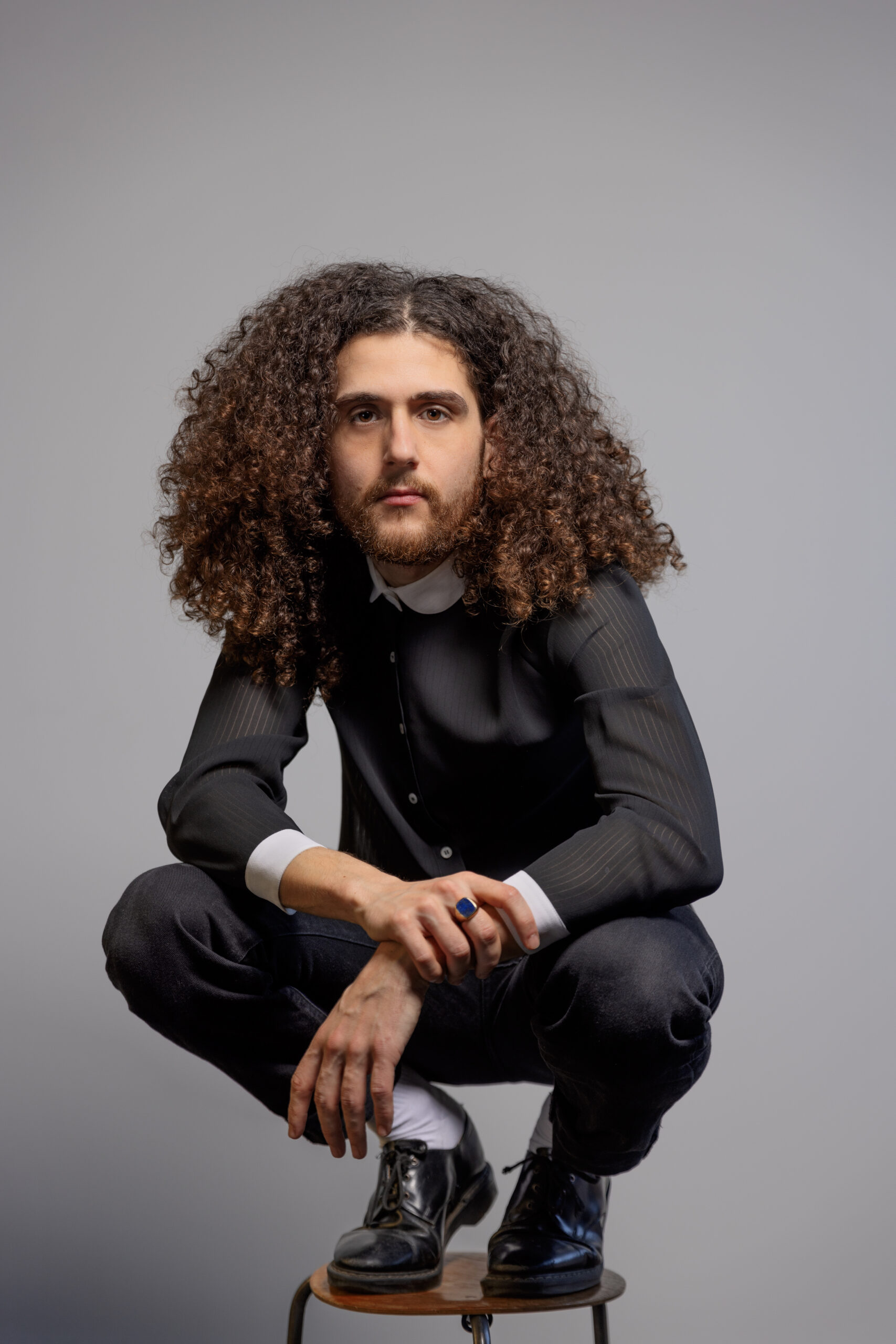
Elias Sadaq (b. 1994, Aarhus, Denmark) is a poet and playwright. He holds a BFA in Theatre and Performance Making (Playwriting) from the Danish National School of Performing Arts. His critically acclaimed poetry collection Djinn has been described as a pioneering work in queer literature. He adapted Djinn for the stage at Blaagaard Teater in Copenhagen in 2025. Sadaq has received grants from the Danish Arts Foundation and was nominated for the Prisma Nordic Literature Award for Djinn. He is writer-in-residence at the University of Southern Denmark and a profiled artist at Teater Momentum in Odense.
Denver David Robinson’s work has appeared in Gulf Coast, The Mesquite Branch, Buckman Journal, The New York Times, Vice, and elsewhere. He has received an Oregon Literary Fellowship in Nonfiction, GLAAD’s Outstanding Digital Journalism—Multimedia Award, and the Richard J. Margolis Award for nonfiction writers of social justice.