Film by SASHA WATERS
Review by HANNAH GERSEN
Mary Oliver is a poet whose work is so well-known, so ubiquitous, that even if you think you’ve never read her, you’ve probably heard snippets of her poetry or seen lines of it on Instagram or tumblr. The phrase “your one wild and precious life” from her poem “The Summer Day” and “the soft animal of your body” from “Wild Geese” have become memes. She has a seemingly universal appeal that transcends age, gender, and politics: everyone seems to think she is speaking directly to the concerns of their soul.
Despite her popularity, or maybe because of it, I’ve always felt confused about her literary reputation. She seems to be the country’s most beloved poet and, at the same time, is often overlooked by critics and writers. I rarely hear her mentioned as an important influence, and I was never assigned to read her poems in school. I came to Sasha Waters’ new documentary, Mary Oliver: Saved By the Beauty of the World, hoping to make sense of this writer whom I both knew and didn’t know.
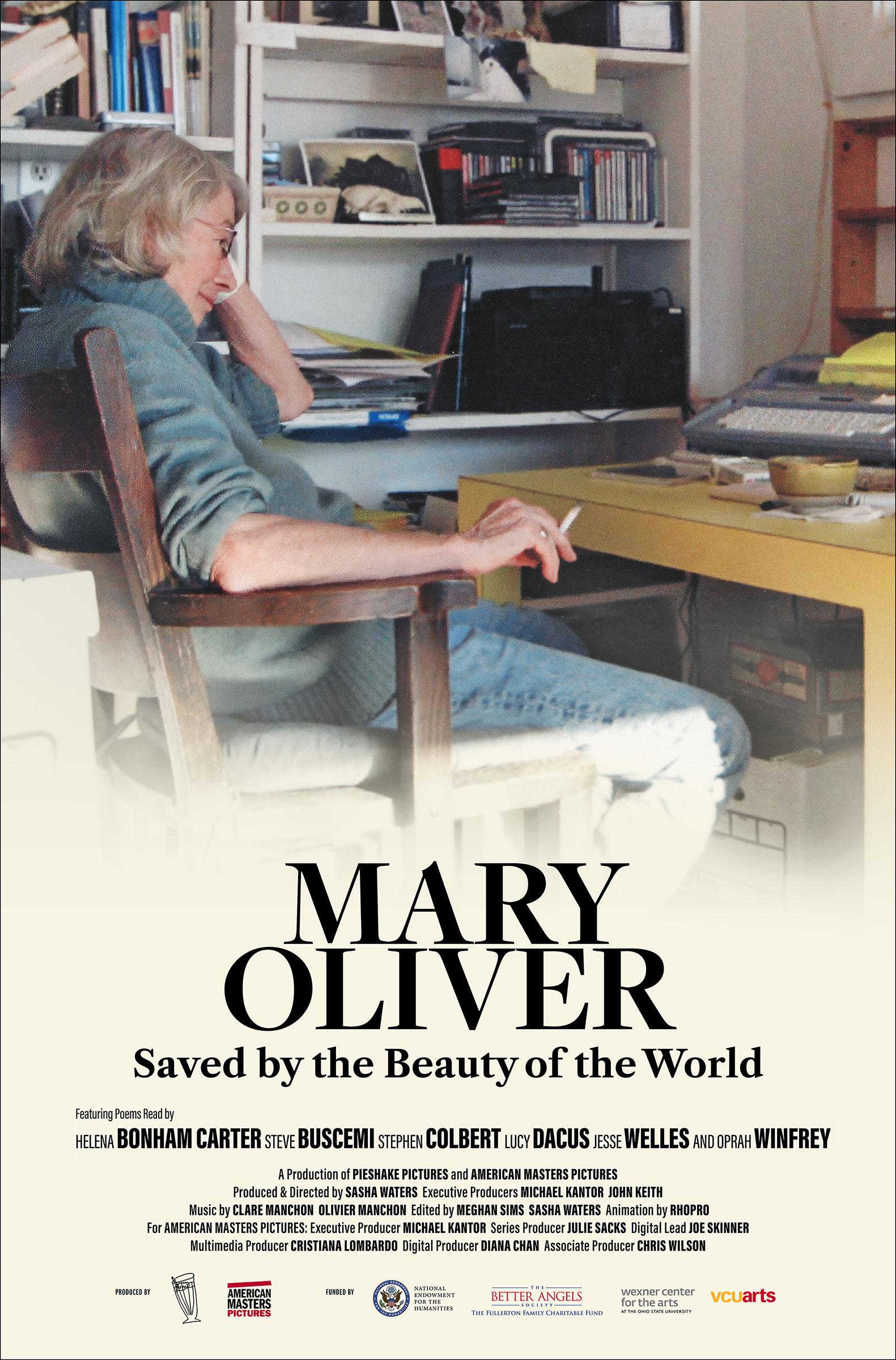
Waters’ feature-length film is being released this summer and will make its streaming premiere in the fall, as part of PBS’s American Masters. Founded in 1986, American Masters is a biographical television series whose recent subjects include Rita Moreno, Alvin Ailey, Miles Davis, Amy Tan, and Toni Morrison. These are legacy-making documentaries, made with the subject’s help, when possible. Oliver, who died in 2019 at age 83, could not be interviewed for Waters’ film, a situation Waters works around by interviewing Oliver’s friends, family, and colleagues. Unfortunately, Oliver’s lifelong partner, Molly Malone Cook, the person who likely would have had the most to say about Oliver’s writing process and daily life, died in 2005. The couple left behind no children or extended family. Although Waters gets some wonderfully candid interviews from people in Oliver’s tight-knit Provincetown social circles—most notably, the filmmaker John Waters—her friends remain protective of her privacy, even after her death. Several subjects allude to private conversations with her that would remain so, out of respect for Oliver. As a result, I felt I got only glimpses of Oliver, as a person, throughout the documentary. But I gained a much deeper appreciation of her poetry.
Recitations of Oliver’s poetry form the backbone of Waters’ film, which opens with Stephen Colbert struggling to make it through “The Summer Day” without crying. We revisit Colbert’s recitation throughout (eventually hearing the entire poem) and hear other celebrities, contemporary poets, academics, and critics share their favorite Mary Oliver poem and reflect on its meaning. We also hear many of Oliver’s own readings, culled from footage of public appearances. There is no one narrator; instead, Waters stitches together a chronological telling of Oliver’s life through a chorus of voices—some who knew her personally, but many who only know her life story from studying her work.
Waters had full access to Oliver’s archives: a trove of photographs, letters, drafts, notebooks, and she uses these to dramatize Oliver’s life story. Where there are gaps in the photographic record—and there are many—Waters uses stock footage from the time period under review as well as nature photography and videos. Often, the nature footage is quite literal, as when Waters illustrates the poem “Fish”—read by Steve Buscemi—with images of fish swimming. Other times, Waters’ choices are more whimsical. There were times when I wished Waters would stay longer with her interview subjects as they recited poems, instead of cutting to nature imagery, but my eight-year-old daughter, who was my viewing companion, appreciated how the images helped her understand the poems’ meanings.
We learn that Oliver grew up in Ohio, in what she described as “a dark and broken house.” She found solace in woodland walks and reading “dead poets,” eventually writing her own poems when she was around thirteen. Walt Whitman was her most important influence and remained so for her entire career. Upon graduating from high school, she made a pilgrimage to upstate New York to visit Steepletop, the estate of the late poet Edna St. Vincent Millay, whose younger sister Norma invited Oliver to stay to help her organize her sister’s archives. Oliver ended up living with the younger Millay at Steepletop for four years. After attempting college—it didn’t take—Oliver moved to Greenwich Village but continued to visit Steepletop to get doses of nature. It was during one such visit that she was introduced to Molly Malone Cook, who would become the love of her life.
Cook was ten years Oliver’s senior, an accomplished photographer who worked for The Village Voice. She was glamorous and self-possessed, and Oliver was smitten with her immediately. Filmmaker John Waters, a lifelong friend to Molly and Mary, describes Molly’s confidence as foundational to Oliver’s success: “Molly was a very strong character. Molly gave her the belief that she was a great, great talent and that she was going to succeed.” John Waters is a frequent narrator, and his lively, irreverent presence helps to bring Oliver down to earth. Those who know Oliver through her poetry regard her as a spiritual guru, but to Waters, she’s his beatnik “shitster” friend who curses like a sailor and smokes too many cigarettes. He’s not overly impressed by her forays into the woods, claiming that she was once bitten by a badger that she tried to befriend.
Oliver’s move to Provincetown, Massachusetts, an artist’s colony on the easternmost tip of Cape Cod, was key to her development as a writer. She and Cook visited in June 1964 with a plan to stay for the summer. But, like many artists before them, they ended up putting down permanent roots in Provincetown. Cook opened an art gallery that morphed into a bookshop—one that employed a very young John Waters—while Oliver walked the woods and beaches of Cape Cod and wrote poems about what she saw, creating the body of work that would come to define her. The two women had very little money, but they managed to survive through odd jobs, foraging, and the kindness of Provincetown’s artistic community. Norman Mailer, another writer who made Provincetown his full-time home, employed both Cook and Oliver as typists and archivists.
The Provincetown that Oliver and Cook occupied seems considerably more bohemian than the touristy spot that exists today, with its high-priced rentals and restaurants. But the nature preserve that Oliver frequented remains as magical as ever. Having visited the area myself, I speak more from personal experience than from what I saw in Waters’ film. It’s hard to convey just how otherworldly the woods and beaches are, and how strange it is to find such quiet, still places of contemplation just a half-mile from P-town’s boisterous Main Street—and to encounter so varied a landscape on this small peninsula. There are woods, marshes, ponds, a bay, and the ocean, all within walking distance of each other. It’s not at all surprising to me that Oliver found a lifetime’s worth of material in this particular corner of Massachusetts.
One of the questions that this documentary successfully answers is: how was a talent as special as Oliver’s nurtured? How did it grow? I found it refreshing that Waters emphasizes the people and places that contributed to Oliver’s well-being and flourishing. There’s no feeling that her fame was inevitable, given her gifts. Nor do we see an artist persevering through sheer force of will or battling demons. Though Oliver did have both these things, they were well tempered by the care she received from Cook and the hours she spent immersed in Cape Cod’s nature preserve.
Oliver was not an overnight sensation. Papers from her archives show her meticulous lists of submissions and rejections. One important early outlet was a monthly gig writing for The New York Times. Another career boost was a glowing review by Joyce Carol Oates of her book, The Night Traveler. Even so, she continued to struggle financially and had difficulty finding steady publication. She felt pigeonholed as a “nature poet” and refused to be marketed as a “woman poet” or “lesbian poet.” Although her peers pressed her for comment, she had no interest in being an activist for LGBTQ rights or writing poems addressing topical issues. Her insistent focus on the natural world seems prescient now, in our era of climate change and increased awareness around environmental issues.
At age 48, fame came for Oliver after she won the Pulitzer Prize for her book, American Primitive. The second half of Waters’ documentary explores Oliver’s celebrity and how it affected her life and work. She took advantage of more opportunities to publish and teach, including authoring A Poetry Handbook: A Prose Guide to Understanding and Writing Poetry. One curious effect of winning an important literary prize was that some critics turned on Oliver, writing her off as too simple and accessible. As poet Ada Limón explains, “The conundrum with poetry is that sometimes when you gain the people, you can lose the poets.” Critic Ruth Franklin confirms that Oliver really was under-appreciated by the poetry establishment, noting that she never received a full-length review from The New York Times. Waters lets contemporary poets mount a defense of Oliver, the poet. Several point out that it is not at all easy to write simply, and that the forms Oliver chose suited her themes. Only Nick Flynn ventures a real critique, expressing a wish to see “more” from Oliver: “I know there’s a lot more to her life than just waking up in the morning and going for a walk…like, what is the storm?” But Flynn also concedes that he has not read all of Oliver’s books and may be missing her darker works.
The darkness comes in the documentary’s final act, which looks at Oliver’s life after the death of Cook, and finally, Oliver’s passing in 2019. After Cook died, Oliver drank and smoked to excess, worrying her friends in Provincetown, who felt they could do little to stop her. John Waters explains: “The drinking was crazy, too. But she was headstrong. Nobody told Mary what to do. Ever. Except Molly.” Without Cook to protect her privacy and shield her from press inquiries, Oliver took on more speaking engagements. This led to her talking publicly for the first time about how she was sexually abused by her father, and how writing poetry about the natural world was a means to heal from this terrible wound. “I got saved by poetry,” she says in an interview. “And I got saved by the beauty of the world.”
In the spirit of Oliver’s poetry, Waters’ film is accessible to a lay audience. I went in without much knowledge of Oliver’s work, and by the end, I’d heard poems from every stage of her career and life. My eight-year-old daughter, who watched the first hour with me, surprised me a few days later by asking me to recite “The Summer Day” to her. Later, I found her perusing a volume of Oliver’s poetry, which I’d checked out of the library to aid in writing this review. Reading is not one of my daughter’s strongest subjects, so to see her enthralled by Oliver’s blank verse gave me a new appreciation for the poet’s radical simplicity. It’s not easy to write something that speaks to the souls of children as well as adults—it’s only the big subjects: birth, death, beauty, pain, that can span a lifetime.
Hannah Gersen is the author of two novels: We Were Pretending and Home Field. You can find more reviews of books and movies in her newsletter, Thelma & Alice: thelmaandalice.substack.com.