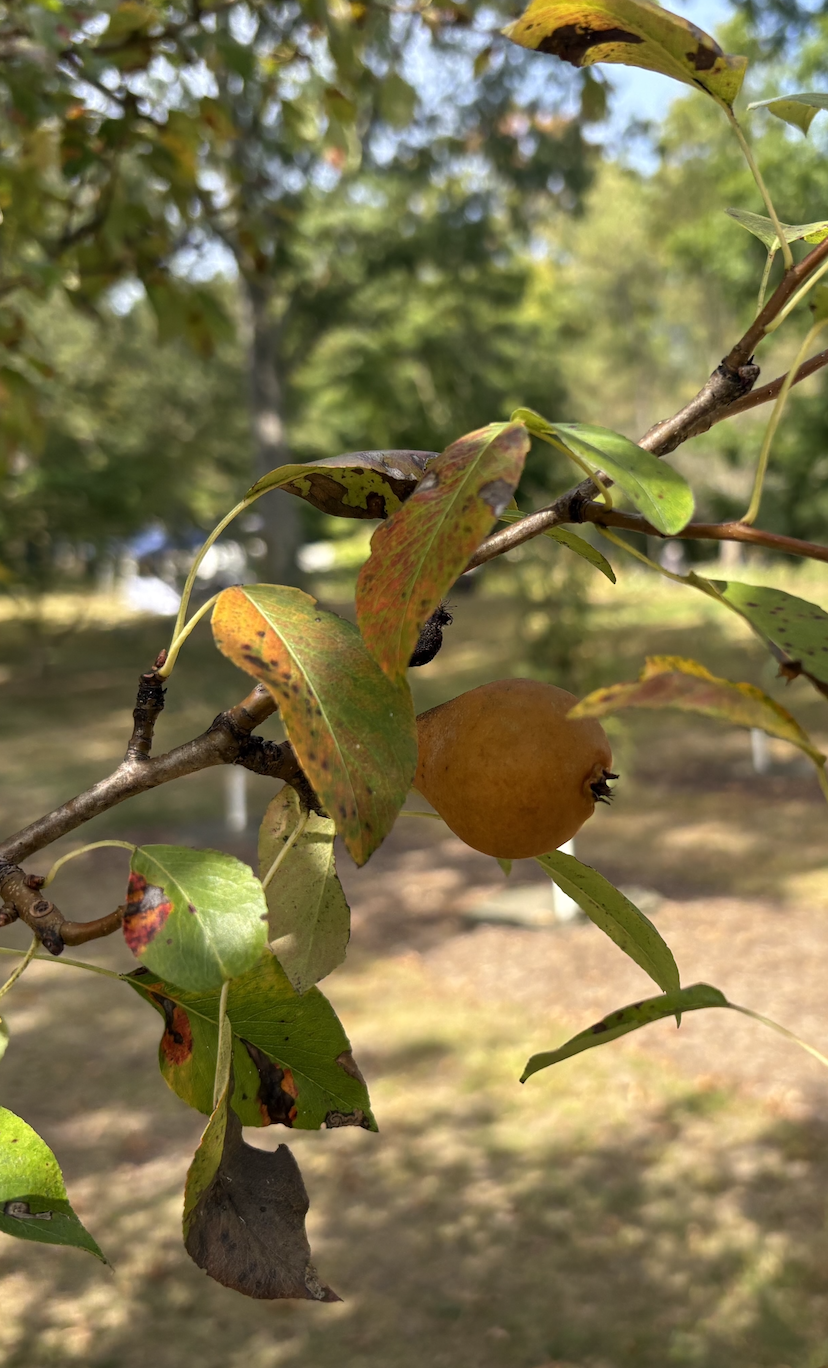
Emily Dickinson Museum (house and grounds), Amherst, MA
Half of Emily’s autumnal garden is sunlit at midmorning, but the little apple and pear trees in the orchard down the hill are shrouded in shadow, and I think of my face as equinox: how I woke last April to thorny vines in my neck coiling up my ear canal, with a numb tongue and drooping left lip and eye: a pox, a palsy on my seventh cranial nerve, inflamed and swollen in its bony channel, its roots and delicate capillaries choked off: Then Space – began to toll, // as all the Heavens were a Bell, / and Being, but an Ear…
*
I couldn’t smile, blink, or cry—the nerve damage prevented tears from forming, made my cornea brittle and dry. Like the blight of an early frost afflicting tender green fruit, over days and weeks my face withered on one side and died. I had to tape my eye closed at night and I wanted to hide—from mirrors and people—Wrecked, solitary, inside: for the first time, my invisible ailment, migraine, had blossomed across my face. All I could do was wait for the nerve to regenerate at a rate of one millimeter per day. The specialist in Boston told me full healing might take up to eighteen months. I sat in my chair with a heating pad on my neck and face, cold rain dripping down the chimney, tea dribbling from the corner of my mouth when I tried to drink from a mug. My mind was going numb.
*
A half-year later, from my perch on a stone bench, I drink in the untidy patches of aster, hollyhock, and foxglove, spiky names to match petals and leaves with sharp edges, a jumble of overgrown herbs and ornamentals, roots tangled, stems and leaves intermingled like my misfiring facial nerve. I got my smile back but the branches miswired, connecting my lip to my eye, which narrows when I pucker, chew, or sip, and closes when I yawn. My left eye closed equals my left cheek lifted and tensed; a laugh or a grin clenches my neck and imprints a lopsided dimple in my chin. My ocular muscles flutter and twitch, and my ear still rings and rushes (A Service, like a Drum…beating – beating), dizzying me.
*
There’s a name for it, synkinesis, these faulty connections permanent, another chronic condition.
And it hurts: most days since my face fell down, I’ve felt a Funeral, in my Brain. At first, I Kept treading – treading – till it seemed / That Sense was breaking through: …a Plank in Reason, broke, / And I dropped down, and down –. I took a year’s leave from teaching, which feels like failure and reprieve tied up in a nosegay. I breathe deep, the air pungent with a touch of decay, mugwort that catches in my throat, a bite of cold on the breeze even in full sun. I feel winter creak across my Soul, roosting in my cells and bones. My soil is depleted, spirit stripped of nutrients, and I know my work is to surrender to fallow, to sleep for months like the quiet violets and snowdrops under ice.
*
Emily missed her garden so in winter that her father built her a conservatory off the library. Soon the October glow will give way to gray Silence, but today I listen to the strange Race of the last few pollinators flitting anxiously among the burnishing foliage and desiccated flowers like Mourners to and fro. I praise the last gasps of fiery fall petals—mums, pansies, geraniums. What they lack in perfume they make up for in hue. If they had a scent it would be citrus tinged with rust and smoke: blood orange, lemon yellow, burnt umber, the ruby red of a cleaved grapefruit. And I could weep over the marigolds, so small and unassuming they look like weeds: dandelions, tough little perennials that can survive anything, roaring flames with golden manes, nourished by the milk in their own green veins.
(Italicized text from Emily Dickinson’s “I felt a Funeral, in my Brain,” (340))
Therese Gleason (she/her) is a writer, mixed-media artist, and migraine advocate. She is author of three poetry chapbooks: Hemicrania (Chestnut Review, 2024), winner of the 2025 Jean Pedrick Chapbook Prize from the New England Poetry Club; Matrilineal (Finishing Line, 2021); and Libation (2006), co-winner, South Carolina Poetry Initiative Chapbook Competition. Her poetry, flash, and essays appear in Cincinnati Review, The Louisville Review, Miracle Monacle, New OhioReview, Pithead Chapel, and elsewhere. Originally from Kentucky, she lives in central Massachusetts, where she teaches writing at Clark University. (Online: theresegleason.com).