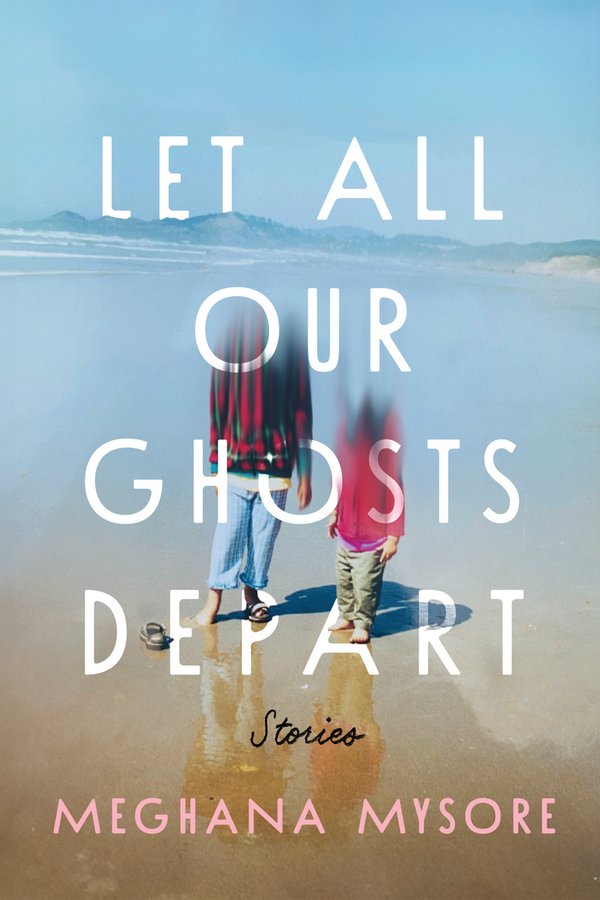
By MEGHANA MYSORE
Review by MICHELLE DONAHUE

A reader needs to look no further than the title of Let All Our Ghosts Depart for a taste of the lyric mix of dark and light that so characterizes Meghana Mysore’s debut short story collection. These are stories full of ghosts—literal and figurative, haunting and loving. Sometimes these apparitions are unwelcome or violent; for example, in the title story, a grandmother’s dead sister possesses her, “shaking the core of her being,” an experience that is “like an insect swimming around in her depths”. Often these ghosts are welcoming and kind; in “Blood and Bone,” a dead father talks with his daughter via FaceTime and worries about her well-being, asking if she’s “sleeping enough” and telling her to “prioritize yourself.” What I perhaps found most impressive about this collection is Mysore’s ability to compellingly and realistically render a range of contradictory possibilities like this on the page. Here she gives us benevolent ghosts and vicious ghosts, delivering stories with unsettled endings that feel both devastating and optimistic. The result is a collection that feels fresh and wild in its approach to themes of belonging, inheritance, immigration, family, and memory.
The depiction of disparate elements occurs at every level of the collection, from macro aspects like structure, setting, and genre to micro moments of cultural commentary and vivid description. The collection as a whole embraces this duality, feeling both beautifully scattered and cohesive. Mysore creates a unified landscape by visiting and revisiting central themes and by creating a cast of characters, mostly young and old women, who share similar desires—to be seen, to be wanted emotionally and sexually, to find their place and meaning on this earth. Amid this, the stories meander obsessively between distant places, from specific locales like the Deveraju Market in India and a Denny’s in Colombia, Missouri, to general regions like the Northeast and Midwest of the U.S., as well as parts of Southern India.
In terms of structure, recurring emotions and motifs (rainbows, parents returning to their children after death, dancing and twirling, poetry and art, balls of yarn, children playing games of pretend, people telling stories) become the organizing backbone of the collection. I didn’t really detect a clear, singular narrative or thematic arc throughout the stories, the way some writers attempt to provide a novelistic thrust to a collection. And this felt wonderfully purposeful. The overall structure of the collection mimics the movements and displacements of the characters, many of whom are unmoored and are first or second or third-generation immigrants.
Mysore flits between genres with the distinct panache with which she moves through everything in her writing. This collection offers readers a delightful mix of fabulist and realist premises. Children play games of pretend to pass time on a long train ride to a temple. A mother and daughter flee a wildfire in Oregon. Three generations of women transform into rainbow squirrels in response to trauma and lives’ other complexities. A dead mother returns to her daughter in the form of a car at a repair shop. Mysore shines in both realist and fabulist realms, offering a reader a wide range of emotionally riveting tales.
In the fabulist stories, a variety of tonal approaches (quirky and absurd, lyric and thoughtful, deadpan and serious) help ground the fantastic premises, resulting in heartwarming and heartbreaking narratives. The opening story, “Hoarder,” begins with a lighter, funnier tone, luring readers in with the promise of unusual whimsy. The narrator thinks, “It was always strange when a lover broke up with you and transformed into a scarf. I thought it would become less strange with each transformation. But no.” This funny voice and playfully truncated syntax appear in other fabulist stories, too. For instance, in “Spring Fling,” a college student’s mother and grandmother visit her after she stops going to class, and the grandmother is especially flatulent, a detail that remains constant even after a significant transformation: “Even in squirrel form, her grandmother has digestive issues. Of course.”
The humor throughout is delightful, yet there are always deep emotions lurking beneath that absurdity. As the tone of a story shifts, so, too, does the content. In “Hoarder,” the narrator describes her sister who “had inherited the disease of incessant feeling, and it engulfed her. She had rainbow swirls not only on her legs but on her belly, and the doctors found solid masses of rainbow in her stomach. ‘Like tasty little lollipops’ one had remarked.” The more lyric and contemplative tone here prepares a reader for the emotional heaviness to come. Although the reference to “tasty little lollipops” carries some of the earlier whimsy, it falls flat both to the reader and the characters in the story. The doctor is “trying to make her laugh, but she just stares back at him blankly.” Soon after this, the narrator remembers another moment before her sister’s death, where she watched her sibling standing naked in front of a mirror: “She looked like a painting, coils of yellow and slivers of rainbow dancing on her body. I watched her as she touched every place of color. The trouble was that her body couldn’t hold all the feelings.” Without the earlier playfulness, the serious moments wouldn’t cut as deeply, and the story would feel too one-note for the mostly hopeful ending about coming of age and acceptance to land. It is Mysore’s tonal approach, even more so than her imagination, that makes these stories so successful.
Although I love fabulism, and Mysore executes it with all the verve of any expert in the genre, I found myself most captivated with the realist stories, which are elevated thanks to smart and unusual craft choices. Take the story “Adalita,” which appears in roughly the middle of the collection. On the surface it’s a simple narrative about Manoja, a widowed woman, as she reflects on her past and worries about her daughter, Pooja. But this story ultimately is a fascinating exploration of time, a theme Mysore builds through explicit narrative references and a meandering accumulation of vivid memories. I thought the interplay between these two was breathtaking.
Time is mentioned early in the story: “Manoja feared that her daughter saw visiting her as another task she had to complete, something else to cross off her infinite to-do list. Being old and alone did this to you. The cruelty of time transformed you into a pitiable object.” The real magic of this piece is how the story’s structure and the intrusion of Manoja’s past memories reverse this “cruelty of time,” transforming Manoja from a tired woman who has accepted a quiet end to her life into a woman full of agency and promise. Manoja recalls her time in high school spent with her best and only friend, Adalita, where her favorite times were spent on bus rides to or from speech and debate tournaments, because she could “exist in the same frame with Adalita, watching the light fall on her shoulders as the bus pulsed forward, and time was a run-on sentence, not yet arrived.”
As more memories creep into the story, time feels less solid, more like a run-on sentence with all the promise and beauty that the future provides. Her memories become more emotional and vivid, as Manoja begins to reclaim her agency, begins to live more. When she finally sells her house in Portland and moves to a Washington island where her family used to vacation, Mysore renders Manoja’s memories in one of my favorite passages of the collection:
“She remembered Pooja’s wild laughter and the glistening water, how they had all swum in it once, even though Saurabh was not a confident swimmer. Manoja and Saurabh moved surprisingly far into the depths of the ocean, and they didn’t sink. She helped guide him along. The water contained her memories.”
The writing here is lyric and effortless, an evocative rendering of both place and character. It is in moments like this that Mysore so excels as a writer and makes this collection a necessary read for anyone interested in reading about diverse places and characters (which, in my opinion, should be everyone).
I don’t think any discussion of Mysore’s writing would be complete without addressing the ways she renders South Indian immigrant experiences. The collection is a compelling and earnest contemplation of immigration and race, one that embodies Mysore’s signature duality as it swings from explicit and more familiar commentary to something funnier and more singular. “Blood and Bone” vividly represents the harsh economic realities immigrants often face, as a father overworks himself at the expense of his health and performs for his landscaping customers, telling his daughter “Sometimes acting is necessary”. In “Repair Shop,” the narrator reflects on the expectations the younger generation feels to escape these sorts of economic realities: “I was going to be a success story; I was going to be a model minority, one who had conquered it all.” The collection avoids feeling too expected or didactic about such topics by pairing this commentary with surprising and critical humor. For example, in “Love Letters,” when Mahima meets Evan S. who she matched with on Cuddlr (“an app devoted strictly to cuddling”), she thinks this about him: “He spoke about yoga and sun salutations in a way that divorced the activity from any semblance of culture and made Mahima wonder if, despite his being half-Indian, he was a middle-aged suburban white woman inside.” Mysore’s pairing of earnest representations of immigrants’ experiences with more funnily cutting commentary helps provide a fuller sense of what life is really like for her characters.
If you’re looking to read something dark or funny, witty or poetic, this is the collection for you. Here is a fierce debut from a writer I know I have my eye on. I can’t wait to see what other sorts of ghosts she might bring us in the future.
Michelle Donahue is an associate professor at UNC Wilmington where she is the associate editor of Ecotone. Her short story collection Smoke Phase is forthcoming from Cornerstone Press in 2027 and her novel in stories Budapest | Budapest won the American Buffalo Books Fiction Prize and is forthcoming in 2029. Her stories have been published recently in Shenandoah, About Place Journal, and Brink, and her work has been supported by the Kentucky Foundation for Women. She has a PhD in creative writing from the University of Utah.