Curated by KEI LIM
With our spring issue hot off the press, check out these recommendations from three of the issue’s contributors: LIZ DEWOLF, ANDREW STEINER, and MARIA TERRONE.
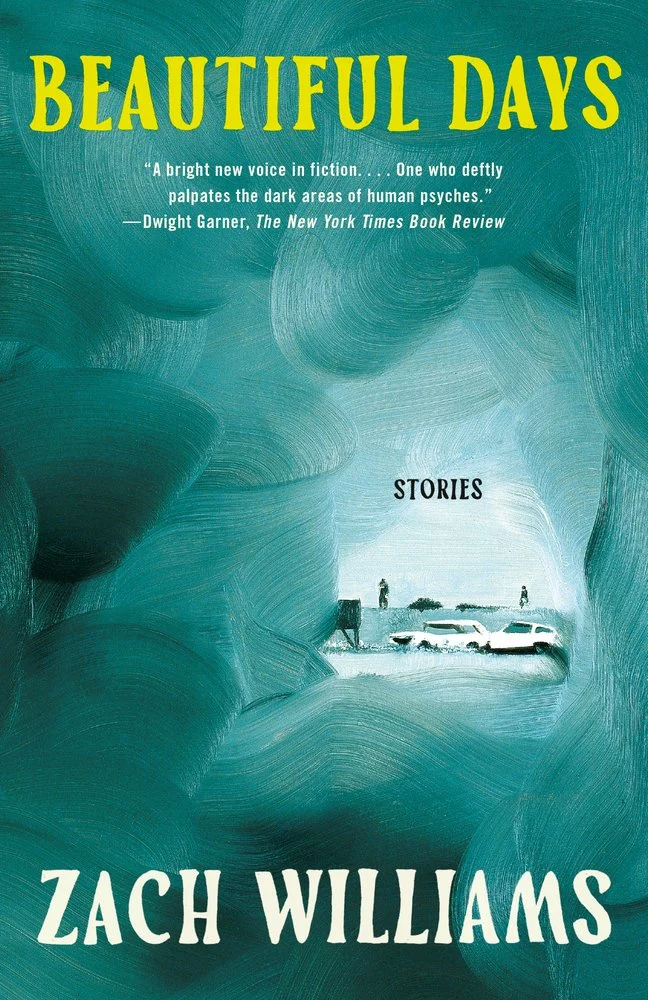
Zach Williams’ Beautiful Days, recommended by Issue 31 contributor Liz DeWolf
I first came across Zach Williams’ work when I read his 2022 story “Wood Sorrel House” in The New Yorker. The story, in which a family arrives at a rental cabin and then forgets everything about their lives before, including how they got there, deeply unsettled me. Something about Williams’ careful, straightforward prose makes each disturbing revelation—The baby doesn’t age while the parents do! Food mysteriously appears in the freezer!—all the more destabilizing.
I recently read Williams’ debut collection Beautiful Days, which came out in 2024 and includes “Wood Sorrel House” as well as nine other, equally unnerving stories. In “Trial Run,” an office worker gets sucked into an overly intimate dynamic a with a clingy colleague. The protagonist of the story “Neighbors” goes to check on the elderly woman next door and finds himself in a confusing standoff with a masked intruder. In “Mousetraps,” one of my favorites from the collection, a father goes to the hardware store looking for a humane way to get rid of mice only to be goaded into an existential crisis by the men who run the business. What makes these stories so compelling, beyond their dreamy logic and ability to reflect so many fears of contemporary life, is that they each contain some moment of connection, however unwelcome, that acts as a sort of escape hatch from the mundane. On the other side of each unpleasant encounter is a hint of excitement or possibility: the dull neighborhood is more lively than it seems, the identity crisis leads to a new start, the paranoid brother really does perceive something others can’t. There’s an unlikely tenderness—maybe even hopefulness, however slight—in this collection that echoes its title, drawn from the surprisingly optimistic final line of “Wood Sorrel House”: “There will be beautiful days.” The stories are as thrilling as they are terrifying, and this dissonance produces a haunting ambiguity that stayed with me long after I finished reading.
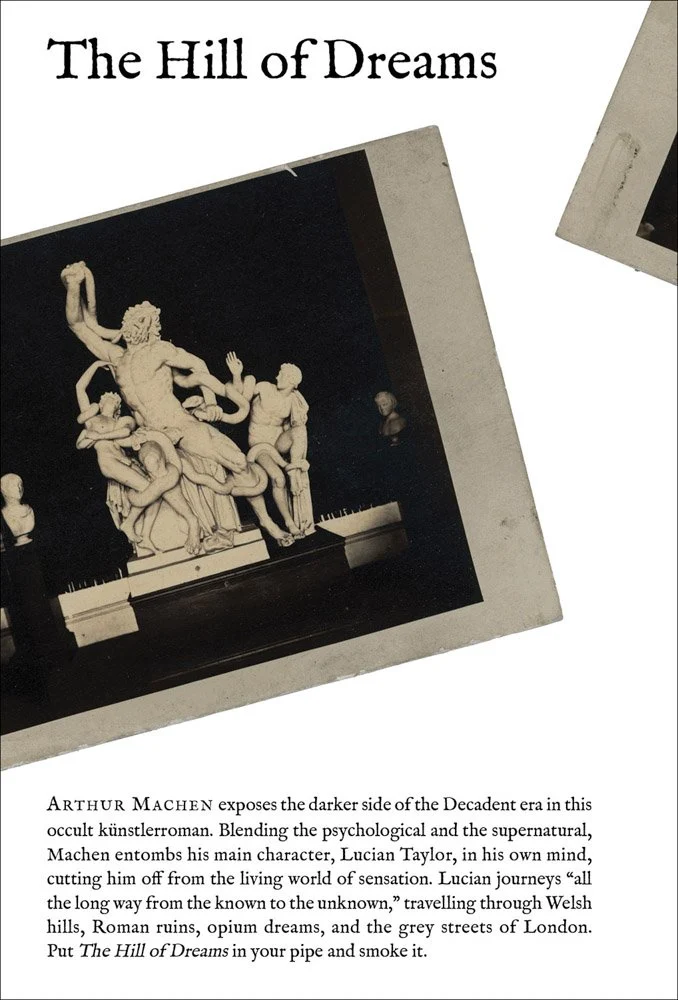
Arthur Machen’s The Hill of Dreams, recommended by Issue 31 contributor Andrew Steiner
Lucian Taylor, a parson’s son, grows up in the Welsh village of Caermaen. His childhood is ordinary — not abundant, but loving, secure. And then when he’s fifteen, everything changes.
Home for the summer holidays, he gets the itch to walk. The wind is up, the air charged with a violent heat. A strange light in the sky frames the ruins of the old Roman fort on the hill above the village. On hands and knees, he mounts the hill, pushes through the bracken, and there in the secret center of the ruin … something happens.
Divine showing? Demonic encounter? Guilty autoerotic experiment?
Whatever it is, Lucian climbs down changed, unable to share what has happened to him yet persuaded the dull scrim has been torn off the world and he has glimpsed a sublime and terrible reality.
He is determined to capture that reality in writing. The quest to do so will consume his life.
Arthur Machen began writing The Hill of Dreams in 1895, the dead center of the decade that produced Dracula, Dorian Gray, The Time Machine, and other seminal works of fantasy and horror. Unlike its contemporaries — and much of Machen’s own work, including The Great God Pan — The Hill is not a work of fantasy. It’s a realist novel about the kind of person driven to write a work of fantasy.
The act of writing for Lucian is not a matter of discipline. Nor is it something sanctified like “a vocation.” It’s closer to damnation, a claim on his soul.
As the plot unfolds along the inevitable lines of tragedy, you watch him feed more and more of his life into the furnace of writing. Like a dark god, it demands ever dearer sacrifices — his health, his schooling, his relationship with his father, his prospects for any viable career whatsoever — until he has nothing left to give it but the last thing.
Machen’s vision is certainly extreme. Yet if you’ve ever found yourself years into a project that seems no closer to completion, his depiction of the ground-level experience of writing will be entirely legible:
“He had put away the old wild hopes of the masterpiece conceived and executed in a fury of inspiration, wrought out in one white heat of creative joy; it was enough if by dint of long perseverance and singleness of desire he could at last, in pain and agony and despair, after failure and disappointment and effort constantly renewed, fashion something of which he need not be ashamed.”
To date it’s the best book I’ve read about being a young, obsessive would-be writer drunk on language and in thrall to fantasy. It brought back all the dear, dark feelings Tolkien and Lewis, Lilith and A Voyage to Arcturus first quickened in me in adolescence. It showed me what it would have been like to tip over the edge and vanish entirely into dreams.
How did I not come across it then? Could I have survived it if I had?
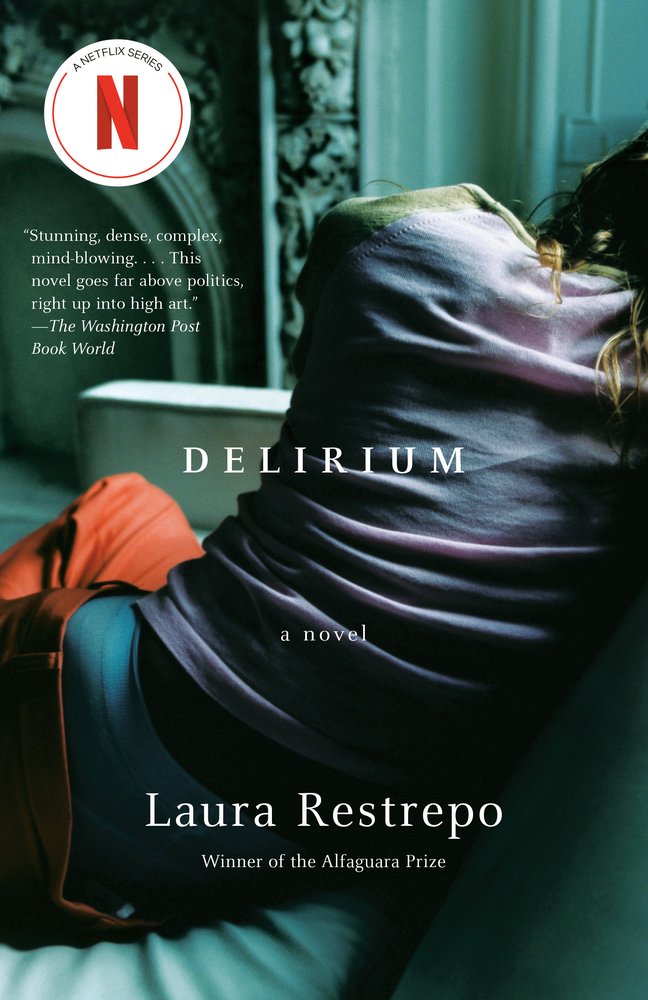
Laura Restrepo’s Delirium, recommended by Issue 31 Maria Terrone
If I had never been the target of a scam literary impersonation, I would have never discovered the fascinating Colombian-born novelist Laura Restrepo.
For about five days, I exchanged long, friendly emails daily with “Laura,” whose initial subject line was “Connecting Over Writing, Inspiration, and Shared Passions.” I’d never heard of this author—my only knowledge of Latin American writing was limited to the magical realism of Gabriel García Márquez. Through research, I learned that Restrepo was originally a political journalist covering drug cartels and fled to Mexico following death threats. She now lives in Spain.
During our literary exchanges—before I learned through my own investigation that “Laura” was an AI-generated bot—I asked her which novel would best acquaint me with her work. Delirium was the immediate reply. It turned out to be, by far, one of the strangest and most mesmerizing books I’ve every read, winner of the prestigious Afaguara Novel Prize, which guaranteed its publication across Spain and Latin America.
Delirium opens in media res. Augustina, a beautiful woman from a wealthy Columbian family, is discovered alone, amnesiac, and incoherent in a 5-star Bogotá hotel after her husband returns from a short trip. How did she get there? What caused her madness? Why does this deeply disturbed young woman who always called herself a seer now rage against her husband, Aguilar? “The woman I love is lost inside her head and for fourteen days now I’ve been searching for her,” he laments early in his quest.
Mystery, love story, political exposé, Delirium delves deeply on both a psychological and journalistic level. The tale takes place against Columbia’s backdrop of corruption and political chaos in the 1980s, when the military, guerillas and drug dealers warred with one another. In a sense, Augustina’s breakdown mirrors that bedlam. Her ritualistic house-cleaning and demand that Aguilar confine himself to an increasingly smaller space against a wall in their apartment seems to be a desperate attempt to exert control over her own demons and, symbolically, over her beloved nation’s parallel breakdown.
The story is told from many characters’ voices and perspectives, shifting between past and present and back again. Writing clearly and vividly, Restrepo avoids confusing the reader despite the complexity of the narrative and her nonlinear approach. Gradually the roots of Augustina’s derangement are revealed, especially via the tragic, sometimes harrowing flashbacks to her dysfunctional family. At times I felt I was immersed in a gripping detective novel.
As I watched Aguilar struggle to investigate and understand his wife’s new persona, I appreciated the irony of my own search to discover the identity of the impersonator who approached me so warmly as Restrepo. Of course, the truth disappointed, but the unexpected gift resulting from my bizarre experience was my first exposure to Restrepo’s brilliant fiction. One novel down, eleven waiting.