Review By: BRITTA STROMEYER

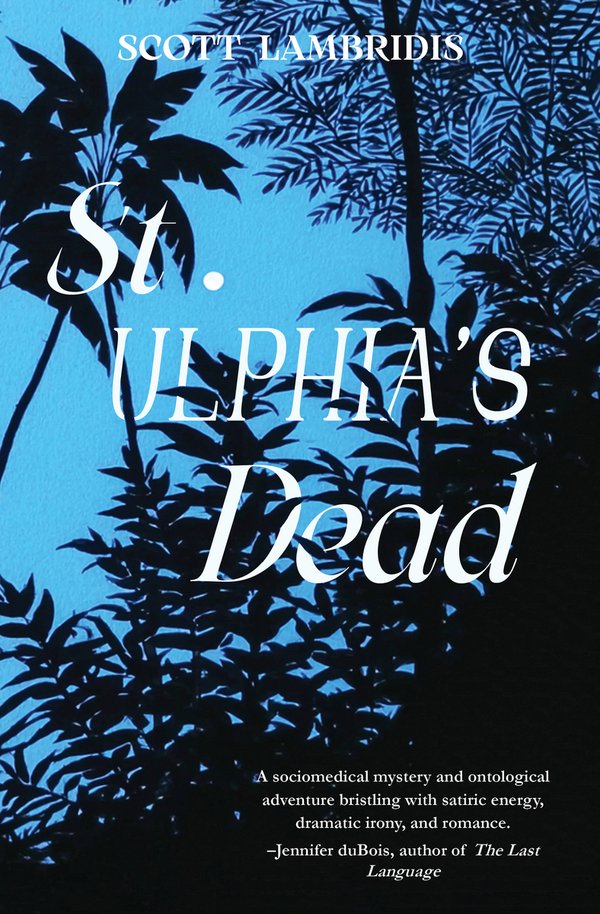
“If you want the truth, you must ask someone else. Someone like me, who’s been here, on this island, all along,” writes author Scott Lambridis in his dizzying and darkly humorous debut novel, St. Ulphia’s Dead. Addictive and deceptive, the novel demands the reader’s full attention—as nothing is quite what it seems.
Set on a remote island off the coast of northwest Africa, the enigmatic fictional village, St. Ulphia—both beautiful and unsettling—tests the boundaries between reality and the supernatural. The village is a mysterious, insular community. Isolated, rife with rituals, and haunted by myth, St. Ulphia functions less like a backdrop and more like a living character—one that actively shapes the beliefs, fears, and behaviors of its inhabitants.
The story follows CMC (Central Medical Compendium—a global institution responsible for the verification, classification, and publication of medical and psychological conditions) investigators Dr. Mirs and Jo as they travel to St. Ulphia to investigate reports of Wendigo Psychosis, a disorder defined by cannibalistic urges. They arrive to find a bizarre community, entrenched in local legends, pointing to the Wendigo as the culprit for a recent murder. As Mirs and Jo conduct their medical exams and interviews with the local population, they are pulled into a mind-bending sequence of unexplained deaths and possession claims, uncovering a village that exists on the edge of reality. Blurring the line between actuality and delusion, the novel grapples with the nature of life and death, the power of collective belief, and the search for meaning in an uncertain world.
At its core, the novel unfolds as an unconventional love story, tracking Mirs and Jo as they negotiate the fragile intersection of their professional partnership and personal intimacy against a backdrop dominated by the specter of death. As Dr. Mirs and Jo immerse themselves in the island’s eccentrics, the setting systematically dismantles and questions their own rationality—both investigators are pushed past their vulnerabilities toward an emotional and existential reckoning. Time is deliberately vague, smudging the lines between past, present, and future and blending modern bureaucratic procedures with folkloric and archaic traditions. For example, characters frequently relate their accounts as stories of their past and the village’s history—villagers’ stories are repeatedly punctuated with admissions like “I don’t remember the order” and “I’ve long since forgotten,” or: “Days passed, barely conscious, as he plotted his escape like a caged animal—frantically, erratically, with his body not his mind. He thrashed at the door, the walls, but he was weak.” This temporal elasticity drives the characters and readers to contemplate the mysteries of life, the limits of human knowledge, and the space between sanity and delusion. The presence of the Wendigo myth and the villagers’ rituals reveal how humans cope with trauma and isolation, and the stories they tell each other to survive.
Lambridis blends traditional narrative with philosophical musings and magical realism, but he also infuses his prose with hilarious dark comedy. For example, during an interview with a villager, Chemie, Jo is transported back to reflect on the decline of her marriage. Jo watches as Dr. Mirs asks Chemie if she has ever eaten another human being. To their shock, Chemie shamefully admits that she has. She stammers out her confession in broken fragments, explaining that her possession took hold two weeks after witnessing the beast, a creature with green and luminescent eyes and “engorged veins threaded across the whites, and half-dried blood pooled in its tear ducts.” This spurs Jo to reflect on her divorce, wondering “if her life would’ve been simpler if instead of divorcing him, she’d have just eaten her ex-husband—eaten and maybe even stuffed as a souvenir of her independence. She felt a pang of remorse for the violence of her fantasy before yielding to the rising anger she felt at herself for once again subsuming her own needs to his.”
The novel’s tone balances its wry, absurd humor with genuine existential inquiry, continuously questioning the nature of reality, identity, and mortality. By shifting perspective between the clinical investigators and the peculiar villagers, the narration dissolves the boundaries separating objective truth from subjective experience.
By centering the Wendigo myth and the villagers’ shared belief in possession, Lambridis offers an incisive commentary on how communities construct collective realities as a defense mechanism against trauma and marginalization, suggesting that our afflictions, histories, and identities are not passive interpretations of the world, but the very scaffolding that shapes it.
St. Ulphia’s Dead delivers a sharp satire of the human impulse to categorize, diagnose, and master the world’s enigmas—from mental illness and trauma to mortality itself. Lambridis exposes the act of naming as a double-edged sword: a mechanism that promises control yet ultimately falters, unable to capture the untamed complexity of lived human experience. The whispers of St. Ulphia’s Dead will linger in readers’ minds as haunting stories and Kafkaesque musings on place, time, and existence. With its atmospheric setting and thematic weight, it is a compelling novel for readers interested in the intersections of myth, psychology, and the human condition.
Britta Stromeyer is a member of the National Book Critics Circle. Her writing appears in The Common, World Literature Today, Tupelo Quarterly, Beyond Words Magazine, Necessary Fiction, On the Seawall, Flash Fiction Magazine, Bending Genres Journal, Marin Independent Journal, and other publications. Britta has authored award-winning children’s books and holds an MFA from Dominican University, CA, an M.A. from American University, and a Certificate in Novel Writing from Stanford University.