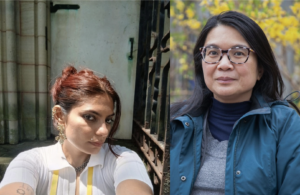
Kanchi Sharma (left) and Yu-Mei Balasingamchow (right)
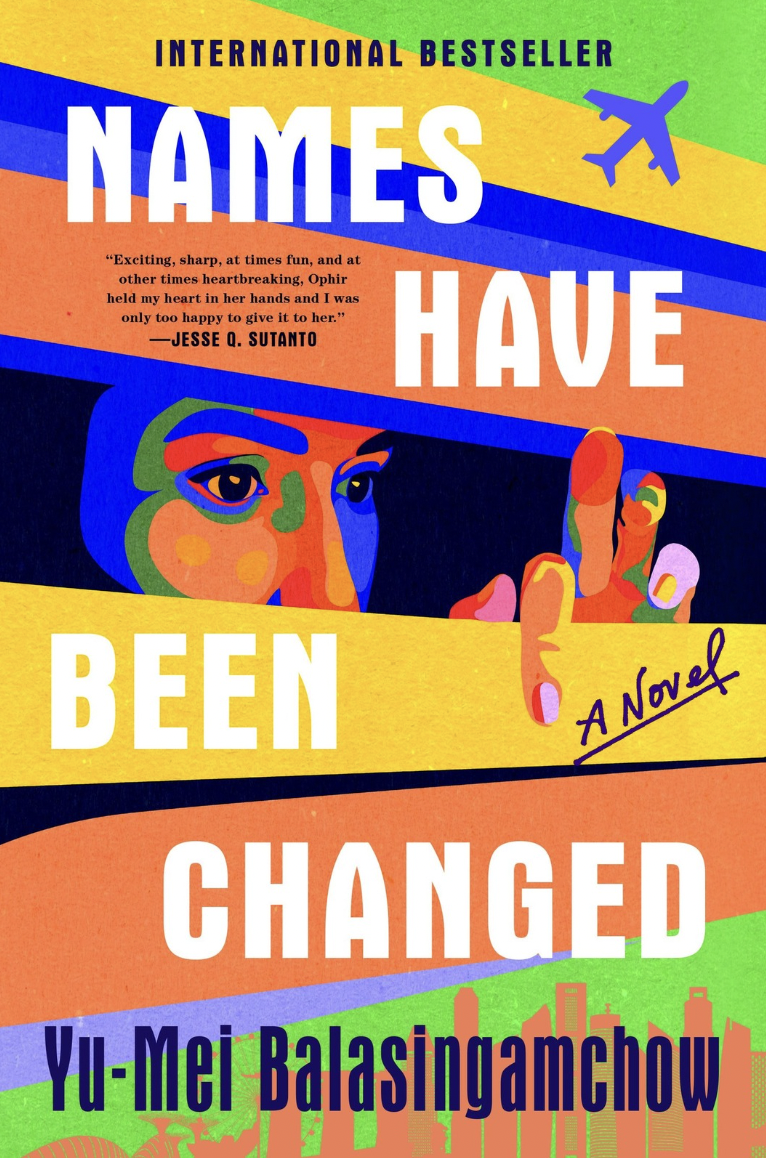
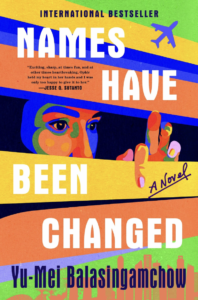
KANCHI SHARMA and YU-MEI BALASINGAMCHOW first connected despite the limits of time zones – Kanchi in Mumbai, Yu-Mei in Boston. Years after seeing each other in pixels, they met in person at AWP. Bringing it full-circle, they met over Zoom to discuss Yu-Mei’s debut novel, Names Have Been Changed, its masterful portrayal of modern exiles, diaspora, concealment, and the quiet violences of bureaucracy and border.
Kanchi Sharma (KS): So many brilliant threads weave through this novel simultaneously: consumerism, passport privilege, asymmetry of legal and bureaucratic systems – who it weighs most on, who gets to walk away clean, who’s rendered complicit. Your character is globetrotting during COVID but you turn it on its head. Ophir has lost her passport privilege and is constantly on the run. You explore surveillance anxiety, class, gender and sexual politics, and the parasocial relationship that develops when one puts their story out into the world today. Ophir broadcasts herself while also becoming a vessel that absorbs everyone else’s stories as she moves through these cities. How did your vision shift across drafts?
Yu-Mei Balasingamchow (YB): A voice kind of popped into my head one day, and I started writing. After the first thousand words or so, I sat back and saw a character emerge. A woman calling herself Ophir, from Singapore, who’s committed a crime and fled the country without quite thinking it through. She’s an accidental fugitive who can’t go home.
That gave me the central tensions of the novel. She’s constantly on the go, there’s forward momentum in her life and in the book. She’s constantly homesick, because she didn’t mean to leave permanently. There’s the tension of having to conceal her identity, because she doesn’t want to get caught.
I threw in a lot of ideas, and the one that became the linchpin was Ophir’s encounters with other Singaporeans she meets around the world. None of them are criminals like her, but all have a fraught relationship to Singapore, reasons they left, and reasons they stayed. It was interesting to explore the many reasons people leave home, which today’s discourse tends to flatten into being an “immigrant” or “migrant,” as if it’s simply about better prospects. It’s often more complicated. There’s a character, Hamidah, an older woman who leaves Singapore to join her daughter overseas. She leaves out of love, leaving behind a country and relatives and friends, because home, for her, is wherever her daughter is.
The novel evolved into more of a story about diaspora and the things that bind it. The interactions that affect her most deeply are with these diasporic characters – Singaporeans, Moroccans, Jamaicans, and so on. Their passports decide who gets to move through the world invisibly and who doesn’t. It was never glamorous. Ophir isn’t living a jet-setting fantasy but scraping by and experiencing her positionality shift with every border she crosses.
KS: You’ve executed the structural frame of the podcast so masterfully. It gives Ophir a listener without a face, and the listeners a confession without a face. It’s a contemporary vessel for a very canonical narrative impulse — the fugitive’s testimony. What drew you to the podcast specifically, and what did it let you do that a conventional first-person narration wouldn’t have?
YB: I had the voice, and I had to figure out who she was telling her story to, and why. She’s on the run for a decade, can’t trust people. She’s isolated even when she’s surrounded by people, working in a restaurant or a bar. That pressure builds. Then she finds out, through a Google search, that her father has died. Then it’s a COVID lockdown. Everything that’s been building needs to come out somewhere.
Her friend Tina wants her to start a podcast and it seems like the perfect solution: she can say whatever she wants and put it on the internet, and nobody knows who or where she is. It also suits her because before she became a criminal on the run, she was social, loved dancing, being the center of attention, and was even a voice actor. Talking into a mic isn’t a big deal for her. So it’s natural for her to tell her story this way, safe in the knowledge that no one knows where she is, but also performing.
She wants to clear the air, clear everything out of her system, in the middle of grieving her father. I became interested, as the writer, in what it means to tell a story out loud, and how you do that within a novel, which is, by definition, static text on a page.
There’s also a two-way parasocial dimension. The listeners start imagining who’s talking. Ophir starts imagining who’s listening: Is anyone out there? She wants someone to call her by her real name, and it’s been years since anyone has. That’s driving her to talk and to look again at things she maybe hadn’t wanted to examine closely. We tell ourselves stories to make sense of our lives. Saying it out loud does something else.
KS: The nation-state rarely announces itself as a character here, yet it’s everywhere: in the logic of who gets to leave, who gets tracked, whose departure reads as ambition, and whose reads as betrayal. Singapore’s particular relationship to bureaucratic reach seems to seep into even the most private, interpersonal moments. How were you thinking about the relationship between institutional structures and the intimate lives of the characters?
YB: Singapore is a small state, and the government is effectively the largest employer in the country, so there’s a degree of administrative reach that isn’t logistically possible in a large country like the US. The government appears throughout the novel in small ways: sometimes subtle, sometimes heavy-handed, depending on the character. Someone who’s a political exile has had direct and unpleasant interactions with the state. Another is just doing her job, representing the government in an economic development role. I was interested in how these small interferences surface, and how they can touch a life, long after someone has left the country.
KS: Ophir’s criminality is neither premeditated nor glamorized, and she feels a constant guilt. That felt like a deliberate refusal of the more familiar antihero logic, where the transgression is calculated. Why accidental criminality?
YB: I often write about ordinary people who become extreme outsiders because of something that’s happened to them, or something they’ve done. Before she runs away, Ophir is living an average life. She doesn’t have a great career, is the youngest of six children, is loved by her family. She’s tempted into a criminal enterprise because she wants a nicer life and doesn’t think through the consequences. Even the decisive moment when she flees Singapore, she’s running before she’s fully registered that she’s doing it. The police are closing in, she takes the money from the ATM, grabs her bag, and she’s crossing the border before she’s really processed what she’s doing.
That’s very human, we panic and act. Only afterward do we realize that maybe it wasn’t the best decision. For most of us, that doesn’t turn us into an international fugitive. We just have to apologize and feel embarrassed for a while. For Ophir, the stakes are much higher, which makes for good novel writing. It let me examine what’s underneath a criminal label. What motivates a person, and what desire, or lack do they carry afterward? The political exile character didn’t do anything wrong, but she’s haunted by that label for the rest of her life, unable to return.
KS: Ophir survives by concealment (false names, passports) and at the same time, some of her most genuine relationships form precisely inside that concealment. Belonging keeps surfacing in the very spaces built for hiding. How did you think through that tension between the necessity of disguise and the persistence of real connection?
YB: Just a few pages in, Ophir tells the listeners of her podcast (and us, the readers) that she won’t reveal her real name. So the novel became, for me, about shifting identities and concealed selves. Ophir changes her name in every city and conceals who she really is. But the people she meets also have concealed selves, even under their real names.
Take Ah Mun, who manages the Chinese restaurant in London where Ophir works. Her name sounds Cantonese, but she looks South Asian. She speaks Cantonese, English, and Mandarin, but also Tamil and other Indian languages Ophir can’t identify. She runs the restaurant with total authority, but to most people, she doesn’t track. She was fun to write, and I think she gestures at something true, that a lot of people who move through the world, including you and me, are confounding to others because we don’t fit the boxes we’re expected to fit. But that doesn’t mean we don’t know exactly who we are.
By the end of the novel, we never learn Ophir’s real name. I don’t think it matters, because we know who she is by then. Names, official labels, passports don’t tell us who we are. At the same time, the novel isn’t saying names don’t matter. Ophir yearns for hers precisely because she never hears it. When someone does call her by her real name, the effect on her is enormous.
KS: Formally, the novel refuses to italicize or translate the languages moving through it. Malay, Singlish, Cantonese all sit on the page with the same authority as English, asking the reader to either keep up or sit with not fully understanding. That’s a real risk against the pull toward legibility a lot of international fiction faces. Multiple sentences in the book made me speak them out loud, imagining what the Singlish dialect itself would sound like. “Can you hear it,” Ophir asks. How did you negotiate the competing needs of readers who share that linguistic world and readers who don’t?
YB: I think of books like Angela’s Ashes, Wuthering Heights, and Chimamanda Ngozi Adichie’s body of work. Adichie’s work is full of languages the reader isn’t necessarily handed a key to. Those books gave me permission to think: it’s possible, you just have to think about who’s coming along with you, and how far you can take them without losing them.
As long as a reader feels like they’re still inside the story, they don’t need to understand every word. So scene by scene, I’m thinking about what’s emotionally happening and what the reader needs in order to feel that, even if they don’t catch every reference. Sometimes Ophir tells a joke and says, if you’re from Singapore, you know. Other times, like when Hamidah says something loving about her daughter, Ophir repeats the Malay line, untranslated, because she’s fully inside the emotion of the moment. It wouldn’t occur to her to translate it.
I was lucky that my agent, editor, copyeditor, and audiobook team never asked me to overexplain. That felt like confirmation the story was working emotionally. I hope more writers and publishers extend that same trust in treating multiple languages as a natural, considered part of the texture, not something that needs flattening for an imagined “general” reader.
KS: The refusal to translate implies a fairly specific idea of who the book is for, and who it’s willing to risk losing. At the sentence level, when deciding whether a phrase gets glossed or left alone, who is the reader you’re writing toward?
YB: The author R. O. Kwon talks about audience in terms of rows: front row, second row, third row. My front row is a reader from Singapore who maybe hasn’t seen a book quite like this and is curious enough to pick it up. I don’t want Ophir playing native informant for them. But I also don’t want to lose readers who aren’t from that world. I try to give enough emotional context that each scene still lands, and if someone is curious about an unfamiliar word or phrase, they can always look it up. I trust the reader that far, and then some. The reader isn’t monolithic.
Yu-Mei Balasingamchow was born in Singapore and moved to Boston, where she was a bookseller at Papercuts Bookshop and where she teaches writing workshops at GrubStreet. Her short fiction has received a Pushcart Prize special mention and been shortlisted for the Commonwealth Short Story Prize. She has an MFA in creative writing from Boston University and has received grants from the Elizabeth George Foundation, Sewanee Writers Conference, and Singapore’s National Arts Council. Names Have Been Changed is her debut novel.
Kanchi Sharma is a writer, editor, educator, and veteran brand and copy strategist from Mumbai. She currently teaches Fiction Workshop at Vanderbilt University, where she is also pursuing her MFA in Creative Writing as the Russell G. Hamilton Scholar and University Graduate Fellow. She is a Kenyon Developmental Editing Fellowship finalist, Curb Center Public Scholar, and SLF Diverse Writers & Diverse Worlds Grant longlistee. Kanchi’s work has received support from Tin House, Kenyon Review, VONA, Napa Valley Writers Conference, Fine Arts Work Centre, Community of Writers, NYS Summer Writers Institute, Curb Center, and more. She’s working on two novels and a polyphonic art installation.