The dog is crossing a circle. Dawn light catching silver strands on a gray coat, saliva on a panting tongue, a red collar. A lost dog.
For an instant, we lock eyes, then I continue around and take the north exit. I’m in a hurry to get to the meet-up point. My first time running with others and I’m dreading it, but doctor’s orders and all that. Besides, I’ve promised my husband. I will be late, I will be late, I will be late, I say through my teeth, then pull over to look for the dog.
I walk back to the circle. A sorry circle. Tufts of dead grass and weeds pushing through. Where I live, just a few miles west, this would never be the case. There would be turned soil and a feature plant; perhaps an ocotillo, its spiny branches reaching skyward, fingertips in fiery bloom. A last hurrah before the start of summer. The heat has arrived early this year. No breeze on this valley floor. You run in the blue hour—or close to it—to beat the sun rising fast over the desert mountains.
It is Sunday. No traffic, and no dog. I try to calculate the distance it could have traveled, those short little legs moving at speed. I can still see its face. A long snout, and black button eyes with an expression of—what exactly?
I decide to walk east. An unfamiliar neighborhood. Skinny streets curling into one another like snakes. An old neighborhood; small bungalows and small front yards. A rusted car with no wheels in one driveway, a child’s plastic wagon on its side in another. A papier-mâché piñata, iridescent in the morning light, hangs from a basketball hoop. Aloes and cacti grow haphazard behind crisscross wire fences. My neighborhood has rolling front yards and uniform side hedges of smartly trimmed bougainvillea.
It is quiet, except for the birds. Crows atop palm trees calling to each other. Kraa-Kraa-Kraa. I think of calling the lost dog. But how to call a dog without a name?
Then a different sound. I come upon an old woman in her robe and slippers filling a birdbath with water from a garden hose. Her white hair hangs loose over her shoulders.
“Have you seen a lost dog?” I say. “Like this.” I make a rectangle shape with my hands.
She turns off the water and comes to the fence, wiping her hands on her robe. Dark, deep-set eyes staring at me curiously.
“¿Es tuyo?”
I can’t think of the Spanish for lost. “Lost,” I say.
Her gaze moves from my neon leggings to my neon sneakers, bought new for the running club. My cheeks burn.
“Espere un momento,” she says and walks slowly toward the house.
It is a modest house, with small, high windows and a flat aluminum roof. The horizontal rain gutter has become detached and hangs at an awkward angle. Maybe from the force of our last storm. I can’t think when that was—six months ago, a year? The front door is painted a cheery yellow, and the old woman opens it and calls “Pedro,” or maybe “perro”? My mind leaps to the improbable. Did the lost dog wander into her house, or was it hers all along and simply trotted home?
But the old woman doesn’t return with the dog. Instead, she comes back with a yawning teenager who looks fifteen or sixteen, at most. His tousled hair and stripy pajamas make him seem younger. I am reminded of old photographs of my husband as a boy. If fairer, this teenager could be my son. I have to stop thinking like that.
“You lost a dog?” the boy says to me, rubbing sleep from his eyes. Large, and deep-set like the old woman’s.
While I explain, the woman rests her hand on his arm. He translates for her, and she says something and he gives her a resigned look, then goes back inside the house. The woman smiles and gestures for me to wait.
I want to ask if the boy is her grandson, but I don’t know how to say that in Spanish, so I stay silent, thankful for the distraction of a crow that lands heavily on the birdbath. It has trouble finding its footing and flaps its wings before settling and taking a drink.
Just when I think the boy isn’t coming back, he appears at the door with a large ceramic bowl. The crow flies off, probably spooked. The boy fills the bowl with water from the hose and passes it over the fence to me. It is heavy.
“For the dog,” he says, jutting his chin to indicate where I should put it down.
We both look at the bowl, conspicuous on the thin strip of sidewalk.
“I guess you could check the park,” he says, pointing vaguely behind me. “You a runner?”
For a moment, I am reminded where I should be, or at least where I am not. Doctor’s orders. I shrug, because anything else would require an explanation, and what would this boy know about trying and trying and trying to bring a new life into the world—then failing, and trying to take your own life out instead? I’m doubtful a running club will sublimate my grief, no matter what my doctor says. “Group camaraderie,” but I sense this is code for safety in numbers.
Still, I’ve promised to try.
I watch the boy walk back to the house, sure-footed in his bare feet. The old woman waves goodbye to me from the doorstep.
The park is surprisingly big, and seems empty until I see the figure of a child in the distance on a bench under a palo verde. The tree is in bloom. Petals the color of the sun. The child, bent over, is lining up what looks like plastic water bottles at his (her?) feet. Hair a brown nest. A cart from a supermarket is parked to the side. The child looks up. The child has a beard.
“Did you see a dog?” I call. Once again, I make the shape with my hands. “A red collar.”
“Yep,” he shouts back. A gruff voice.
I walk closer, then closer still, fighting the urge to keep a safe distance. The sun catches his face and the hatchet lines of age show through the dirt. He reeks of sweat.
“Nice dog,” he says. “Very friendly dog.” The man has kind eyes. Blue, I think. He points to a lone barrel cactus by the fence. My heart sinks, but I walk over and look behind it. I am suddenly struck by the thought that the dog might be hiding.
“Did you see its name?” Surely there was a name on the collar?
The man doesn’t answer. He is staring at my sneakers. He reaches out with his hands as if to grab a ball. I look at his feet; feet about the size of mine. He is wearing tennis shoes, the toe boxes coming apart. Both his big toes poke through.
“Such a good dog,” he says, returning to lining up more bottles—Evian, Arrowhead, Fiji—all empty and missing their caps. “I loved that dog.”
Loved. The word slipping into the past.
“What’s your name?” he says, looking up.
I hesitate, aware of being alone in a park talking to a stranger, a vagrant, but he has moved on and is counting the bottles.
He stops at nine, then goes to the packed shopping cart, stopping to hitch up his shorts that have fallen past the waistband of his underpants. It strikes me that he still cares.
“Here,” he says, lifting out a plastic grocery bag, knotted at the top. He struggles to open the knot. Short fingers. Long nails. He roots around, bringing out a red apple. It has begun to turn. “For Buddy,” he says, offering it to me.
Buddy. My heart breaks. “No, that’s okay,” I say. “You keep it.”
I leave the park, unsure of what to do next. I consider giving up my search, but what about the dog? The owner? Their chance to love and be loved snatched away. Just like that.
The sun, ever higher, shines through palm fronds, making shadow patterns on the asphalt that reach across the street. Guadalupe Street becomes San Cristobal. Cam Arroyo becomes Cachanilla. The streets and syllables sliding into one another so fast I cannot keep up.
On Cachanilla, a woman on her knees pulls at something in her yard. Weeds, I see as I get closer. Rosales takes care of our weeds courtesy of our HOA dues. I assume Rosales is his name. It is the name on the side of his truck: Rosales Gardening. Lawn Repair and Tree-Trimming. Speaks English. I have memorized the words on my daily runs around the complex. Nothing but time on my hands. One advantage of leave of absence, I suppose. There is Rosales in a neighbor’s yard, wearing long sleeves and pants, reseeding or mowing the lawn or waving a leaf blower. The wide brim of his straw hat pulled low. A gaiter pulled up over his mouth to keep out the blowing dust. So much dust.
It occurs to me that I have never seen his full face.
The woman wears gardening gloves and passes her arm over her face to wipe off sweat. A striking face, with high cheekbones, and arched dark eyebrows furrowed in concentration. She looks in her mid-thirties, or maybe late thirties, like me, but the sun has not been kind. There are deep creases around her eyes and mouth.
Beside her are bags of potting soil, and small pots of succulents waiting to be planted. I pick out a star cactus, a zebra plant, and my favorite: a ghost plant with waxy rosette leaves the color of dusk. Her yard is full of plants. They look loved.
“Have you seen a dog?” The words come easily now. “This big.” I make the shape and describe it.
“No,” she says. She looks genuinely sorry. “But I will tell my neighbors.” A soft Spanish lilt. Then she adds, “We will pray for it.”
She smiles in a way that tells me she’s registered my surprise. “My son’s cancer was cured with prayers,” she says.
I don’t know what to say to that. I’m not sure I believe in God anymore.
“Cancer of the pancreas,” she adds, as if I’d asked for clarification. “He had one”—she flaps her hand, as though searching for the right words—“broken part.”
I must have been staring at the ghost plant because she holds up the rosette in its pot for me to see. Long, spidery roots have grown through the drainage holes.
She takes out her phone. “What’s your name and number, in case we find it?”
But I’m stuck on “broken” parts. My ovaries do not look broken. They are not diseased. The parts just don’t work. The cruelty of it.
The woman is looking at me strangely. “Your name?”
I give her my name but can’t remember my own number.
She laughs, then says, “You have a pretty name. We will pray for you too.”
I force a smile. More prayers. I’ve lost count of the Jehovah’s Witnesses ringing my doorbell, always before noon, as if sent to check on me.
“Thanks,” I say.
“Of course,” she says. “For your tranquilidad.” The word, slow and musical in her mouth. “For your worry for the dog.”
A motorbike with a throaty exhaust speeds past, starting up the crows. Sound has taken on the hard edges of daylight. I watch the bike disappear around a corner. I don’t know if it is the heat, but I am somehow turned around.
“Can you tell me the way back to the main road?” I say to the woman. She is patting down soil.
“The way you came?” she says, and winks, or maybe sweat has gotten in her eye.
Back in my car, I am tired and hot, but wired. Not merely a sensation but a feeling so distant in memory that it catches me off guard. I don’t want to go home. I reach for my running bottle, warm to the touch, and drive to the desert foothills. A small voice reminds me that I should let my husband know my whereabouts, but my phone is at home. I tell the voice that I have no choice.
The directional signs offer more trails than I remember. I choose a loop that sounds vaguely familiar and walk for a bit until I can’t resist and pick up speed into a jog. The uneven ground jolts my body. A sharp intake of warm air makes me gasp. Head down. Body forward. I keep going. Up and up. Left sneaker, then right, appearing in my sight line. My tread erasing the sandy prints left by others.
At the lookout point, I catch my breath, a hand on my chest to steady my thumping heart. Ba-bump. Ba-bump. Vibrating through my fingers.
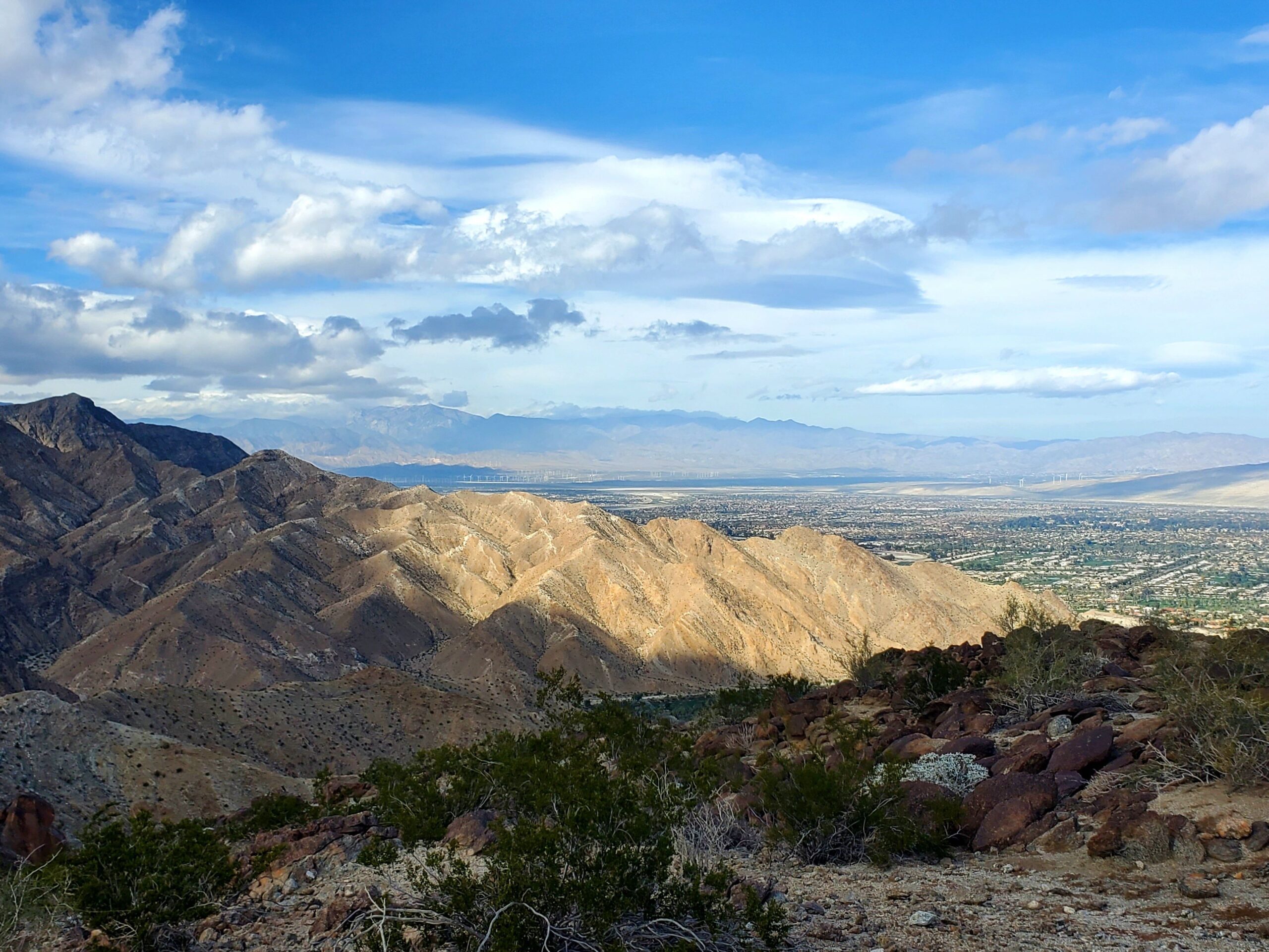
The valley lies shimmering below. A patchwork of green and brown bisected by Interstate 10 and framed by looming mountain ranges that invoke the saints: Santa Rosa, San Jacinto, San Bernardino. I try to locate the traffic circle and the old Hispanic neighborhood, but it is impossible. As impossible as trying to locate my own house in those clusters of green, in one of the ubiquitous gated communities with a golf course and manicured lawns. On the other side of the highway, the green thins out where land is cheaper. The houses surrounded by mostly sand and scrub. No fairways to mow and yards to prune, and the thought takes me to Rosales. For the first time, I find myself wondering where he lives and how long it takes for him to drive home.
A runner appears at the lookout. Flushed and panting, he gives me a look that says we should both know better. I should know better.
I was last on this mountain with my husband. We had reached the top and sat gazing out at the Little San Bernardino Mountains, making plans for growing a family as newlyweds do. One child—no, two! A race against my clock, but not impossible. The empyrean seemingly within touching distance. Giddy with possibility, we threw our heads back laughing, covering our faces with sky.
The runner does some stretches, then nods my way and leaves, the crunch of his footsteps becoming fainter. I walk over to the precipice and watch him descend the switchback until he recedes from view.
My water is low, and I should follow, but first I walk over to a large, flat rock and sit and lean back, looking up at the expanse of blue. It is the same blue as the bottle of blue pills. A different blue than the flashing blue ambulance lights. There is no sky big enough to cover my shame.
On my descent, the Valley contracts, distorts, shifts closer. Halfway, strips of gray morph into multi-lanes, and my eyes track the lines of moving cars that look so small and in a hurry. For the rest of the way, I force myself to look at my feet, until the cars (at last) are bigger than me.
When I get home, I ignore my phone’s notifications. The idea comes to me to check the Lost and Found Pets group pages on Facebook. When my husband calls me, frantic, from his conference hotel—Hon, why haven’t you returned my calls? We agreed—I tell him I overslept, and his silence tells me he’s disappointed. I don’t tell him about the lost dog or mention the trail. I do tell him that I feel different, and he asks if that means happier. The desperation in his voice makes me sad.
After the call, I continue scrolling. Lots of posts. Lots of comments. Commenters chastising an owner for losing their pet or berating a finder for taking the animal to a kill shelter. There are volunteers who band together to look for lost dogs. It’s a thing. Some do not comment but “like” a post or give a care emoji.
Then, I see it.
The post is three days old. A photograph taken in a kitchen. A large, modern kitchen not dissimilar to mine. The dog is looking up at the camera with that same unfathomable expression. A gray coat with silver strands. A collar that looks red to me, partially obscured by the dog’s fur. I read the post:
June Von P.
3d
My rescue ran away. Last seen in Desert Mirage Country Club.
There’s a telephone number. I check for comments. None. It passes through my mind that this is unusual. I start to feel anxious and, despite the heat and my sore legs, decide to go for a short recovery run.
On my run, I see Rosales standing next to his truck, holding a leaf blower. I slow to a walk and lift my hand to wave, but at that precise moment, Rosales dips his head to start the motor, the brim of his hat coming down on his face like a shield. I feel relief, but he suddenly looks up. His gaiter under his chin, his features in shadow. An older man, with a neatly trimmed moustache and a dimpled chin.
I wave. An awkward wave, as though pushing him away. But he nods my way and raises his leaf blower in acknowledgement, then goes to work.
I will have to do better next time.
Back home, I drink water, then dial the number. I imagine June Von P. compulsively checking her Facebook post, longing for her phone to ring. Sleepless nights, blaming herself for a door left ajar or an unlatched gate. Now, a chance for her to turn back time. It is all I can do. The enormity of the moment threatens to overwhelm me. My fingers keep tapping the wrong keys.
“June.” Sharp. A woman’s voice. Laughter in the background. It sounds like a party.
“Hi, June. I saw your dog. I was—”
“Hold on,” she says. The sound of a phone brushing against something. Then an older man’s voice, muffled: What, darling?
She comes back on. “Are you sure it’s my dog?”
I tell her what I saw.
“Aha,” she says. “Aha.”
“I can help you look,” I say, thinking of those group volunteers, “but we would need—hello?” More laughter in the background. “Hello?”
“I’m here,” she says. “Look, you’ve caught me at a bad time. I can’t talk now. I’m at a Celebration of Life.”
Maybe June Von P. mistakes my silence for understanding, because she hangs up. I stare at my phone for a while, then Google “Celebration of Life” to double-check the meaning. All I know is that her dog is alive. Surely that is cause for celebration?
Your dog is alive, I say out loud, replaying the conversation as it should have gone. Your dog, I say, louder, insistent—and then it hits me: I had not asked for the dog’s name, as she had not asked for mine.
Pretty name. The woman planting succulents has popped into my mind. Gracias, I answer. Then she transforms into the old woman, her eyes searching mine as her grandson translates my need to find the dog. The full weight of her understanding, I now see, in a bowl of fresh water for a dog that may or may not appear. For my tranquilidad, I murmur. I pick up my phone to call back June Von P., but instead look up the Spanish word for grandson.
It is rush hour when I reach the traffic circle, the island appearing and disappearing between the cars. I park farther up, and lug my duffel bag to the intersection. On the sidewalk of each corner, I take out a soup bowl and set it down, filling it with ice-cold water from my running bottles. I catch the curious looks of revolving faces.
Back behind the wheel, I drive slowly through the old neighborhood, pulling over at intervals to let other cars pass. A tricky maneuver in these narrow, twisty streets.
The blaze of sunset gives way to a dreamy, periwinkle sky of fables and fairy tales. But darkness is imminent. The blue hour transposed. For a panicked moment I am disoriented but then recognize a front yard. A garden spotlight shines on a papier-mâché piñata that hangs from a basketball hoop like a unicorn moon.
Up ahead, soft light emanates from the house with the yellow door. The ceramic bowl is still on the sidewalk. I stop and lower the car window. A faint smell of cooking wafts in. I conjure the old woman making supper for her nieto.
I drive on, sensing the park is nearby. On Cachanilla, I pass the yard with a fresh border of succulents. The house is in darkness. But wait! Something is on the lawn. A solid, gray shape. A sleeping… but no. It is only a bag of potting soil. A trick of the failing light.
When I arrive at the park, a woman is pushing a child on a swing. They are in silhouette. The child squeals with laughter; beautiful, and it pains me.
I call across. “Did you see a dog?”
The woman shakes her head.
This time, I don’t make a shape with my hands or describe it. I have thought long and hard about the dog’s expression. My rescue ran away.
Over by the bench, a streetlamp illuminates the palo verde and it shines like a dandelion sun. The man is not there, and the shopping cart is gone, but the bottles remain, glittering in the scattered light, and inexplicably this gives me a measure of comfort. I take out my neon running shoes and place them at the end of the line. I sit for a minute, watching crows—noisy as ever—fly from palm to palm. Inkblots across a dissolving sky. How still, then, the lone barrel cactus, as I walk over to it and set down a soup bowl, filling it with the last of my water. Then I slowly walk back to my car, looking back, eyes alert for a lost dog.
I know it’s silly, but I find myself calling, Buddy? Buddy? Buddy?
Juliet McShannon is an emerging fiction writer. She is a graduate of the Warren Wilson College MFA Program for Writers and was selected as a Luso-American Fellow for Disquiet International. Her writing has appeared in the New England Review, Five Points Literary Journal, The Guardian, The Independent, The Star, and elsewhere.