Many fiction writers aspire to mastery of the short story form. From commercial offerings such as the “MasterClass” online series to college curricula, we are taught techniques to create a strong character and a plot leading to a resolution. The goal? “To uncover a single incidence or series of linked incidents, aiming to evoke a single effect or mood from the reader,” as phrased by Sughnen Yongo writing for Forbes. I’m convinced that this conventional attitude that expects singleness from the short story is selling it short.
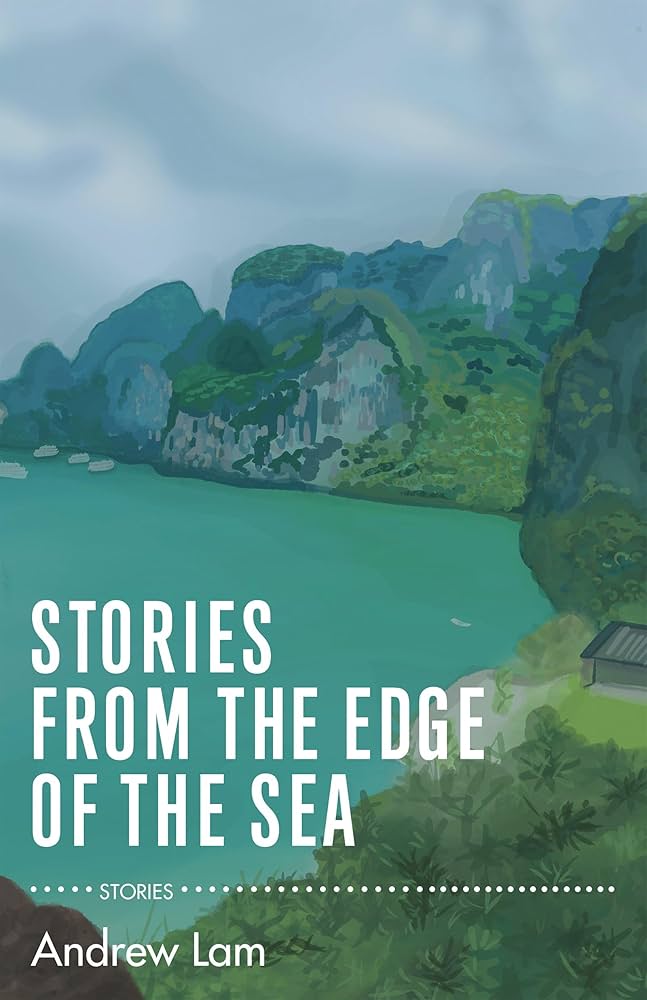
In his latest collection Stories from the Edge of the Sea, Andrew Lam delivers work far beyond that narrow definition of the form. The settings are complex. Even a five-page story can encompass several decades of a character’s life. Though many pieces focus on a single protagonist, often the cast of characters is big enough for a multigenerational saga. Sometimes, the perspective shifts unexpectedly from one character to another across time and space, and in other stories a first-person narrator’s voice that begins a story disappears and the story continues in the third person, as though looking over the shoulder of the earlier first-person narrator. The emotional effects of these fourteen stories are layered; they leave us with no easy truths, but push us away from stable shores into the stormy seas of human experience.
Love and a sense of fundamental human aloneness are the two great themes of Lam’s collection, his fourth book. As in his earlier books of essays Perfume Dreams (2005), East Eats West (2010), and a work of short fiction, Birds of Paradise Lost (2013), Lam sets the stories in the Vietnamese-American diaspora. Here, diasporic characters are shown to be in constant dialogue with artistic, ritualistic, and creative practices across different cultures, often in search for recipes against heartbreak and the encroaching sense of disconnectedness between people in the modern world.
The dialogue with ancient practices begins in the foreword set in Laos, where the author recounts a soul-retrieving ritual he had once witnessed. A shaman and a group of dancers ceremonially kill a rooster in an attempt to cure a woman who is believed to be sick because the man she loved suddenly died. The author reveals that he, too, is struggling to heal after a heartbreak. How much does the ritual help? The author’s local guide suggests that whether or not the magic is real doesn’t matter because “it seems to make everyone feel better. That’s all you can do, right?” The author offers us the book in a similar healing gesture. “I’ve got no magic spells [to heal heartbreaks],” the author tells us. “All I’ve got is my imagination and the desire to tell stories.”
This opening narrative frames the collection and sets the pattern: trying to move forward in recovery from grief, trauma, or heartbreak, look back at the past and aside at different cultural practices. The looking back here is neither a gesture of nostalgia, nor an attempt to find comfort. The memories of the past are often unbearably painful, and the ancient practices can be as brutal as that ceremonial killing of the rooster. But the process of looking back or reconnecting with different traditions is necessary to affirm one’s values; it helps characters discover suppressed desires and the things that are worth living for.
Lam’s engagement with different cultural narratives is often very explicit. The second story of the collection, “Agape at the Guggenheim,” beautifully evokes both Western and Eastern artistic practices as it engages with the politics of desire. A millennial-sounding narrator (“Yo Journal!”) becomes infatuated with a stranger he meets at the China’s 5,000 Years of Civilization exhibit at “the Gug.” This story would be little more than a missed connection piece, except the museum setting and the act of being looked at makes the narrator particularly self-conscious about his physical appearance and the racial stereotypes that are baked into sexual attraction.
How does a white man whom the narrator nicknames Adonis for his “alabaster skin, muscular arms, blushed cheeks, curly hair clinging strategically on his smooth forehead,” see the narrator who is here because even though he was born in Vietnam, his grandfather was Chinese? “Previews of Terracotta Warriors waiting for him on the second floor? Shy Asian boy starving for love? Brunch?” “You Tarzan, me Boy. You chisel, me scribble.” These are the epithets that occur to the narrator when he thinks of himself through Adonis’s eyes.
The narrator doesn’t make a move on Adonis, and this is the mature choice: he has been around the block, and he knows that his yearning for love cannot overcome the differences between them. The narrator’s sense of loneliness, his estrangement from his home country, his family, and his experience of moving “from one language to another, having changed my name and allegiance” destabilize his sense of self. Less explicitly portrayed is his exhaustion from, I assume, previous attempts at overcoming racial prejudice. His longing for a connection helps him achieve a better understanding of himself:
“I saw the future then, saw that this longing doesn’t end; it stays in the heart as long as it beats. And it keeps governing my grief, yet it’s also clear that it feeds my imagination.”
Though the themes of this story are echoed in several pieces throughout the collection, the missed connection feeling of it most clearly re-emerges in “Muni Diaries: Sex on the Bus, Love Down the Avenue.” Though this story is placed much later in the book, second from the end, an encounter with a white stranger it describes reads like backstory to “Agape in Guggenheim.” This episode occurs in San Francisco, as the narrator, still in his twenties and uncertain of his sexuality, is cruised by a “Hot Guy.” “Hot Guy” rubs himself against the narrator on a crowded bus going toward San Francisco’s Chinatown, whispering “Yum […] Salty . . . Sweet” into his ear. The man then disembarks, leaving the narrator with “irrefutable self-knowledge” that he definitely prefers men.
“Muni Diaries” is a complex, intricately woven story, that develops both forward and backward in time, as it connects the adult narrator who is breaking up with a long-term partner of four years to himself as a teenager, experiencing both sexual desire as he witnesses a friend masturbate, and the rush of first infatuation as he watches his best friend sleeping. A whole lifetime separates those moments, packed with experiences of coming out to himself, becoming a lawyer and also an exotic dancer. Alongside these experiences, there’s a list of books. As a teen, going to visit his friend, the young narrator is reading The Old Man and the Sea, and later he writes an essay “about man’s determination: the willpower and sacrifice needed to get what you desire, despite everything.”
He gets an “A” in his English class, but his later life challenges that notion of willpower and its usefulness in fulfilling one’s desires. Decades later, on a bus after his breakup, the narrator is carrying a stack of books he’d left at his boyfriend’s place and now has to take home: Marquez, Didion, Nabokov, Baldwin, Ishiguro, McEwan, Ondaatje. It’s a great list, but it seems that none of these Western literary classics can provide solace to the narrator, disillusioned by life, at the moment of heartbreak. What seems to help in that moment is another chance encounter: a Black teenager on the other side of the aisle offers the narrator a napkin to wipe his tears. Grateful, in exchange, the narrator hands the young man a book: One Hundred Years of Solitude. “Man, that’s a long, long time to be lonely,” the young man says before exiting the bus.
Works of literature in this story act as breadcrumbs. They allow the narrator a connecting thread, however thin, to other human beings, who may not share his experiences but do share his desire to overcome loneliness. Other stories, including “Bleak Houses” and “What We Talk About When We Can’t Talk About Love” invoke romantic plots in Western literary tradition to promptly complicate them when Vietnamese gay protagonists, ravaged by their traumatic immigration journeys and cultural expectations unsympathetic to fulfillment of desire, find themselves unable to approach the language of love. “To show [. . .] love is the same as hurting the person you love when you’re gone,” as Lam puts it in another story.
Elsewhere in the collection, Western art and literature play a far more sinister role. In “This Isle is Full of Noises,” in a cruel trick at a campus party, a frat boy recreates Van Gogh’s self-portrait using a real ear he’d bought from an unhoused vet. Lam gives us the back story of how during the Vietnam War this vet—then an American GI—cut an ear off a dying Vietnamese teen to take home as his wartime trophy. The frat boy seems to intentionally design this trick to trigger his rival, the protagonist of the story, a biochemistry student from Vietnam, Cao Le Y-Bang who goes by the nickname of Koala. The frat boy, dressed as a wizard, further toys with Koala’s sense of identity by telling him, “Well, slave, what bethink thee of my charms?”
Couched in cruelty, Western art is particularly destructive. But Lam shows that a concept that comes from an Eastern tradition can also become bizarrely thwarted by its encounter with the West. In the centerpiece of the collection, “To Keep from Drowning,” a Vietnamese mother Nhung who is sick with lung cancer and doesn’t have a hope of recovery takes her three school-age children on a picnic to a beach in San Francisco. The idea is to perform a Buddhist ceremony on the beach, and as she comes to the end of her journey, Nhung repeats: “Ohm mani, mani, mani, pedi, pedi, ohm.” She traces her cancer to the nail salon where she has worked after immigrating to the US, and the phrase is “both a joke and a prayer.”
“How many hands and feet had she scrubbed, washed, massaged, and how many nails painted, this last decade? She couldn’t possibly know. Thousands, surely.” And so a Buddhist mantra becomes itself cancerous with overwork and toxic fumes.
Ancient traditions alone cannot help immigrants survive and thrive in the United States, but they are also not entirely powerless. By skillfully shifting storytelling perspectives in this story, Lam shows us that Nhung’s children see her struggle and her prayers for them, and though young and immature, the children are finding ways of caring for each other that she couldn’t have anticipated. So Nhung’s bizarre prayer strangely achieves at least a part of its purpose: her children see her sacrifice and they will carry on her love for them. As in Lam’s foreword, the ritual, no matter how bizarre, does make the family feel better.
Of various artistic practices and ancient traditions, perhaps the most promising Lam offers us in terms of its potential for healing human bodies and spirit is soup. An early story in the collection, “A Good Broth Takes Its Time,” showcases the personal and cultural significance of a soup recipe when a Saigon restaurant owner reacts to the sound of bombing by dictating to her daughter a pho recipe.
“Get pen and paper. You should have memorized it by now, the way you devour poetry, but I know you haven’t. And may Lady Buddha Quan Yin protect us all,” the mother says. This soup recipe is at least as important as poetry and religious ritual. Soup, in fact, proves here a far more effective recipe against loneliness than novels.
In this story, a pho recipe connects people whose lives, disconnected by the war, have taken the most circuitous routes. From Saigon to a Belgian castle, to San Jose, California, to a scientist’s colony at the edge of Antarctica, people dream of sharing the most perfect bowl of soup. “To make pho, be of many minds. […] The broth demands constant care, for without it, my dear, you have nothing.”
Soup, like art and literature, is not a universal cure against all ills. In “Love in the Time of the Beer Bug,” a COVID-era story, a teenager stuck at home because of quarantine witnesses his parents’ bitter fighting. At the scariest moment, his mom throws a pot of pho at his white dad who told her that he never liked her “Vietnamese cooking.” Here, soup, too, like other cultural and ritualistic practices becomes “too heavy to carry.”
Nevertheless, in the concluding piece of the collection, a personal essay “The Tree of Life,” that Lam first wrote as a eulogy to his mother and that first appeared in World Literature Today under the title “To Feed, to Nurture, to Protect,” Lam lands on soup as the most grounding of human activities. In describing his mother’s life path of going from poverty to wealth to helping others to caring for her family, he shows how her soup-making combined everything from an artistic practice to love language to a spiritual ritual to a daily meal:
“War and death and sadness didn’t own her. She, in many ways, owned them: she was always an active agent in the face of calamity.
That is to say, she was busy making soup.”
I find it very satisfying that in a book about the complexities of sexual attraction, desire, and love, as well as human aloneness, exacerbated by traumatic history, we find ourselves not only engaged in a dialogue with different artistic and cultural practices, but also, at the same time, carrying away an intricately described sensory taste and smell of soup. Great books and works of art can ground us and help us rediscover our sense of selves, and great soup can do that too—at the same time as nourishing our bodies.
Olga Zilberbourg’s English-language debut Like Water and Other Stories explores multicultural identity, bisexuality, and immigrant parenthood. Zilberbourg’s writing has appeared in Narrative Magazine, World Literature Today, Electric Literature, Lit Hub, Chicago Quarterly Review, Confrontation, and elsewhere. Born in Leningrad, USSR, in a Russian-speaking Jewish family, she has published four books of fiction in Russian. She lives in California where she co-facilitates the San Francisco Writers Workshop and, together with Yelena Furman, runs Punctured Lines, a feminist blog about literatures from the former USSR. She is at work on her first novel.