By RO SKELTON
The first apartment that I lived in in Dakar was brand new and backed onto the far end of the airport runway, so that from my bedroom window I had a distant view of the ocean and of a vast baobab tree silhouetted against the hazy Saharan sky. The neighborhood––modest two-story family homes and the occasional new building like mine––was as far out of town as taxis would go, and even then they would refuse to take me the whole way, grumbling as they dropped me at the entrance to the neighborhood, so that I had to walk the rest of the way to my apartment along a potholed, sandy road.
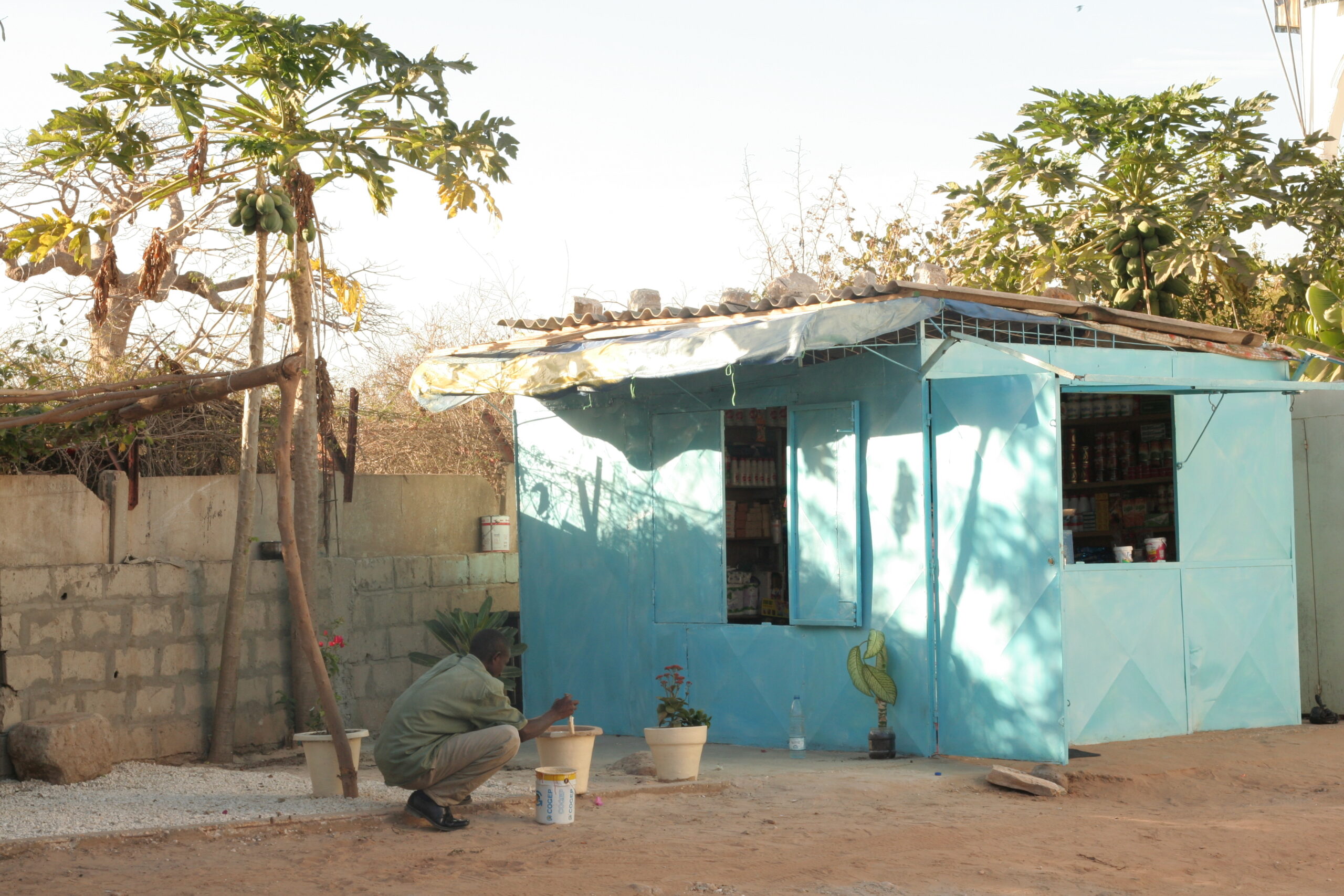
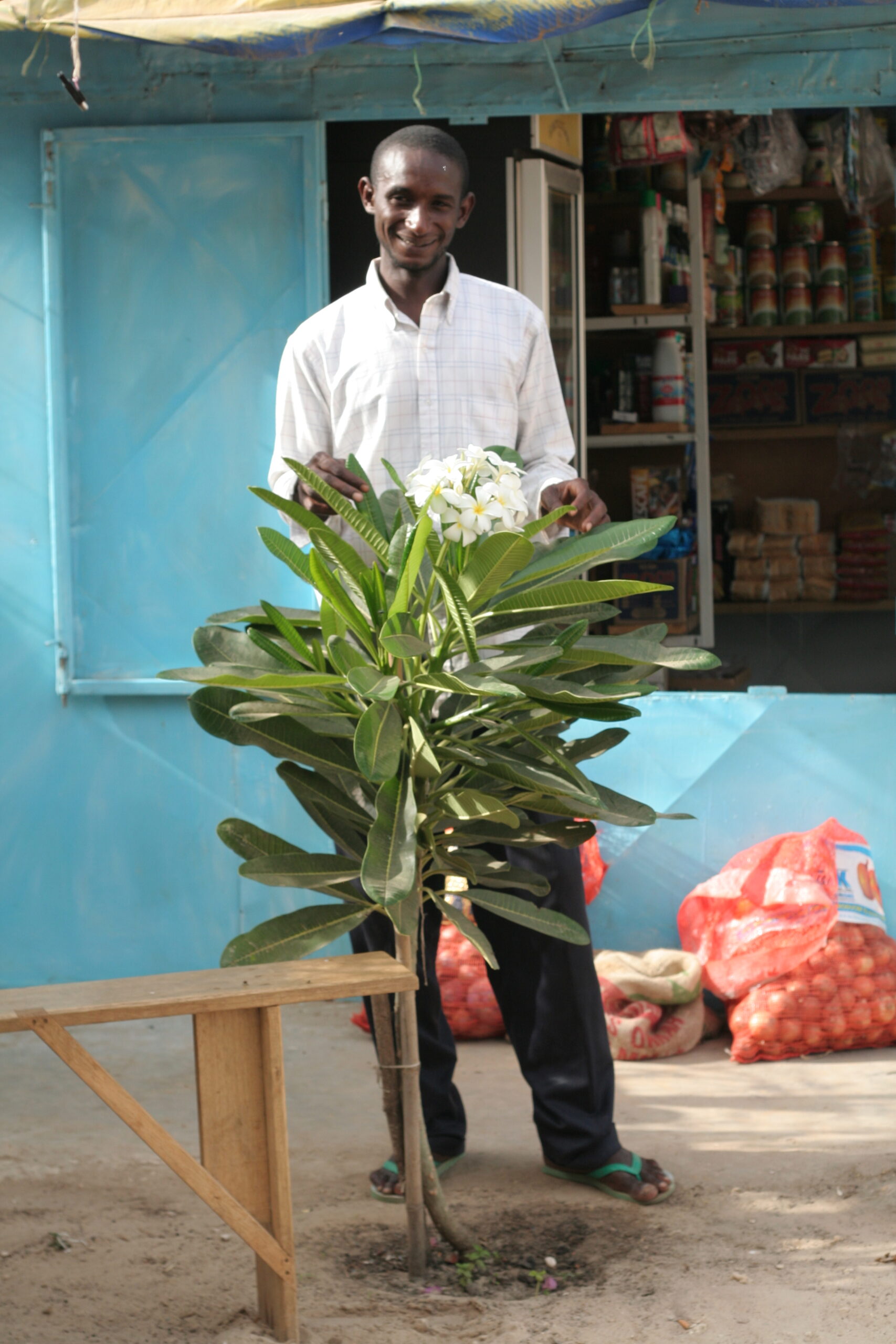
From my apartment’s narrow balcony, I could see a turquoise metal cabin––what was called a boutique––with a roof made from jumbled sections of corrugated metal and a hatch propped open to the street. The boutique measured six feet wide and the same deep, and sold items piecemeal: teaspoons of Nescafé, single segments of baguette, individual sachets of laundry detergent. After I had been living in the apartment for about a month, I slipped on my flip-flops and walked down the sandy street to the cabin, where a tall man about my age, twenty-four, greeted me with a wide and impish smile.
“Bonsoir Sokhna-ci,” he said in a mix of French and Wolof, and I noticed that, along with giving me a formal greeting of respect as a “Sokhna,” a noble lady, he also wore a smart pressed shirt and trousers with a crease down the middle. Even his leather shoes––which I knew to be secondhand because back then only the rich who travelled to France or America had access to such things new––were polished.
“Salaam aleikum,” I replied. “Lu dekha-bi wakh?”
I had learned obscure Wolof phrases like this one––literally, What is the neighborhood saying?––by interviewing rappers and haggling with taxi drivers, but often, when I deployed them, people were so excited by me, a foreigner, speaking their language that they would switch to French, asking me where I learned Wolof, where I was from, and wondering if I was married. But this man at the boutique, whose name I discovered was Naow, didn’t flinch. I bought one cigarette from him and then leaned into the cabin so he could light it, his long, slender fingers striking the wheel.
In the cool evening air, we stood for a while and talked about Casamance, a region in the south of the country, bordering Guinea-Bissau to the south and The Gambia to the north, where he was from and where I had lived for a while before coming to Dakar. I attempted to assess what was different about this man. He spoke with a formality that matched his smart attire but seemed at odds both with how I was usually treated as a single white woman, especially one who smoked, and with the surroundings in which we found ourselves––a makeshift cabin in a not-yet-finished neighborhood on a road that, in the dry season, coated everything and everyone in dust and, in the rainy season, was sludge. Naow was young––his face was unlined, his teeth were cared for––but he didn’t wear the kind of clothes other young Senegalese men who weren’t from backgrounds of means tended to wear––secondhand Nike tees or shirts with obscure logos and slogans that had travelled thousands of miles to the conservative Muslim surroundings in which they had ended up. Naow asked me questions about my work, where I was from, and who my friends were that showed a curiosity for me that felt completely novel, having often been treated by strangers as an exotic––and, crucially, unmarried––creature from another planet. As I smoked and he leaned against the cabin hatch, I got the sense that a hard life had not destroyed his sense of joy. To my great relief, he wasn’t in the least bit flirtatious.
Over the weeks that followed, I went every evening to sit on the wooden bench beside Naow’s boutique to smoke my nightly cigarette. I came to find out that Naow, who is Senegalese, had grown up in a village on the border of The Gambia and, every morning, had walked across the border to an English-speaking school. This meant that he and I could speak English together, which was such a balm after tiring days in which I struggled my way through two other languages, never being able to express myself entirely in either. It also meant that we had a language that no one around us could understand.
Naow had grown up on his family’s peanut farm in Casamance. I went to visit the farm once––the house was built of cinderblocks and sat in a vast yellow landscape of scrub and blooming mango trees. His father, blind by then, lay on a daybed on the porch under a tin roof that was rusting at the nail holes, almost entirely swallowed up by his baby blue boubou––embroidered Muslim robes. I don’t know where Naow got the gumption to leave that farm, because when he decided to move to Dakar, he had never left Casamance before. He didn’t speak French or Wolof, the languages he would need in the city, and he didn’t have any money or anywhere to sleep. But in the bush taxi to Dakar he met a man, a doctor, who sensed in him a trustworthiness and hunger for work and loaned him $400 to open the boutique. Once he arrived, he quickly taught himself what he needed to know, including two languages, and, using the loan, opened his shop tucked away in a small corner of a neighborhood that was just starting to grow.
A couple of years into our friendship, after I had met most of the people close to him and my mother had loaned him the money to open a second boutique, I got malaria and spent days and nights alone in my apartment, unable to get out of bed even for a drink of water. I had moved from that first apartment by then and was living downtown, and every evening, after Naow closed up the shop, he came to my place and lay on a mat on my bedroom floor, piling quilts on top of me when I awoke shivering, dabbing my head with a cold washcloth when I cried that I was burning up. When the fever got worse, he took me to a doctor, who, assuming Naow was my husband, asked him to stay when he pulled down my underpants to give me a shot in the behind. Even in my misery and pain, we laughed about it, Naow covering his eyes and looking away while I took the injection. In the taxi home, bumping along potholed roads, he held me, stiffly, to his side.
I wasn’t new to Dakar. I had first come as a student from London to write a dissertation on the Sufi brotherhood’s control of the music industry. I had spent a month sitting at vendor booths in the cassette tape market listening to Wolof hip-hop songs praising the brotherhood leaders, and the physicality of it all––it bit into the loneliness I lived with and the depression I had experienced on and off since teenage years. Perhaps it was the way in which people were constantly reaching out to shake my hand or running their fingers over the scales of my psoriasis to ask me what was wrong, or the music that shuddered out of loudspeakers in bus garages and nightclubs. Maybe it was being woken every morning at dawn by the crackling of the mosque’s loudspeaker and the muezzin’s voice that called us all to prayer. In Dakar I was no longer alone as I had been in London, waiting for a friend to knock at my door or a stranger to greet me in the street. In this sand-blown city there was always someone I could crack through a bag of peanuts with or an offer to squat on the floor of a tailor’s shop and scoop spiced rice with our hands, invitations to midnight dance parties in the street where the drummers beat the skins with acacia sticks until they splintered into the night air, or an offer of company home from the bus stop for the sole reason of not having to do it alone.
By the time I moved to Dakar a few years later, I was twenty-three, newly graduated from college, and knew––had known forever––that writing was going to be my life. In the meantime, I figured, I could be a journalist to make some money, a move I grossly underestimated and that would engulf the next thirteen years of my life. For the first year or so, I house-sat for expats, camping in empty houses and living off omelettes and rice. Then, as I began to get more work, I moved to the newly built apartment at the end of the airport runway. That was where Naow became a daily feature of my life, as I passed his boutique on my way to the telecentre to fax newspaper editors in London, Boston, and Sydney with my ideas for articles, walking to the bus stop to interview someone or, later in the day, heading out to hear a band play in a nightclub.
Naow was always there. In the hot summer months, he would be sitting on a cinderblock in the shade of the cabin, catching whatever breeze blew in off the ocean. In winter, he would huddle inside the boutique, the thin metal walls shielding him from the dust storms that came in from the Sahara Desert to the north. There were always people with him, always men, often wearing shirts worn to threads though always clean, and I came to find out these were mostly men from Naow’s region in the south of the country who were trying their luck in the city but had not yet found jobs and had nowhere else to go.
“Bonsoir Sokhna-ci,” Naow would call out as I walked past.
“Salaam aleikum,” I would call back, my greeting conjuring a smile from his face so wide that his skin seemed to ripple.
“Kai tok,” he would say: Come sit. Then he would jump up, brush dust from his bench, and offer me his spot. Others sitting on the bench would shuffle along to make space for me too, each one greeting me as I settled in.
That was where I came to know the displaced characters of this growing neighborhood. Idrissa, Naow’s friend from his village, tired of university strikes that stretched for months, came to drink a cup of Nescafé at Naow’s boutique in the morning and then stayed for most of the day. Omar, a cotton farmer who had left his farm in Casamance to look for a job in the city, also came to sit, sometimes with a coin for a segment of baguette, sometimes not. Mamadou, the night watchman at my apartment building, came in the morning for his breakfast, because, other than the hallway floor that he slept on in our building, he didn’t have a home. The bonnes, the young girls who lived and worked in the larger houses of the neighborhood, who had been sent from their villages to the city to earn money, came for their single sachets of laundry powder and bread for their bosses’ children. Now they stayed a couple of minutes to flirt with the men gathered on the benches.
By the time Naow’s friendship had become a daily staple of my life––about a year after moving to the apartment––the precarious life I had constructed for myself of selling articles, photos, and radio programs to whomever would take them had become too exhausting and unsettling, and I picked up a string for an American newswire, transforming myself into a finance reporter, something I knew absolutely nothing about but threw myself into with complete dedication. My life began to look more legible, at least, but now I had the added pressure of a job that required me to be available at all times and have access to a world that I just wasn’t a part of, a world of men in business and banking, all in a language––French––that I spoke like an African rapper. The headaches I had suffered through childhood and teenage years came back worse than ever in that period and lasted, often, for days, and the undiagnosed depression I had lived with on and off started to become a regular feature of my life. I didn’t have comforts at home like air conditioning or an oven, and rarely took taxis, more often thumbing down a rattly old bus while my colleagues from the other agencies drove to the expat parties in their company-supplied cars. To get the internet, I hung my laptop off the balcony, connecting to my neighbor’s signal across the street. Comparing myself to the established reporters I knew, my life felt precarious and scruffy.
At Naow’s boutique, I had another life, one where being precarious and scruffy was the norm. In the morning I would take my coffee down the street and sit on the bench, enjoying the cool of the morning as Naow’s customers drifted in from their rented shared rooms around the neighborhood. There was always a jerrycan of water available, which those who didn’t have bathrooms would use to wash their faces or clean their sandy feet in the derelict space beside the shop, and the air was punctuated with the sound of men clearing their throats and noses into the sand. If I was there in the afternoons when trade picked up, I would serve alongside Naow, surprising his customers who had never even seen a white person speak Wolof before, let alone use the kind of slang I had learned on buses and in recording studios with my rapper friends. On the metal counter I would pile one person’s shopping: six onions, five hundred grams of rice, one head of garlic, one stock cube, one serving of peanut oil that I poured into a plastic bag from a can, spinning the bag around with my finger to tie a knot in the neck. When Naow’s shop expanded and he moved in an antique fridge, flipping the lids off Coke bottles became my job, until the fridge gave me an electric shock so severe that it flung me out into the dirt road, something I didn’t risk again.
When I was enfolded in the world that Naow had built at the boutique, I wasn’t thinking about the pressures of my own life: my work that never got any easier or more stable; my boyfriends who cheated on me or moved away; my parents, who seemed doubtful that the life I was living was a legitimate one. And when I was entering or on the other side of one of the depressive episodes that I hid from everyone, including Naow, believing, as I would for another twenty years, that this was just another thing I was failing at in my life rather than an illness that I had no chance of overcoming alone, the company of the boutique could slow down the progress or speed the recovery of the attack.
Naow was a good and patient listener, and I talked to him about almost everything. We were able to forget, perhaps through the dailiness of our interactions, that we had almost no intersecting life experiences, no shared educational background, no religious commonalities, no specific life goals that we could nod our heads to in understanding. I had no intention of getting married or having children, and he had already done both. But, looking back, we did have things in common that brought us together, and they were things that surpassed the daily or the material. We were both outsiders to the worlds we had found ourselves in in Dakar, and we were outsiders to the worlds we had come from, too. We would chuckle about the things that happened at the boutique, the way Senegalese men and women were always hassling me about why I wasn’t married or having children, and could talk about our parents’ expectations, how they made us feel when we were failing to do what they wanted for us in our lives. In the world of the boutique, Naow created a place for himself and for me, a place where we always had company, as well as for the lost and lonely people of this neighborhood who had failed to find jobs in the city, who were homeless, hungry, or hadn’t seen their children for months or even years. For the displaced, dispossessed, or plain bored, this modest boutique, with its rows of canned foods, cellophane slips of hair weave, and single cigarettes, became a place for all of us to call home.
Naow and I have been friends for twenty years. He’s back in Casamance now, living in a small town surrounded by forest close to the Guinea-Bissau border, and has a plywood shop in the market selling phone accessories and television remote controls. Through the month we send voice notes and talk once or twice. Last week he texted me a Tik-Tok video wishing me a happy end of Ramadan. I send him photos of my son, or my garden; he returns photos of the progress on his house, which he has been building for the last ten years. He’s keeping chickens in a shed to sell at Christmas. When his father died, he wrote to tell me, and then when his mother died too. When he married, when he divorced. This week he told me the optometrist diagnosed him with cataracts––he’s been struggling to see for some months and only just got to see a doctor. I will send him some money, because I’m sure the surgery is astronomically expensive. This has been the only relationship with a friend in Senegal who is less well-off than me that has been financially easy. I send him money occasionally when he is struggling with something big, and he never asks.
Another part of our relationship that has been blessed with surprising ease is its reciprocal platonic-ness. This is one of very few friendships with men that hasn’t devolved into a lopsided romantic complication. Even though I am now married to a woman and was always attracted to women, I am also attracted to men and did, back then, mainly date men. That is how Naow knew me––as someone who dated men. But the attraction never extended to him, and as far as I know, it wasn’t directed at me either. In a country where sex and flirtation is an important currency, where men and women seldom socialize together, and where the majority of my male friendships ended for this reason, it is stunning to reflect on the fact that, with Naow, I have always been able to love him unguardedly.
I never discussed with him the fact that I was attracted to women. I didn’t discuss it with anyone. I didn’t know where the queer women in Dakar were, and I’m sure if I had made an effort I could have become part of the underground network of queer foreigners that surely exists that would have brought me into contact with them. But I was also happily dating men, so I felt no need.
I was also, at that time, surrounded by a vitriolic hatred of gay people that I didn’t fully take in, exactly, because I wasn’t so sure that it was directed at me, but that I witnessed daily––on the radio, in the streets, amongst friends. I remember sitting inside a rattly old white bus when a slim-framed young man with kohl around his eyes tried to board at the back. The conductor, a skinny lad with oil-stained jeans, took a length of rubber and began to beat him with it until he fell off the back of the bus, skidding in his flip-flops onto the road. The passengers let out a sigh of relief.
The hatred was particularly directed at men, perhaps because no one could imagine a woman having the agency to choose her own romantic destiny. I heard Muslim clerics preach about the scourge of gay people. I covered court cases in which gay men were jailed for life for having been “discovered,” the public rejoicing as if they had been found giving each other blowjobs in the street, when in reality they had probably been ratted on by a suspicious neighbor. I listened to comments made by smart, well-travelled Senegalese friends and boyfriends who believed that homosexuality was imported by white people to spread HIV/AIDS and kill Africans, conversations I chose not to engage with, so overwhelmed by the ignorance and hatred that I could only pretend it wasn’t happening.
I never heard such a discourse from Naow, and we never discussed it. But if I had to have guessed at the time, if I had to say whether Naow, like almost every Senegalese person I ever encountered, wanted gay people to rot in jail, I might have said that Naow wishes harm on no one.
Twelve years into our friendship, in 2017, I was in my new girlfriend’s bedroom in a Brooklyn apartment, sunlight streaming through the high windows of what had once been a hospital. She was lying on the bed next to the desk where I hovered my mouse over the Skype button, willing myself to call Naow. Nomi and I had met at grad school a few months earlier and, despite barely knowing each other, were planning on spending our lives together. Naow had seen a photo of us on Facebook and commented, “jolie,” meaning nice or pretty––I had no idea how he meant it in this context, if he knew.
“Allo?” he said, his face clicking into view. We caught up, me asking him about his family, him asking me about my work.
“I have something to tell you,” I said, knowing there was no point in prolonging it. It was a risk to tell him, but this was the one friendship in which I couldn’t not be myself.
“The photo you saw on Facebook,” I said. “I love her.”
Naow let out an awkward laugh. “Okay?” he said.
“Je l’aime,” I said. I love her. He laughed again.
“Bouga-na la,” I said, this time in Wolof. “Di na ko takk.” I am going to marry her. As the words formed in my mouth, they surprised me too.
I could read nothing of Naow’s expression. He giggled again, something he does whenever he is nervous, happy, or shocked. After a long pause, he spoke.
“Are you happy?” he asked.
“Yes,” I said.
“Well, then.”
The community garden on the derelict land next to Naow’s boutique was my idea. I had seen this once before, in London, where my neighbor Sim had grown cherry tomatoes in an old bathtub and trailed them up the front of his shared house. One summer morning I had watched the kids from the local housing estate stop to pick tomatoes, gobbling them as they made their way toward the school. Sim, who was halfway up the front of the house, pruning, climbed down and split open a tomato to show them the seeds inside.
The unfurling of the fruit and the revelation of those seeds stirred something in me. I knew this work––I held it in my bones. Long before my parents’ divorce, before boarding school and the dissolution of the farm that I had grown up on, I worked alongside my mother in her herb garden, where she tended to an acre of land filled with edible, medicinal, and rare plants. People came to visit the garden, and she was always there, bent double, her hands working with the soil. Sometimes she had help in the garden, a woman named Tillie, and once I saw Tillie’s bosom squirm where she had put a tiny rescued vole in her bra, intending to relocate it later.
From the moment I was born, I spent time in that garden, and when I could walk, my mother had a job for me. “Walk on the lawn,” she would say, and I would make my way to the center of the garden, where there was a soft green patch of chamomile with a sundial at its core. Laying one bare foot on the chamomile and then another, I pressed the plants low to the ground, so that they grew forming a fragrant flowering carpet. The scent swam beneath my feet.
When I suggested a community garden in the derelict space next to his boutique, Naow shrugged his shoulders: What good reason was there not to? At that time there were no public gardens in Dakar; in a country struggling to feed its population, the idea of using land for pleasure was unheard of. But Naow understood that something more could be done with this land. Perhaps he sensed that I needed it. Either way, we set to work.
The ground was sand and stones and sat inert in the shadow of the airport wall. A long chunk of concrete and rebar occupied most of the space. It was nothing like the chalky loam I had first gardened in on that farm in England. It didn’t rain in Dakar from one year to the next––it pelted rain in July when the weather began to get hot––but that was about it. I wasn’t sure how to get anything to grow.
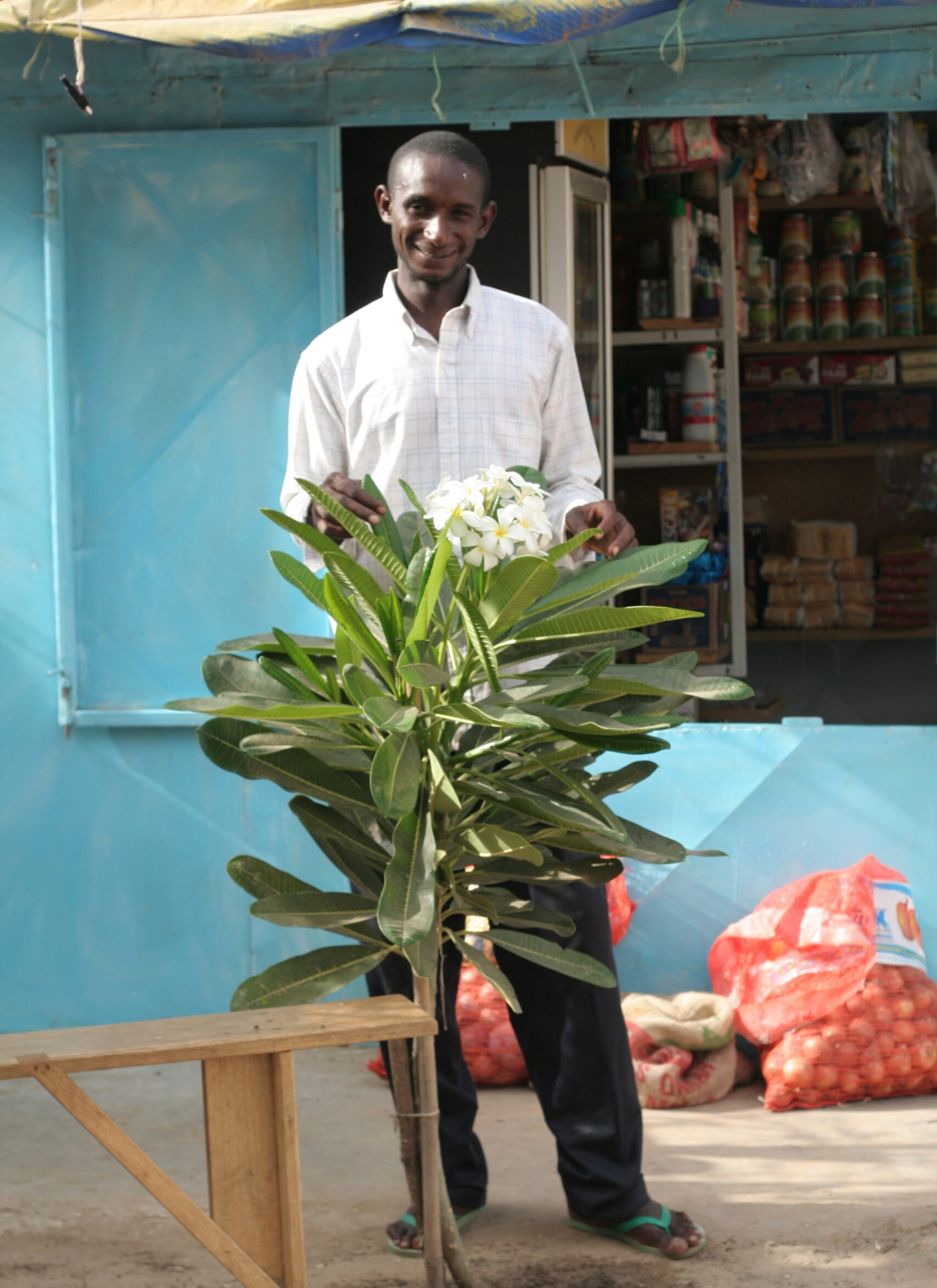
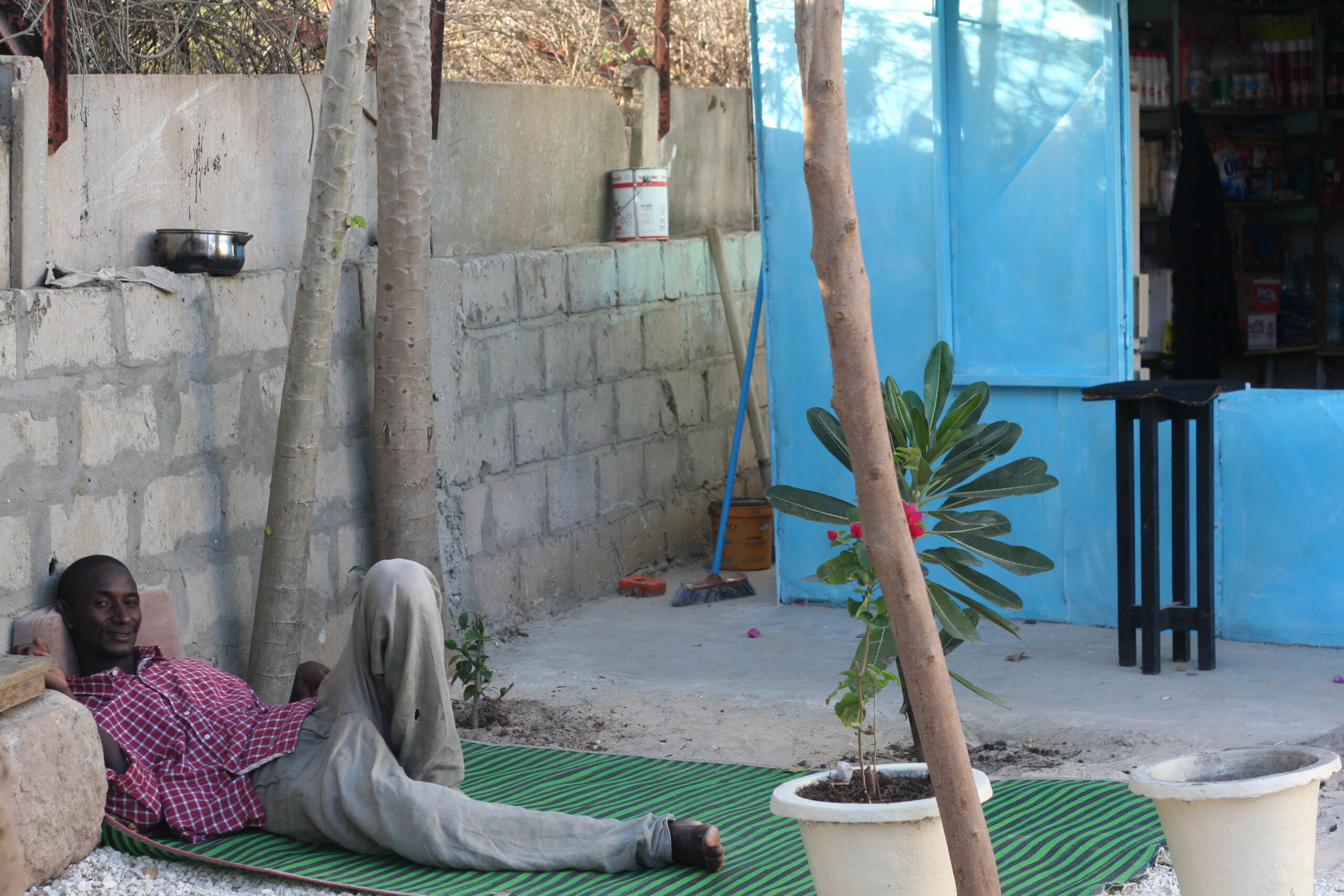
But Naow is a farmer used to working in adversity, and he and I set about creating an environment out of the nothing that we had. We cleared the area of debris, then planted a small frangipani tree that had outgrown a pot in my apartment. We set a bougainvillea into the ground, a thorny climbing plant with crimson, papery leaves, and Naow found materials to build a trellis, long branches cut from a tree and a crisscross of poles atop the verticals. We laid gravel and planted cuttings in old water containers. Come summer, and the much-awaited rainy season, the two papaya trees that had seeded themselves in the corners of the garden started to drop fat fruits on the sand below. Bats, noisy and naughty, pecked those ripe papayas when we weren’t looking.
Making use of found treasures––chunks of cement, planks of wood, three-legged plastic chairs to which we had sewn a fourth leg back on with wire––we made seats. We bought a cheap woven mat and a second wooden bench. Naow found a welder to make him a rubbish bin out of an old oil drum, the first I had ever seen in Dakar. We made a place for people to come.
And people did come––the old and the many new. I would go down with my coffee and sit with the regulars––Omar, Idrissa, and Mamadou––as the morning clientele rolled in for their baguettes and hair weave, and the starlings gathered and squawked on the telegraph wires above. Seeing the garden, and us sitting there, customers who otherwise would have taken their shopping straight back home stayed a while to chat, and we watched as Naow took their coins and then frothed hot water from a canteen into a paper cup of sugar and Nescafé, lifting the cups into the air, pouring hot chutes of coffee from one cup into the other until perfectly black and foamed. Then we would edge along the bench to make space for these new friends, one or another of us jumping up and saying, “Tog-al, tog-al,” sit, sit, gesturing dramatically to encourage them, someone making out they needed a stretch anyway and wanted to stand, so that everyone knew they had a place, somewhere to sit and consume their breakfasts.
When mealtimes arrived, a metal bowl of rice and fish wrapped in a colorful cloth would appear on the counter of the boutique, and when Naow was ready, he would call us all to eat. I never asked and never found out who paid for this lunch, whether it was ordered from a food stand somewhere in the neighborhood or if a family nearby knew that there were hungry men gathered at the boutique and sent down some of what was left after feeding themselves. Either way, everyone gathered at the boutique was included in the meal, which Naow placed on the woven mat, and we squatted around and dug into with shared spoons, making sure that everyone had enough, someone always feigning to be full after just a couple of scoops, aware that there were hungrier people at the bowl than them. At the end of the day, when the visitors to the garden had waned and I had finished my hectic day of work, Naow would roll out a mat on the ground, and I would take my shoes off, lie beneath the papaya tree, and not be alone.
That was when Naow tended to the garden, raking the gravel, twisting the bougainvillea tendrils into the trellis, picking up the rubbish that littered the floor and dunking it in the bin, something his clients were not used to doing. Then he would disappear into the neighborhood with an empty container to get water for the plants, and as the sun set on our dusty little street, and instead of engine noise the air was filled with the brackish sound of the ocean, I would watch Naow scoop water around the base of the frangipani tree, rub his wet fingers on its leaves to wipe away the dust that had accumulated during the day, bend and smell the blossoms. Sometimes he would bring cuttings of other plants and anchor them in soil too, scoop a little water into their pots, watch for new growth from the stems. And sometimes we would just lie, he and I, side by side on the mat and make fun of the horrendous day I had had, trying to fit myself into the shape of a financial journalist in a language I was learning on the job, and when the loudspeaker on the mosque began to crackle and the muezzin cleared his throat, Naow would get up from the mat, ask me to watch the boutique, and use the same bidon of water he used for the plants to wash his hands, his feet, and his face, rinsing his mouth and the inside of his nose, then prostrate himself in that garden, the prayer mat pointed toward Mecca, the garden for an instant turned holy site, a sacred space, in its way, for us both.
Skimming through my photos from those years, the garden appears periodically amongst other pictures of my life at that time. There are photos of the 2007 elections in Sierra Leone, a trip I took to Morocco, rappers in a Nigerian slum, elections in Mauritania followed by a coup d’etat in 2008. The garden appears in different forms––when the frangipani was knee-high, when we built the trellis, when the bougainvillea had grown so much that the garden was entirely shaded by a purple haze of petals. Then the pictures trail off, and photos of a particular boyfriend start appearing, and of the flat downtown where I moved when the gig at the financial newswire took up so much of my time that I had to live within walking distance of the Central Bank.
Then suddenly I am leaving Senegal altogether. It is 2009, and Naow is helping me pack up my flat. My headaches had become so severe yet inexplicable to doctors that they suspected a brain tumor. I didn’t have the kind of medical insurance I would need to investigate, and the only place of stability I had was my mother’s house in London, a place that she had always made unquestioningly available to me even if I couldn’t tell her why, all of a sudden, I needed it. I left my home, my career, my friends, and a country I adored.
My life unraveled, and so did the garden. Change in the neighborhood had happened rapidly, and more homes had gone up of the kind where occupants were shopping with credit cards at the supermarket, not piecemeal with coins at Naow’s boutique. In my absence––I was back in London by then––Naow’s boutique closed, and with it the garden. Naow moved back to Casamance. The last photo I have is one he must have sent me, of a huge pile of construction sand and gravel dumped against the trellis. The garden disappeared. Along with it, the men––including Naow––had scattered.
This past winter, I went back to Dakar for work and found myself with a free afternoon to wander around visiting old friends and haunts, the kind of luxury of time and mental space that I crave so much and yet rarely, these days, experience. It was warm out, and a yolky haze filled the sky, grains of sand under my fingernails, crusting in my nose.
I wandered toward the street where I had once lived, navigating myself from the pharmacy where I used to wave down buses, where now a high-rise stretched out of the sand. Walking toward our street, I saw that the Guinean fruit sellers were still there, and the house where I had once camped before I had got my own place, now looking dilapidated, vacant. I found my way into our little road and spotted the breeze blocks of the airport wall and the papaya tree that Naow and I used to rest underneath. As I turned the corner, ahead of me was the apartment building I had lived in twenty years ago, its ochre paint now peeled, and the small bush outside grown into a handsome little tree.
But that’s about all that remained. Naow’s boutique––long gone. The garden––a parking spot for cars. No frangipani, or bougainvillea, or trellis weaving purple flowers into the sky. Some kids played basketball in the street, and I had an intense pang of longing for my own son and, as happens to me now occasionally, the realization that while I crave time and space to metabolize my own thoughts, I do not miss this life I once had––not the one I had in this street, not the one I had anywhere.
I video-called Naow and showed him the street. “The garden,” he said. “Dem-na.” Gone. We laughed recalling the old neighbors, a woman we called Madame France, and we wondered what had happened to Mamadou, the caretaker for the building I had lived in, and Omar the cotton farmer. Naow told me he himself had got married again, to a woman called Salimata. He’s happy; his kids are fine. One of them has gone to be educated in Touba, the spiritual heartland of Senegal. He showed me the chickens he’s rearing for Christmas. We talked until my phone battery died, and then I walked back to the pharmacy, where I thumbed a bus to take me back to my hotel.
That night I ate some fish at a beach restaurant where I had gone so many times, where I used to leave my clothes and keys in a pile behind the counter so that I could swim the ocean crossing to N’gor Island, returning by the same route. One of the waiters at the restaurant did a double take when he saw me, though it’s been eight years since I was last there, and asked me if I was still swimming. I told him I’d had a son and had moved to America. I left the rest up to his assumptions––that I had had him with a man. “Bakh-na,” he kept saying, over and over again. This is good.
Ro Skelton is a writer and gardener from Scotland. She is currently working on her first book, Easement, a memoir about radical acts of gardening. Previously a reporter in West Africa and a member of an oceangoing rescue crew, she now lives and gardens on the Isle of Mull.