Curated by AIDAN COOPER
While many lounge into the soft heat of these summer months — leaning back, feet up, a cold drink in one hand — The Common’s editorial assistants have been perched on the edge of their seats, hunched over stories large and suspenseful. In this edition of What We’re Reading, interrogate boatfuls of questionable characters; restage plays sparking with historical intellect; ride alongside mercenaries galivanting in the Brazilian backlands; and balance on a tightrope of familial love above the darkness of half-remembered myth. Here, AIDAN CAHILL, BEN TAMBURRI, CAMILA MASSAKI GOMES, AMAYA RANATUNGE, and I have been reading stories that epitomize summer’s intensity: flowering with fruitful prose and hurtling by at a landslide pace.
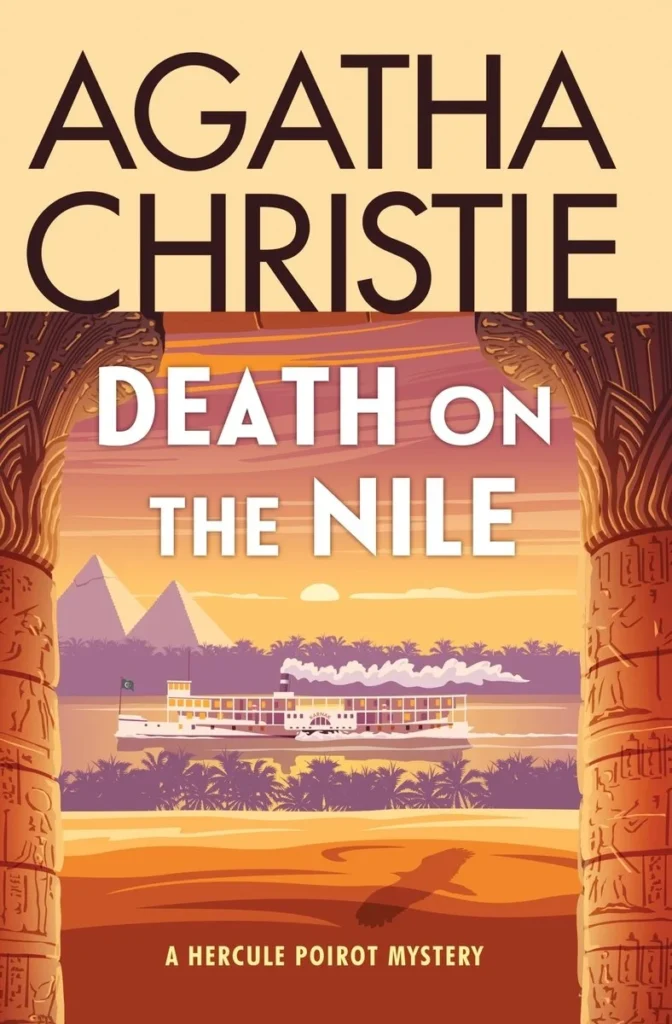
Agatha Christie’s Death on the Nile, recommended by Editorial Assistant Aidan Cahill
I was reading Death on the Nile on a porch swing just off the Floridian coastline when a sudden bout of nausea overcame me. Yes, perhaps the languorous back-and-forth rhythms of the swing had something to do with it. My stomach notoriously has a low tolerance for jarring movements — just ask the teacup ride at Six Flags. But it was also quite possibly the product of the scene I had just read. Agatha Christie has the audacity to introduce a character who is insanely likeable, develop her over the span of 150 pages, and promptly kill her off in a single devastating sentence. Only then, of course, does the narrative twist. A murder mystery kicks off, and simple guests become shadowy, secret-shrouding suspects.
It is interesting, because Linnett Ridgeway, the murder victim, is not typically considered to be a sympathetic character in literary circles. She is the classic spoiled rich girl, yet she is so endearing you can’t help but like her. She uses her power to get what she wants—would we not do the same given the opportunity? That is not to mention that beneath her demanding nature, she is a softhearted romantic, a sharp businesswoman, and caring for her friends (well, when she is not stealing their fianceés). Somehow, beforehand I was unaware that she was the murder victim in this classic novel, and I found myself devastated to read the line of ultimate finality. Perhaps even more gut-wrenchingly, the characters express little sympathy for her—a lack of mourning that suggests her wealth brought about more envy than admiration. Instead, we jolt into the “classic Christie” part: the questioning of suspects, the narrowing of possibilities, the final confrontation.
But Death on the Nile strikes me more for its opening chapters. Whereas most Christie novels open on or quickly lead to murders, Death on the Nile takes the time to build suspense. It extends character introductions, establishes motives, and perhaps most importantly, takes time to develop a sense of place. Death on the Nile differentiates itself from the usual Christie novel by avoiding England, instead choosing to wander through Aswan hotels, Saharan temples, and centrally, a riverboat cruise up the Nile. The imagery is glamorous. Even if you’re not lounging in Florida like I was, expect to be mentally spirited to a grandiose summer vacation.
Of course, Christie’s works come with controversy—here, namely how Egyptian locals are portrayed as second-class citizens, relegated entirely to the background. Her work singularly captures the country through a colonial tourist’s eye, which is important to recognize but not entirely detracting from the narrative magic. I attribute it more to the era in which the book was written than to any personal vendetta on Christie’s part, especially because her criticisms extend to the wealthy passengers on the cruise as well.
As for the murder mystery component itself, it is gripping, complex, yet in hindsight, logical—all the qualities you could ask for. Once I overcame my bout of nausea and fled to the safer confines of a living room couch, I was enchanted by how many possibilities presented themselves to me—and how they were all, conclusively, wrong. Playing inner detective is one of the best parts of any murder mystery read, and Death on the Nile does not disappoint. What I appreciate even more is the commentary on class that Christie makes. While the murderer may only be one soul, every aristocratic passenger harbors either laughable vanity or unsavory secrets. Christie does not hold back from assaulting the glitzy, polished view of high-class life that predominated the early 20th century, and even better, she uses it to bolster the complexity of the mystery. It is a lot harder to pinpoint a murderer when other suspects are lying to cover their faults. Yet while this may portray Christie as cynical to the human condition (as all murder mysteries must inherently be), I wager that there are moments when true, inner hope for humanity shines through: sparking romances, leniency for lesser crimes by the detective, the passengers coming together to work in the name of good.
All in all, a brilliant, casual vacation read—although one I recommend keeping off the porch swing.
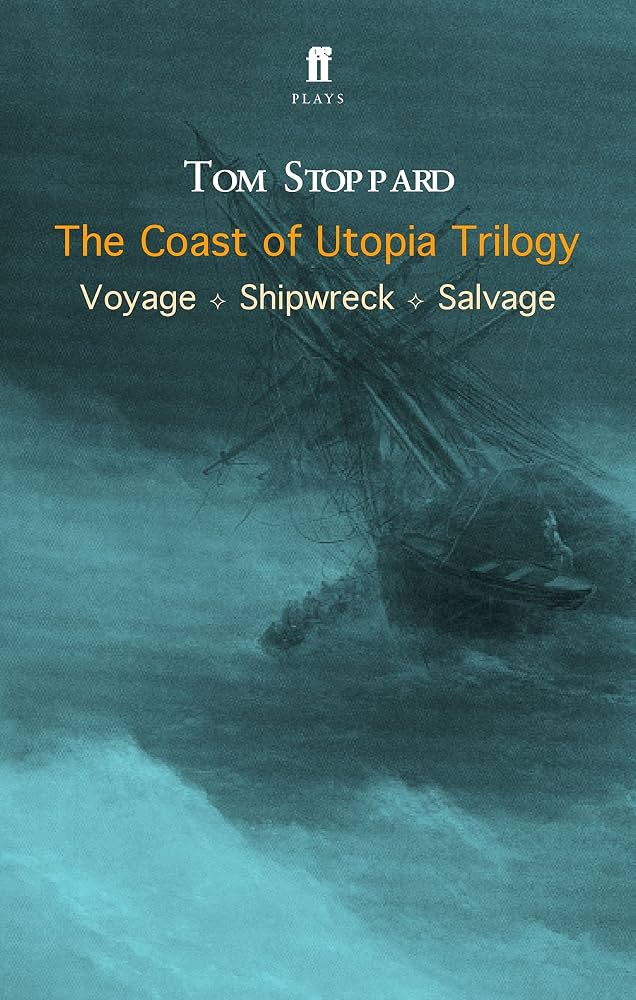
Tom Stoppard’s The Coast of Utopia, recommended by David Applefield ’78 Fellow Ben Tamburri
The central irony of Tom Stoppard’s The Coast of Utopia is that creating a utopia is only possible in an already perfect world. The circle of Russian critics, publishers, and artists that make up the cast of this trilogy of plays come to discover this as their youthful dreams of correcting history’s path away from tsarism and toward a perfect world erode and mature into the more fundamental and pragmatic question: how do we live? The plays span thirty-five years of Russian history, as this band of intellectuals exiled from their mother country navigate new ideas in a world where reason seems to fail, where there is no “solution” prescribing a perfect society or a life well-lived.
While the plays in some capacity serve as a survey of nineteenth-century ideologies, Stoppard’s focus is on the people behind these ideas and the political conditions that make a utopia so appealing. Famed memoirist and publisher Alexander Herzen helms the trilogy, as it follows his exile in Paris and London, the dissipation of his marriage, the success and then failure of the 1848 French Revolution, and the eventual abolition of serfdom in Russia. Herzen carries a cool rationalism amidst the cacophony of romantic and impractical solutions for social and political change. “If we can’t arrange our own happiness,” he declares, “it’s a conceit beyond vulgarity to arrange the happiness of those who come after us.” Championing the present, he sees the impossibility of solving tomorrow’s problems with today’s solutions. The search for utopia is, inevitably, a search for an ideal, a movement toward an impossibility, yet it’s a constant search every generation must undergo anew, must seek to approach for themselves, and know they will never reach it.
Parts of the trilogy drag at times, and the characters are weaker on the page than I imagine they must be on the stage, but Stoppard’s ability to extract timelessness from this very specific moment, to stretch its applicability into a larger statement about the patterns of history, the importance of art, and stuff this story of exile with moments of celebration, heartbreak, and drama make it a relevant, worthy read today.

João Guimarães Rosa’s Grande Sertão: Veredas, recommended by Editorial Assistant Camilla Massaki Gomes
Six years ago, in an interview for The Common, Heath Wing interviewed Alison Entrekin, an Australian literary translator from Portuguese into English. Wing was interviewing Entrekin not only to explore and learn more about her expansive collection of translated titles but particularly to talk about her ongoing translation of João Guimarães Rosa’s Grande Sertão: Veredas — a project she had been working on since 2014.
I couldn’t have known this six years ago, as a 14-year-old who had just moved from my home country, Brazil, to the USA, but roughly six years later, this book — Grande Sertão: Veredas — Alison Entrekin, and all the complexities unearthed by the translation of this Portuguese classic would take over my academic life.
Grande Sertão: Veredas is a conversation. Riobaldo tells the story of his life to an illustrious, mysterious interlocutor. Our narrator is a jagunço — one of the mercenaries who become something like outlaw heroes of the backlands— bringing life to the arid caatinga and cerrado biomes of Brazil. This is the Sertão, the mostly unknown backlands of Brasil, where evil and good are one, death and life mingle, and love as well as hate know no limits; this is where God and the devil meet.“Living is a dangerous thing,” Riobaldo chants between battles, love, loss, and victory. The many mysteries and wonders of his land and life lie in this mostly unknown epic.
Characterized by a dazzling blend of archaic and modern Portuguese, regional dialects, and the oral traditions of Brazil’s backlands, Grande Sertão: Veredas, published in 1956, is a notorious classic of the third wave of modernist Brazilian literature. Despite being among the top 10 most-sold works of Brazilian national literature and winning many Portuguese literary awards, the book has received very little international recognition. For years, the only English translation was long out of print, with used copies selling for hundreds of dollars.
I’ve dedicated the last two years of my academic research life to exploring this classic. Not only its beauty, notoriety, or innovative language, but its mysteries, too. How does a work so celebrated at home remain nearly invisible abroad? What happens when the very qualities that make a novel extraordinary are deemed “untranslatable”?
This month, six years after the interview with Alison Entrekin, I read Grande Sertão: Veredas for the third time and prepare to write my senior thesis on the linguistic challenges of translating this classic, as well as the difficulties of bringing experimental and daring texts from peripheral regions to recognition in the international sphere. This month I read Grande Sertão: Veredas in its mother tongue, but my hope — for myself and others — is that in a year’s time I get to read Entrekin’s new and, surely, improved translation of what is one of my favorite novels of all time.
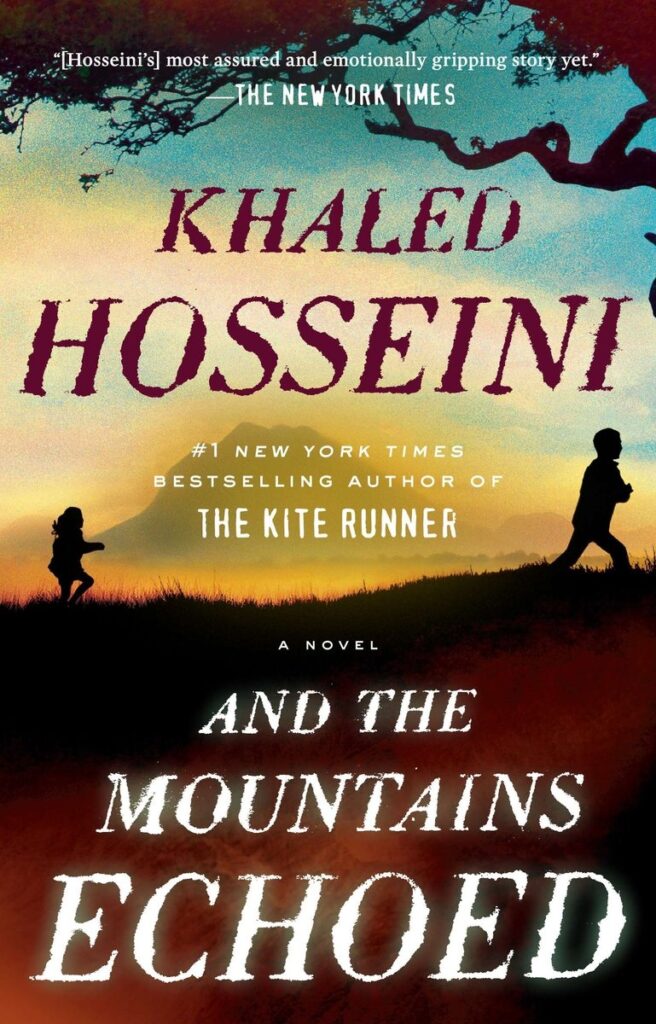
Khaled Hosseini’s And the Mountains Echoed, recommended by Editorial Assistant Amaya Ranatunge
If you ever mention Khaled Hosseini, most will immediately think of The Kite Runner. Give them a few more seconds, and they might remember A Thousand Splendid Suns. Don’t get me wrong—both are incredibly poignant novels. Yet allowing these two books to define Hosseini’s literary reputation has, in many ways, overshadowed his third novel, And the Mountains Echoed, which is a true hidden gem and, in my opinion, his most ambitious work.
Before even starting the book, it’s easy to wonder whether a third novel again set in Afghanistan could ever live up to the success of its predecessors. After two contemporary classics, another return to familiar landscapes and themes might seem repetitive, or simply unable to measure up. That’s exactly why my copy sat unread on my shelf for nearly three years, quietly slipping from my mind until I finally decided to give it a chance.
And the Mountains Echoed is a novel, but simultaneously it is also a collection of elaborate short stories contrived to be connected. Unlike his previous novels, it is fragmented and scattered. The novel begins abruptly with a folktale about a div, a mythical demon, that carts off children from the village “Maidan Sabz.” The chapter ends without a heroic warrior showing up to slay the mythical demon and save the children. Instead there is passive acceptance of their fate by the villagers, because sadness passes “as all things do.”
This first chapter is a nested narrative and functions as a symbolic miniature of the novel itself. The div emerges as a striking metaphor for the Western welfare organization that, under the guise of providing Afghan children greener pastures in life, ultimately perpetuates the painful separation of families. The framed story also captures the lack of autonomy given to Afghan families already disturbed by financial distress, when facing such welfare organizations. At its heart, the novel explores the fragile coexistence of hope and grief, showing how separation reshapes—but never entirely severs—family relationships.
The story centers the life of two inseparable siblings, Abdullah and Pari, in 1950s Afghanistan and spans for nearly 60 years of Afghan history. As their financially-struggling father heartbreakingly agrees to give up his daughter, Pari, to a wealthy childless family in Kabul, Abdulla is forever separated from his sister. Hosseini depicts the ripple effects of that single decision, that original sacrifice, across time and place. The multi-generational cast of characters connected by this central event each share their lives in an interconnected web of short stories dispersed across Afghanistan, Paris, San Francisco, and Greece.
Even though the story is set against a backdrop of political turmoil and war, the central focus remains the intimate, personal stories of the characters, exploring themes of love, family, loss, and the search for one’s identity. Unlike Hosseini’s previous novels, the main objective of the story is not to criticize the political failures in Afghanistan. Instead, Hosseini is interested in the intricate web of relationships that binds his characters together. Even if, as the folktale insists, “all things do pass,” love and human connections continue to echo across generations and continents.
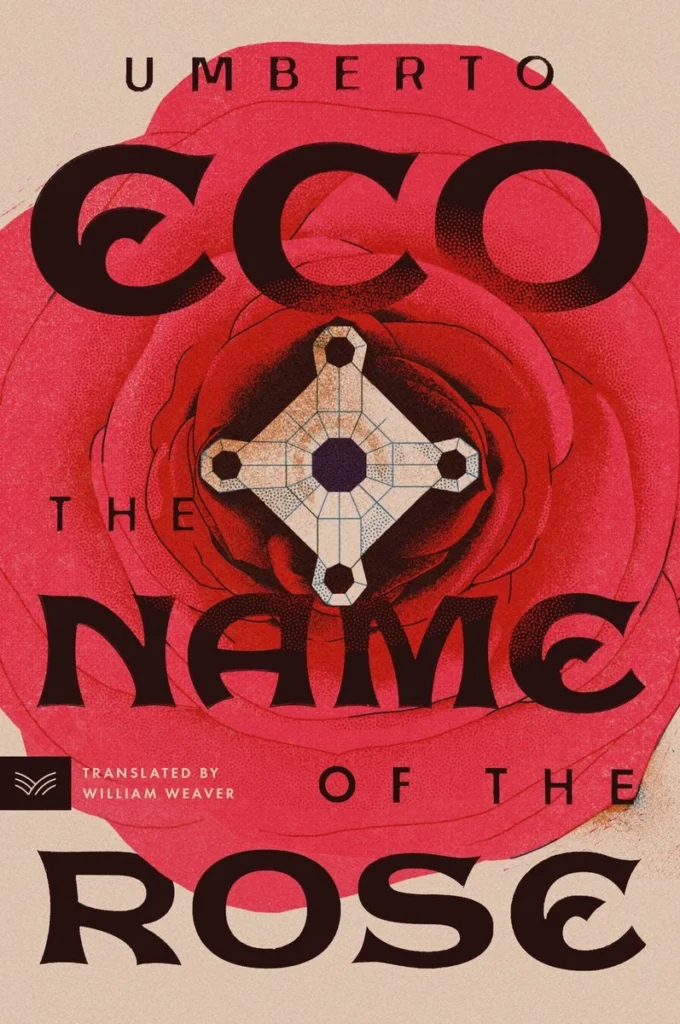
Umberto Eco’s The Name of the Rose, recommended by Literary Editorial Fellow Aidan Cooper
Umberto Eco loves books. A key figure in 20th-century literary theory, Eco popularized a number of critical frameworks — most famously in The Open Work — which would come to define postmodern sensibilities of affectation, relationality, and semiotics. He’s known for his thundercrack book reviews and cultural criticism: On Ugliness and History of Beauty provide an encyclopedic genealogy of western aesthetics, and his investigation into modes of fascist knowledge production in “Ur-Fascism” is a seminal text on the subject. But at his heart, Eco is a medievalist, swept up in the dust of different days, of kings and holy wars, of those early ecclesiastical debates which would come to scaffold the architecture of contemporary thought, like postmodernism, that he himself helped build.
This is the wonderful fusion of old and new that characterizes both Eco’s celebrity and The Name of the Rose, his novel about 14th-century Italy, the administration of knowledge, and the ubiquity of questions without answers.
Initially, a novel seems a sideways leap for Eco. His scholarship attends to vertigo, deconstruction, and fragmentation, and yet he’s writing The Name of the Rose into a form prescribing at least some stake in narrative. He’s trying to fit nonsequential experience into a beat-by-beat sequence; it doesn’t seem to mesh. Yet he finds a solution, and he finds it ripe in the generative (and often overlooked) transtextuality of genre.
Genre allows books to speak beyond themselves. German theorist Hans Robert Jauss coined, in his books on reception theory, an understanding of genre known as the “horizon of expectation.” The horizon of expectation refers to the cultural knowledge or assumptions an audience holds before approaching a piece of art. When we pick up a novel described as “fantasy,” for example, we tend to draw upon certain procedural links to dragons, elves, and magic, to situate ourselves in the cosmos with which the book identifies. These are unfixed, mutable, highly social codes that change with the times, but they nevertheless allow an author to fiddle with what is essentially contemporary folklore. Sometimes to outsmart it, or sometimes, like in Eco’s case, to embrace it.
Luckily for Eco, there’s a literary genre bearing in its bloodstream the precarity to which he’d dedicated his scholastic life: the whodunnit. Mystery stories necessitate questioning; their lingo is in double-crossings and scattered clues to the truth. Parts, bits, fragments. What if Eco were to emphasize this diffusion without promising the Answer? What if he could disguise his argument by leaning on cliches? This is his strategy. This is how he gets to writing: “I wanted to poison a monk.”
And poison monks he does. The Name of the Rose is a medieval postmodern detective novel placed in a remote Benedictine abbey in the Italian countryside. Set to host two disputing Christian factions in the coming days, the abbey is beset with a series of murders, and the mediator of this dispute must solve the case before the opposing Papal and imperial parties arrive. The dispute in question concerns Christ’s poverty: whether Jesus owned property, and, by extension, whether the Catholic Church institution should own property as well. How should piety be lived? What does power do to idealism? Eco follows these questions into labyrinths of books and medieval theology, while maintaining the momentum of a story delighted by and devoted to its obsessions.
I began this review, if it can be called that, by saying Eco loves books. And it is in The Name of the Rose he entirely indulges in this love. Our protagonist mediator is “William of Baskerville,” an obvious Sherlock Holmes stand-in. One monk is named Jorge of Burgos, a blind seer who remembers what he reads by heart — the Argentine writer Jorge Luis Borges. William of Occam, one of Eco’s favorite early philosophers, dashes into the narrative alongside Aristotle, meeting headfirst allusions to writers like Kafka and Dumas. This mystery not only relies on the cosmos of mystery stories, but also creates its own bibliographic cosmos across time and space. As Borges says in an essay about Kafka, “each writer creates his precursors…his work modifies our conception of the past, as it will modify the future.”
Relying on intertextuality and beautifully-navigated genre conventions, Eco spins a spiderweb of temporal mismanagement. The text on the page is only half the story; I spent hours with this book on one knee, a Medieval Dictionary on the other, and a Wikipedia rabbit hole miles deep on my desk. No, not just one rabbit hole, an entire burrow. It’s a whole Watership Down of historical sapience.
This has its drawbacks, of course. What makes The Name of the Rose tick is exactly what makes it tedious, distracted, and more than a little haughty. It’s dense with soliloquies and diatribes about Franciscan worship practices. But despite its complexities, it remains intensely readable. Eco is a brilliant man giving himself permission to admire the thinkers he loves, all while offering you, the reader, certain points of entry to fall in love, too. Because the world Eco finds so fascinating is the exact one you live in; all you have to do is let the book’s depth color your curiosity for it. Get a little lost, a little disoriented, get to the bottom of the mystery, and further — and maybe you’ll get a glimpse of something secret. Something worth pursuing into your library’s hidden nooks.
I did. And by its conclusion I felt I was just beginning; I had a smile from ear to ear, and a secondary-reading stack floor-to-ceiling tall.