By BRAIS LAMELA
Review by ZARA KARSCHAY
It is 1939. Spain is emerging bruised and broken from its Civil War as a plaything for Franco’s crushing rule. People are hungry. The country’s agriculture and rail networks are in shambles. Citizens go where the work is, leaving expanses of rural land unpopulated. Intending to reform Spain’s agrarian economy and redistribute the population across the country, the regime’s “New Colonization” policy (la nueva politica de colonización) draws up plans for several hundred new settlements to be built across the whole of Spain. Some move voluntarily, others are forced to do so, because their own villages are submerged to create water reservoirs. Over three decades, more than fifty-thousand people are displaced.
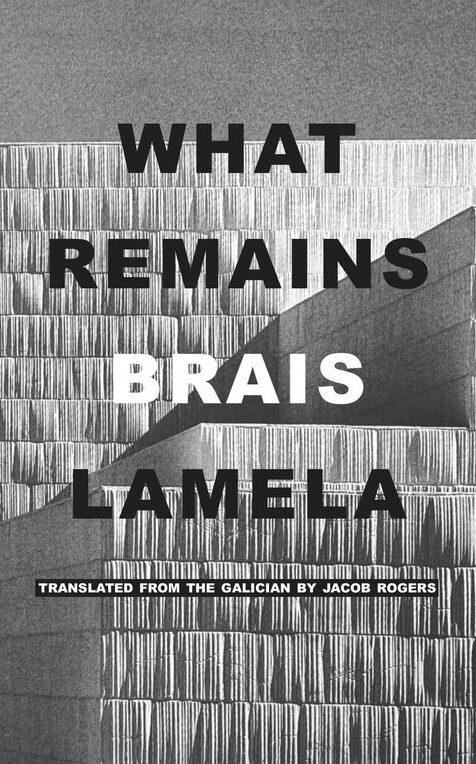
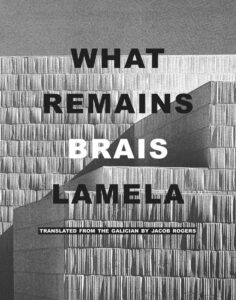
Are rehoused; are displaced—in his debut novel, What Remains, Brais Lamela redresses the passive constructions that litter institutional discourse and submerge human stories in cold bureaucracy. Translated into English from the original Galician by Jacob Rogers, Lamela’s novel foregrounds the Franco regime’s work in disappearing villages, displacing its inhabitants, and forcing hundreds of political prisoners to work on its new reservoirs and dams.
Set in present-day New York, the novel is narrated by an unnamed PhD student writing his thesis on the Franco regime’s pressuring of civilians into resettlement and its links to “various American foundations” that helped facilitate these activities particularly in the 1950s. To investigate the official discourse on this displacement, our protagonist trawls correspondence between Franco’s authorities and officials at the Inter-American Institute of Agricultural Sciences (IIAS) held at Columbia University’s library.
Some of the novel’s archival materials and figures are taken from real historical sources while others are fictional. The narrator has gathered oral accounts and logs from erstwhile inhabitants of villages in rural Galicia that were submerged in the construction of the Grandas de Salime hydroelectric dam. He has more than an academic’s interest in the material, having grown up “near the white houses of the colonists” in Terra Chá, one of Galicia’s comarcas. If the word “colonist” jars, the word did not carry the weight of conquest and exclusion it does today, and yet the reader can’t help but invoke such contexts onto the accounts in What Remains. Today, the story of a colonizer is so often one that uses the fiction of ‘open ground’ or ‘uncivilized’ locals to justify a settlement project, a fiction that finds some reflection in the Franco regime’s Galician “colonists” forced to move.
A ready villain emerges from the archive explored by our narrator in the shape of Dr. Arthur Tannenbaum. This fictional economics professor at Columbia headed a team of engineers and academics in 1959, hoping to export their approach to quelling dissent, one they acquired in Latin America, only swapping that region’s jungles and punas for Spain’s more agreeable terrain. Tannenbaum’s diary depicts the displaced Galicians as in need of civilizing. “[I]n the face of obviously positive reforms,” Tannenbaum notes, “people tended to cling to past traditions, to insist on backwardness.” Their desire to stay in their old homes appears to the professor as “mired in misery.” The novel’s protagonist-narrator, by contrast, has a different perspective. While imagining how that new village might have looked to its inhabitants, he renders it as a “world yet to come.” So the task of the colonists appears both fully formed and without the burden of history behind them: “They’re the first settlers, tasked with rebuilding the world, like Noah after the flood.”
What Remains opens at a conference that the narrator likes to frequent, not least for its free food. Well, he is a grad student, and Lamela paints for him a transient life in New York, flitting from dilapidated rentals to may-as-well sexual conquests. Mariana, his closest confidante and lover, works at a museum where she curates installations about US border crossings that bear close parallels with the narrator’s work on displacement. At the conference, he has half an ear for the speaker whose paper concerns “forensic architecture,” a discipline investigating how memory can be a spatial resource, helping those suffering from trauma and gaps in their recollection to finally seek justice for their forced displacement. Our protagonist has arrived at the perfect moment; he has noted how many of his oral histories mention a woman who disappeared back in the 50s, “Colonist 34,” who we will come to know as Leonita Portela. Lamela drip-feeds us the details surrounding her: Leonita was indignant by how officials handled her husband’s death. She spoke out. Tannenbaum may have caused her expulsion, a plausible inference considering the regime’s desire to quell dissent.
The absence of Leonita’s own voice and story creates the novel’s central mystery. There must be a connection between the histories and geographies of the two Spanish towns, one left behind and now submerged, the other newly built and moved into by the “colonizers.” For the protagonist, the regime officials’ motivations around Leonita’s disappearance might also offer a glimpse into just how much power the US had in Terra Chá. This missing link also bleeds into the novel’s structure: What Remains is cleaved in two – THOSE WHO LEAVE and THOSE WHO RETURN – keeping that crucial middle absent (THOSE WHO ARE). Leonita’s name signifies that gap in time and space, and we spend the novel in anticipation of this resolution.
Gaps emerge elsewhere, too. Conversations with the protagonist’s elderly parents, especially his ailing, wheelchair-bound father, are “punctuated by interruptions, connection problems, silences.” Sometimes, responses come days later, via written notes. Time is also used effectively, even excruciatingly, in the archives, where the protagonist must navigate his “fossil[s] of discourse” manually. Silences become pregnant with meaning; we sense there are whole stories within them, linking the past to the present.
In making the narrator and the reader follow Tannenbaum’s trail, Lamela reveals the slippage in official records between fact and fancy. Lived experience is buried beneath the records, and it lacks the authority granted by official accounts. For the Americans, the civilizing approach of the regime gave its colonists home ownership. The oral accounts corroborate this, but they also note how the regime found a way to maintain a chokehold on its people: “properties [were] tied to debts they would never be able to pay off.” [Italics in original] The repressive architecture of the village shows the regime’s desire to monitor its citizens:
“In place of the spacious kitchens typical of rural Galicia, where neighbors sit together on a bench in front of the fire drinking coffee with moonshine out of crystal glasses, the regime’s engineers had mocked up tiny, enclosed American-style kitchens for the colonists of the Terra Chá, kitchens for a single person…”
Gone are the community spaces. Kitchens are walled off, normative gender roles are implicitly assigned. In Francoist Spain, the space of the home was less private than isolated, devised to “dissuad[e] people from inviting guests, to make them feel alone in their own homes.” These implied spaces load with meaning the protagonist’s search for Leonita – a woman who rejects authoritarianism – among his contemporaneous oral accounts.
In Tannenbaum’s diaries, the colonists themselves are blamed for not adapting to their new homes. They are “evasive,” “clumsy,” and “mistrustful.” Yet all is not lost for Franco’s regime or the US officials supporting it. Tannenbaum’s concerns lie with questions of social legacy, writing of “the middle class that will be hatched within” those unfortunate residents. He emphasizes looking beyond the present and toward a future of security and fortune, keeping the past homogeneous, undesirable, and wrapped in propaganda.
But the novel also considers how we measure the seams of history against ourselves. Its interests in rebuilding spaces that might be fragmented in human memory shares much with several recent works of fiction: Georgi Gospodinov’s acclaimed Time Shelter, Poupeh Missaghi’s imposing Sound Museum, Kenan Orhan’s Booker-longlisted The Renovation, Susannah Clarke’s seductive Piranesi. In these novels, a dark and dangerous nostalgia clings like a limpet to acts of looking back. Though skeptical of Tannenbaum’s clinical estimations, the protagonist comes to regard the colonists’ memories of their homeland in Negueira de Muñiz as “a fictional conceit wrapped in nostalgia and fantasy.” Despite these misgivings, he also glosses over the extent of the dangers in leaning on curated narratives of the past to model the present.
In her seminal work The Future of Nostalgia, the cultural theorist Svetlana Boym writes,
“Nostalgia is a sentiment of loss and displacement, but it is also a romance with one’s own fantasy. Nostalgic love can only survive in a long-distance relationship. A cinematic image of nostalgia is a double exposure, or a superimposition of two images—of home and abroad, past and present, dream and everyday life. The moment we try to force it into a single image, it breaks the frame or burns the surface.”
What Remains instead addresses how forensic architecture might restore the past without this romance. An emerging field of study, forensic architecture has quickly become a credible route for devastated communities to challenge prevailing authoritarian narratives with advanced digital tools as well as historical records and oral histories. Official discourse can now be cross-examined.
Lamela plays with the medley of voices that forensic architecture may use, slipping between narrator, protagonist and author, character and historical figure, between memoir, essay, and fiction, between colonizer and colonized, powerful and powerless. The prose that connects these multiple forms and figures is so controlled it can at times feel intolerable. Third-person accounts of petitions, arguments, and forced evictions are roadblocks to emotional depth and will offer the casual reader a serious challenge in connecting with the novel. The language often scans unromantic—submerged cities, for example, are ever-present in legend, but Lamela keeps his novel’s folkloric ties at a distance: church bells ring somewhere underwater, they appear in Mariana’s apartment, burnished for her exhibition. But when the protagonist makes plans to revisit the settlement in the second section, the prose shimmers: “In the foggy light, the green water looks like the back of a glossy lizard, a planetary, motionless being that slumbers for a thousand, two thousand years.” The Galician coastline is “sinuous,” and “wrinkled.” The move into the second section feels like the kiss of first sunlight, its timing just right.
Zara Karschay’s fiction is published in Ploughshares, The Baffler, The Gettysburg Review, and elsewhere. She received the Harper-Wood Award for English Poetry and Literature from the University of Cambridge and was awarded Second Prize in the Zoetrope: All-Story Short Fiction Competition.