Review by NICOLE SCHRAG
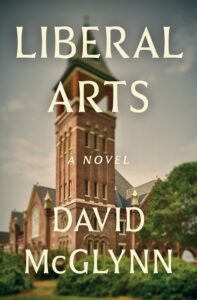
David McGlynn’s new novel-in-stories unfolds on and around the campus of the fictional Buchanan College in Hanover, Wisconsin, a school not unlike McGlynn’s home institution of Lawrence University in Appleton, Wisconsin. Liberal Arts follows the lives of professors and students, alumni, community members, and friends and relations of all of the above over the course of four academic years.
While Buchanan College is always in the background – it is, after all, the reason why many of the characters find themselves in this small Midwestern town by a lake – Liberal Arts isn’t strictly, or only, a campus novel. The book alternates between what could be stand-alone short stories from other characters’ points of view and chapters from the recurring perspective of Jenny Ramirez, the trailing spouse of a sociologist named James. While the first chapter follows students and parents through move-in weekend, the second takes us to the hospital with Jenny, who is languishing in her role as a social worker.
Jenny is good at her job, which has fewer and less intense crises than she encountered in a similar position in Los Angeles. But thanks to her social work role, she loses her only friends in Hanover. When a child ends up in the hospital with a suspicious injury, Jenny becomes professionally involved in a child abuse investigation into one of her new mom-friends. Isolated and depressed, Jenny indulges first in extra glasses of wine in the evenings, then in vodka in her water bottle, and ultimately finds herself responsible for a serious hit-and-run accident involving a Buchanan student.
The move from the first chapter – where students get settled into dorms and continue the annual tradition of streaking and running into the lake that borders campus – to the second – which contains graphic descriptions of a toddler’s broken leg and no clear connection to the college aside from it being Jenny’s spouse’s place of employment – is a striking choice for a campus novel. From John Williams’s Stoner to Donna Tartt’s The Secret History to Julie Schumacher’s Dear Committee Members trilogy, faculty, students, and administrators typically take up at least ninety percent of the most widely read books in the genre, and Liberal Arts’ repeated departures from the hallowed halls of academia were unexpected.
But it’s an approach with tremendous pay-offs. As the geographical frame shifts from chapter to chapter, McGlynn paints an unusually rich portrait of university life. In addition to following Jenny’s addiction and recovery, readers ride along with an adopted student as he drives a couple of towns over for an awkward reunion with his biological family at a cookout. A music librarian road trips to the nearest major international airport six hours away to meet the Eastern European girlfriend he’s been courting online. And a queer Bangladeshi student’s quietly repressive family relationships lead to her education in the States, where she befriends a Bible-thumping girl from Alabama while participating in a performance of Godspell.
Some of the novel’s shifts in setting are less dramatic, but no less powerful: a chapter near the end of the book sees Jenny, James, and their two sons on the far side of the lake, across from Buchanan, close to home but in a space apart, trying to figure out if they can make a life together in this place. Simultaneously, sites on campus, like the Buchanan Organic Garden (the BOG) and an accessible student apartment, accrue layers of significance as generations of students move through, making places their own and changing them, in large and in small ways – even sometimes in ways that last.
While the novel brims with jokes that hinge on the absurdity of academic institutions and the people who belong to them, Liberal Arts isn’t a satire. Instead, the humor originates in situational ironies that arise from the bizarre juxtapositions that might be made possible in and around universities, where people who otherwise have no earthly reason to find themselves in the same room are brought together. In a chapter called “Dusters,” an injured hockey player named Thorst observes a myth developing about the miraculous healing properties of the pool at a rehab clinic near campus:
Thorst looked up the line at all the people waiting their turn in the therapy pool, all the fogeys and coffin dodgers, their bodies beaten and brutalized, if not by illness and injury then by the simple entropy of time, like water dripping into a bathtub. You’d think at a certain point they’d accept defeat, slump off to a quiet corner to watch Wheel of Fortune until the end came. Yet here they were, taking the plunge, as though they had a chance of getting something back.
Rather than skewer its characters for their vanities and delusions, Liberal Arts encourages us to laugh while reminding us that we are all, as it were, in the same therapy pool.
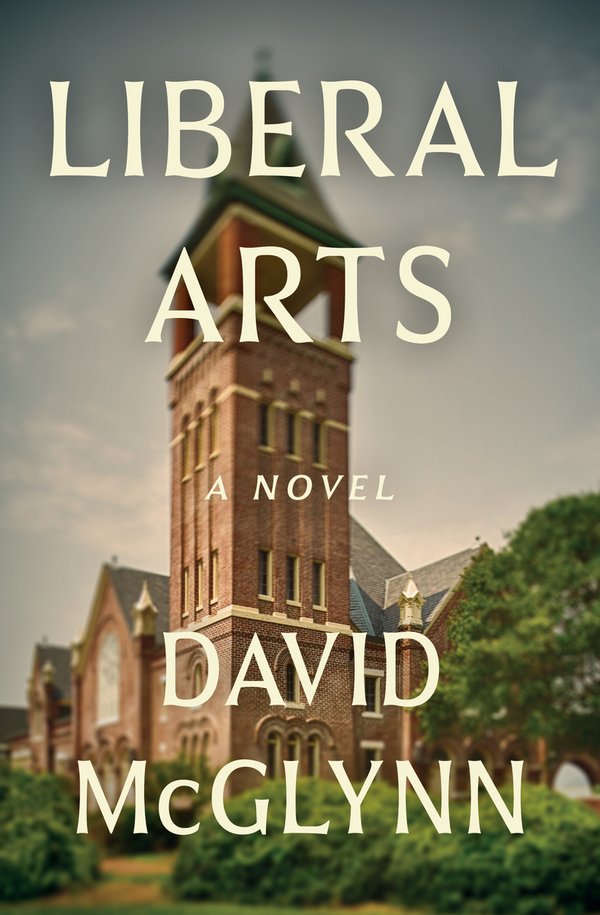
The title and the cover, with its bell tower (collegiate gothic, but practical), announces this book as a campus novel about a particular type of institution, but there is no curriculum drama here, not even a passing reference to a literacy crisis or enrollment woes. Unlike Netflix’s The Chair series (starring Sandra Oh in glorious tweed) and the novels mentioned above, Liberal Arts is not much concerned with administration, with one important exception.
As Jenny and James navigate the fallout from her accident, they come into contact with Buchanan’s Vice President of Justice, Equity, Diversity, and Inclusion (JEDI), Cecil Locke. Cecil never features in his own chapter but appears in student inboxes, in offering a listening ear to James, and in facilitating what is functionally a restorative justice process. “‘Jenny’s not a bad person,’” James says to Cecil. His response: “‘We’re all bad. [. . .] Every one of us. Especially when we think we’re being good. It’s the whole reason jobs like mine even exist.’”
If you talk at any length with a university professor or administrator about their job, sooner or later, they’ll probably tell you about the social, emotional, and occasionally even spiritual labor of working on a university campus. What we have to learn, after all, spills far beyond the bounds of a well-rounded slate of course requirements. And McGlynn celebrates the liberal arts institution as a place that can, at its best, afford space for exploration, for healing, and for communities that facilitate both.
Nicole Schrag is a writer and editor based in Tampa, Florida. Her writing has appeared in the Wall Street Journal, Christian Century, Plough Quarterly, On the Seawall, Full Stop, and other publications. You can find more of her work at nicoleschrag.com.