By INTAN PARAMADITHA
Reviewed by LAUREN YU-TING BO
In 1797, an anonymous essay titled “Terrorist Novel Writing,” in reference to the term used to describe gothic novels at that time, appeared in the British publication The Spirit of the Public Journals. The essay concluded with a “recipe” for creating a gothic novel in the style of author Ann Radcliffe, whose writing would largely be used to define what second-wave feminist literary scholars in the 1970s would call the “female gothic.” The recipe included a list of tropes: “Take – An old castle, half of it ruinous. / A long gallery, with a great many doors, some secret ones. / Three murdered bodies, quite fresh…” And so it goes.
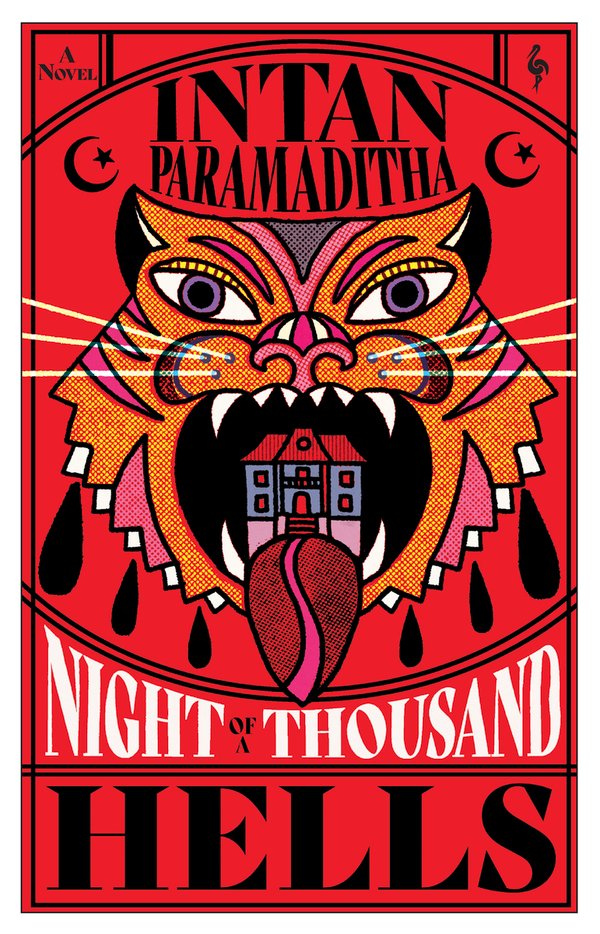
Intan Paramaditha’s 2023 novel Night of a Thousand Hells, newly translated from Indonesian into English by Stephen J. Epstein and Tiffany Tsao, eschews nearly every trope identified in that recipe while remaining true to gothic sensibilities, confronting the scars of colonization, the oppression of a gender critical and liberally homophobic culture, and ultimately, the horror that even those we love may be capable of great violence. Gothic literature has long been a space for marginalized voices to confront cultural anxieties, from female gothic works that challenge gender norms to a diverse spread of international gothic literature that, unlike the medievalist architectural European gothic that is familiar to many English readers, brings together the natural environment, indigenous and aboriginal traditions, and the legacies of colonization. Paramaditha does not abstain from widely acknowledged gothic tropes entirely. Devices such as the frequent changing of narrators, the use of discovered manuscripts, the inclusion of a villainous father and absent mother, and frequent references to the supernatural all contribute to a sense of anxiety. And yet, Night of a Thousand Hells contains mainly the horror of reality. We are told from the beginning that it’s the story of three sisters and that the youngest sister Annisa, “the beautiful one,” has committed an act of terrorism.
“Revolutions always begin with ugly stepsisters.” So the book begins, plunging into the aftermath of Annisa’s death, as told quite theatrically by an unnamed narrator whose identity becomes clear only midway through the book. The narrative framing nods heavily to traditions of oral storytelling and poetry in Indonesia, using sweeping language and demonstrating a keen interest in sisterhood and morality that, despite the gruesome premise, has a fable-like quality. (Consider also the cheeky title of the first chapter: “The Bombings: A Bedtime Story.” ) Though the chapters switch between multiple first-person voices, featuring those of the two elder sisters Mutiara and Maya as they try to make sense of Annisa’s actions, as well as discovered diary entries by Annisa herself, there is a sense that these voices are filtered through this narrator’s performance. The narrator’s chapters speak directly to the reader, setting the stage—“The curtain rises”—and introducing characters as you might in a fairytale. “This is a tale of three sisters, but don’t believe everything I say. After all, childhood memories are deceptive. The world is more massive, more menacing, more magical when seen through the eyes of a child.” The narrator, like Annisa, is largely on the margins of the story, and yet it is the two of them who propel the story forward.
Annisa and her husband, both age 34, were part of a group of suicide bombers that targeted two Christian churches as well as an Islamic study group for trans women. Annisa and her husband brought along their nine-year-old son and two-year-old daughter. Their actions echo those of the 2018 Surabaya bombings in which a series of back-to-back bombings at three Christian Churches were executed by parents who involved their children. The incidents share a date—May 13, 2018, three days before Ramadan—as well as several details, such as one of the culpable mothers hugging someone on site in the moments before her bomb detonated, one of the children surviving the incident, and similarities in timing and method. Annisa’s older sisters Maya and Mutiara are left to pick up the pieces, both literally identifying the pieces that remain of her body while also trying their best to understand what led Annisa to her final act.
One of the key characteristics of female gothic literature is its criticism of gender norms and its expression of female discontent. As Ellen Ledoux bemoans in her 2017 article “Was there ever a “Female Gothic”?,” much criticism of the genre has understood it as inherently depicting the victimization of women. Paramaditha subverts this expectation—Annisa, who throughout the novel is often dressed in white and associated with jasmine flowers, symbols of purity, innocence, and peace in Indonesian culture, is not a victim but rather the primary source of terror. Annisa is frequently referred to as the “bride,” in reference to her grandmother’s prophecy that she and her sisters Maya and Mutiara would become the bride, traveler, and caretaker, respectively. The role of the “bride” takes on a double meaning, marking both her literal marriage as well as her final act:
“Gathering the materials for and assembling a bomb requires great care and forethought—like planning a wedding. And as with a wedding, the ‘brides,’ as we call them, undergo extensive preparation themselves.”
Paramaditha does not necessarily critique the gendered ways in which media still discusses suicide bombers, but she does amplify and call into question what might motivate a woman to take those actions. Though it is often assumed that female suicide bombers are following the orders of their husbands, it is clear that Annisa is fully autonomous, which makes her actions even more horrifying and difficult to comprehend.
Night of a Thousand Hells is richly textured with endless layers to be uncovered—a complex portrait of sisterhood, an exploration of gender identity and sexuality, an examination of the friction between orthodox and syncretic Islamic beliefs, threads of mental illness, familial duty, systemic oppression, inheritance—but it is at its best in how it employs gothic elements to evoke the horrors of present times. As the slippery narrator says early on: “There is no answer to be found in this story, no magic pill, pleasingly round, to be halved or crushed, then swallowed.” There is only the anxiety of being witness to a world that is both terrifying and beautiful.
Lauren Yu-Ting Bo is a St. Louis-based half-Taiwanese writer and critic, primarily exploring multiracial identity, Taiwanese culture and politics, and the impacts of migration and translation. She is a 2026 Periplus Fellow and a 2025-2026 National Book Critics Circle Emerging Critics Fellow. She has written for the Cleveland Review of Books, Words Without Borders, World Literature Today, Asymptote, Kirkus Reviews, and more.