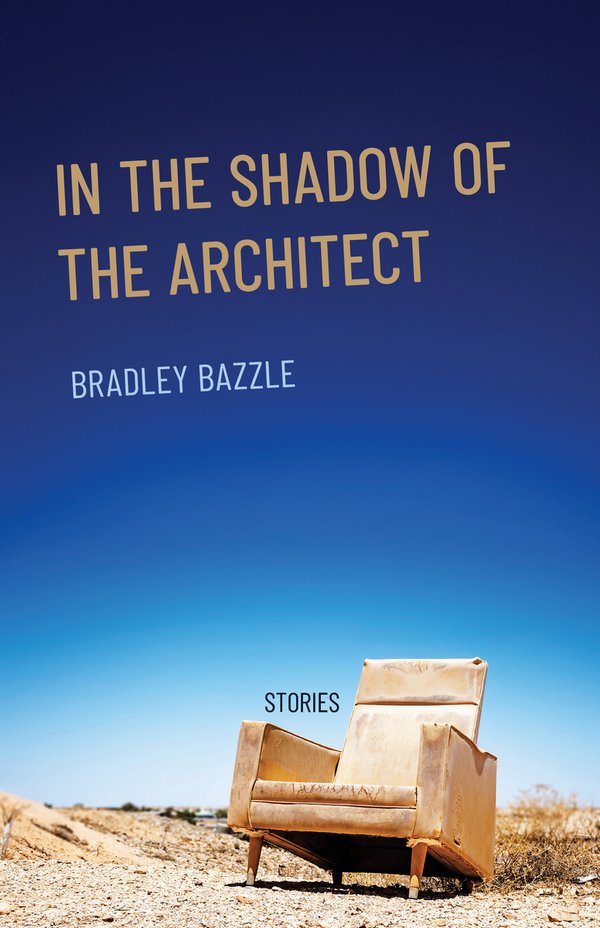
By BRADLEY BAZZLE
Review by AIMEE LIU
“The glass-walled master bedroom still juts from the hillside like a diaphanous fist.”
—Bradley Bazzle, In the Shadow of the Architect
When Steve Almond chose Bradley Bazzle’s debut, Trash Mountain, for the 2016 Red Hen Press Fiction Award, he wrote that the novel’s central figure was “torn between the outsized idealism of childhood and the cruel compromises of adulthood.” Much the same could be said of the protagonists in Bazzle’s compelling new collection, In the Shadow of the Architect.
The men and women in these seven stories, now approaching middle age, wish they could foist their disappointments onto the adults who functioned as architects of their suburban youths. As the novelist/narrator of “The Colleyville Houses of Gil Fontaine” laments, “I saw in the drawings a blueprint of my life, and I blamed my parents not only for keeping and sending the drawings but for starting me down this ignominious road. They should have rolled up my butcher paper, I wanted to tell them. They should have forced me from the house to play football and make friends.”
But the portal of memory is not so forgiving. What this unnamed writer discovers as he tracks down the actual architect of the Dallas-Fort Worth subdivision where he grew up is a doppelganger of his grown self: “silent and serious, almost censorious. I’d been trying not to examine Gil Fontaine and his houses through the lens of my own experience…But the connection had been there all along.” That connection is an affinity of self-invention “from borrowed materials.” What is borrowed is the raw material of all that has been built before, and the borrowers are us.
Who are “we” really, though? This book contains, in effect, a Greek chorus of friends and partners who voice the kind of certainty that second-hand information and snap judgments foster, but Bazzle’s protagonists resist. In “Each Unique Specimen,” a civil engineer struggles to locate the truth of her feelings for a disgraced professor who once encouraged her childhood passion for archaeology in the lonely outskirts of Marigold, Texas. Decades later, Leanne still cannot understand how she could have trusted the professor yet failed to defend him from her father’s accusations and assault. Her partner, Shona, is as quick to absolve her because she was “just a kid” as she is to ascribe her father’s anger to his closeted sexuality, but Leanne isn’t so sure. In fact, “sometimes Leanne perceives in her silence on that long ago night not powerlessness but budding complicity.”
The budding, lurking specter of complicity haunts these stories. In “Missing,” a California neighbor’s missing child triggers memories for the narrator of a boy he abandoned during a long-ago hike around a resort lake in Iowa. In the collection’s eponymous story, set in Houston, the narrator can’t bring himself to fault the older neighbor who cruelly toyed with him as a boy, because didn’t he choose to be mesmerized by her, the famous architect’s daughter? And in “Relatable Influence,” Claire chooses to risk her family’s comfortable brand as online influencers in Atlanta by entrusting them to Kaarlo, a Finnish photographer whose affection for dark fairytales and dangerous poses simultaneously frightens and entices her.
The child’s eye view of adults as confident and rational architects of the world to come is repeatedly tested by older role models laid low. But confusing as it may be for children to witness the frailties and failures of their would-be heroes, the lens of memory keeps shifting in these pages until a new clarity arises. The narrator of “Missing” first observes “that adults only pretend strength, by virtue of the bodies they’ve grown and the knowledge they’ve accrued, all of it thoughtlessly, automatically, just by marching through time.” But when he reflects on an architect with polio he’d known as a child, he realizes that true strength is rarer and different: “a peculiar sort of strength that contained its own negation, a sly suggestion that strength is a put-on.” A form of strength that grows out of pain and weakness and disappointment.
It’s this slyer form of strength that the grown protagonists in these stories struggle to muster and master while they still can. All too often they look back with the sense that they commanded more of this asset in childhood than ever since. As the young father in “Scuttling and Creeping” observes his pre-school daughter coming down the stairs, he likens her to an explorer in a land of adventure and opportunity, but his own access to that land has become tenuous: “In my mind I was somewhere behind her, sealed up in the quiet, empty house. The house that would one day become her childhood home, made hazy by memory. The house where I read and write and creep through time, connected to her by a tether of thought that stretches on and on.”
That tether in Bazzle’s deft hands becomes a diaphanous thread weaving back and forth between the illusions of structure and permanence that so often fail us, and the incontrovertible sensibilities that make us deeply human.
Aimee Liu is the author of four novels, most recently Glorious Boy (Red Hen), and three books of nonfiction. She taught for many years in Goddard College’s MFA in Creative Writing program, and her essays and reviews have appeared in the Los Angeles Times, Los Angeles Review of Books, The Common, Solstice Literary, New England Review, and elsewhere. She writes the Substack MFALore.com.