By SUKETU MEHTA
Papad was the bard of the masses. He sat during the endless school classes
on the bench next to me, composing rhymes which could be appreciated by
all for their elemental simplicity. Thus:
O dear
Come near
Don’t fear
Have cheer
Beer is here
Or, still further atomized, each letter containing the whole of its Hindi word:
OBBG,
TPOG.
TPKI!
QPKI?
There were also his drawings: obscene stick figures copulating, or the mystic
yantra which none could ever complete: a crossed square bordered by four half
circles. The task was to construct this figure in one stroke, without pen ever
backtracking or being lifted from paper, and though we spent hours, days,
weeks trying, no one could ever complete the yantra. But—and this is why we
kept trying—it always seemed eminently possible, as if, should we rack our
ox-brains just a little bit more, we would get it.
It is 1999, and I have moved to Bombay for a couple of years, researching
and writing about my childhood city, and seeing if you can go home again. One
day, after visiting my old school, I decide to look up Papad. I go to his house—
I have a hazy memory of it which turns out to be correct; it is in Malabar
Apartments, the building with the brothel on the fourth floor. He’s not at home,
but his wife, Amita, and his mother are. His mother remembers me, remembers
that I liked to write. “Suki”: Amita remembers what her husband called me.
Papad calls up that very night. “Suki!” he shouts over the phone. I ask him
if I can still call him Papad. “Yes, but I’m no longer like a papad,” the thin lentil
cracker that accompanies most Indian meals. I take this to mean that he’s put
on weight. The name had originated when a teacher had reprimanded him in
open class: “None of your nonsense, or I’ll give you such a slap you’ll break like
a papad and fly away.” How could a prize insult like that not stick? Even his
mother called him Papad after that, we said to each other.
He was always a hapless sort of fellow, principally distinguished by his nose,
which sat on his face like some enormous tuber. He came to Manav Mandir after
having failed in the eighth grade at another school. I shared a bench with him for
two years. I was doing badly in school then, so he was good company. We spent
the periods when we were supposed to be taking dictation flirting lightly with
the two girls behind us, the fat Sangita and the skinny Parul. “Two birds lost in a
wood,” Papad says, reminding me of a joke, the meaning of which is now obscure.
“Do you have any contacts in leather distribution?” he asks me suddenly.
“So you’ve become a cobbler?”
“No, no, not footwear. Purses, jackets, but not footwear.” For the last year he
has been trying out leather goods exports. He has two daughters now, and he is
still in the stock market, but is trying other ventures as well.
We had last met in 1987, twelve years ago. I remember now the name of the
girl he’d been sweet on in his old building, an old chawl in Gamdevi built for
his caste. “Kani.” “You remember her name,” he observes, and chuckles. “She’s
now married a doctor; she’s a doctor herself.” I also recall that he’d met his
wife through a wrong number and tell him I have a story as good: I met mine
on a plane.
He asks about my kids.
“They don’t look like me, thank goodness,” I tell him.
“With those Dracula teeth,” Papad agrees. “Did you get them fixed?”
“And what about your daughters? Do they have your nose?”
“Everybody says they look just like me.”
“You’d better stock up for the dowry, then.” This was how conversation was
generally conducted in our school: through insult and abuse, covering up whatever
good feelings we harbored for each other.
He wants me to help him find leather goods distributors in the States.
So I ask him to come over for lunch that Sunday with his family, and we’d get
on the Internet and find a few.
He comes into my house looking as young as, or younger than, me. His hair
is so thick and black I yank at it to make sure it isn’t a wig. He has sprouted
spectacles; otherwise his face seems untroubled by care.
I ask him about his daily routine. “I leave for the office at twelve or one in
the afternoon.”
“What do you do till then?”
“You know, I’m on the computer. On the Internet, I send out my e-mails.”
“And then?”
“Then I go to the office, see if there is any work; usually there isn’t. My father
takes care of the share business. So I come home by three or four.”
“So what do you do after you come home?”
“I check to see if any e-mails have come back.”
Since last January he’s been trying to start a leather goods export business.
He says he has workshops in Dharavi which employ twenty-five people, and
an agent—“a Hindu Maharashtrian, Vishal, not a Muslim—you can’t trust the
mias”—who runs them. We go into the study to look for importers on the Internet.
We log on, and I type into the search engine, “leather goods wholesalers.”
A whole list of them comes up. I point out that he can go to their sites, write
e-mails to them. He writes down in his notebook, “leather goods wholesalers.”
“That’s enough,” he says, and sits back. He has no wish to waste time going
to their sites. Lunch is being served.
“I got an inquiry from Japan,” he reflects, “but I didn’t reply.”
“Why not?”
“I don’t want to do business with Japan,” he says with mysterious finality.
While we are on the Internet, he asks me if I use it to chat, as he does. “I’ve
got a Taiwanese babe, a Thai babe, and a Greek babe. But they’re all too young.
I don’t do cybersex. I wish I could find someone older. There was a thirtythree-
year-old babe, but she got cancer.” He points to the belt he’s wearing.
“The Greek babe sent me this leather belt. Her father has a leather business.”
“Why don’t you try to get some business going with him?”
“He’s an exporter!” Papad exclaims. I think he is disgusted, but then
I realize he is probably relieved. It would save him the bother of trying to make
a business with him.
Every day, he chats with his babes for three-quarters of an hour. He used to
visit the sex sites on the Internet. He would sign up for the one-week free
memberships. “But I got sick of it. Always the same tits and ass. So I gave all my
passwords to a friend.” I ask if Amita knows about it. “She knows everything.
She is very forward. She knows about the girls I chat with. She doesn’t mind.” He
doesn’t fool around. “How long will our sex life last anyway, another ten years?”
Amita grew up in Kandivli, and can’t take her residence in Malabar Hill for
granted. She keeps asking me how they can get a visa to live in America. Papad
had taken a year’s “break,” as he put it, to enroll in a computer course, in the
hopes that this would get him a job in America. But he didn’t seem as excited
by the prospect as his wife. “Life becomes like a machine there,” he ponders.
“You have to just work a lot.” Here, they seem to have a wide circle of friends,
mostly small businessmen and their wives.
He is kind to his two girls. He doesn’t want any more children, as most
others would, hoping to have boys. His older girl is a bookworm; she disappears
into the children’s room and goes through my son Gautama’s books, like
I used to at her age whenever I went to somebody’s home. Papad’s wife, Amita,
is a pretty, fair woman. I remember he used to rent hotel rooms to be with her,
when they were dating. They’re a good-looking couple, in the Bombay way:
well dressed, well spoken. At the table, Papad eats with delicacy, holding his
spoon so and inclining his head slightly, a gentleman. He likes to eat. They both
like to eat, street foods, Bombay foods. The afternoon wears on unhurriedly.
Papad is not anxious to get anywhere. After lunch, he sits in the armchair and
drones on, pleasantly. It is not important to respond to everything he says.
I get the feeling that I can nap right there and he won’t be offended. A friend
one can keep for a lifetime.
When the cool comes on, we drive to the seaface in Papad’s car, a Fiat of
a model that was dated when I left India. While Papad parks the car and I wait
for him, my wife, Suni, and Amita go inside a café with the children and get
sodas and ice cream. When the waiter brings the bill, Suni pays, as she had
expected and wanted to, but she notices that Amita doesn’t open her purse,
doesn’t even raise it or make the obligatory protest.
* * *
I want to get some gifts for a trip to America, and Papad says I can get
some leather goods direct from his factories in Dharavi, which is reputed to
be Asia’s largest slum. The workshops are just off the main road, and they are
not Papad’s. Vishal is not his “agent”; he is the owner. The paths here are
swept clean; drains run along either side of the paving stones, and a little girl
wearing an orthopedic bandage on her thigh shits at the entrance to a room.
Papad and I enter the workshop, which has a few men sitting on the floor of
the hot, dark room, cutting sheets of leather. Papad and Vishal discuss the
requirements for the next consignment. Thanks to the Yahoo! search results
for “leather goods wholesalers,” Papad has had an inquiry from Germany. “If I
can sell to Germany, I can sell anywhere,” he says. The Germans want “azo-free”
leather; it is the law there. Vishal’s workers are a mix of Hindu and Muslim.
On his desk is an Indian flag; pictures of Hindu gods adorn the wall near him.
Above the workers’ side of the room are two paper Pakistani flags, and simple
white sheets adorned with Islamic calligraphy.
The workers are mostly from Bihar, the poorest state in the country, and they
work fourteen hours a day, from nine to one in the morning, with an hour off
for lunch. Sundays they work from nine in the morning to one in the afternoon.
If there is an urgent order, they’ll work all day and all night. Most employers in
Dharavi pay their employees by the piece; making a wallet, for example, earns
them between fourteen and twenty-five rupees. Vishal’s workers, however, are
on salary, to a maximum of 2,800 rupees a month. Vishal is a good employer;
once a month, he brings in a TV and video to show them a movie. They start
working as young as eight, and do not work past twenty, by which time they’re
not so quick or willing to work past midnight. “They have no friends circle, no
nothing. In their life, they have no program for the future. They only have their
picture theater, Juhu Chowpatty, and Dharavi,” says Vishal. They are illiterate
and unused to paper; you can’t give them a sketch and have them translate the
abstraction into a leather object, but if you give them a sample which they can
hold in their hands, they’ll easily replicate it. They eat for three hundred rupees
a week in small hotels; they eat well by Bihari standards, because their meals
generally include meat, mostly beef. When they finish working, they lie down
on the same patch of ground on which they’ve been sitting for fourteen hours.
For the most part, they work in silence, hands moving in automatic gestures.
We see the samples with Papad’s company logo on them: four diamonds
arranged to make a larger diamond. And the name, Artemis. “Artemis is a Greek
goddess of hunting, and is associated with animals, leather,” explains Papad.
“Also, the name begins with ‘art,’ which is what this is—it’s the art of leather.”
Vishal walks us around Dharavi. He and his family own six workshops,
making leather goods, gold electroplating units, and an industrial washer unit.
On the wall of one room are a whole set of blocks for embossing the designer
name of the customer’s choice: YSL, Trussardi, Calvin Klein. He roots around
in the box and pulls out famous names and logos. The blocks are available for
between 350 and five hundred rupees each. The rooms are on the ground or
the first floor, and each of them has a fan jury-rigged at a dangerously low level
onto the tin roof, so that you cannot work standing up or your head might be
nicked by the whirling blade.
In the midst of the slums there are several multistoreyed apartment buildings.
These have been built by the state housing authority; they demolish
a patch of slum, put the occupants in a transit camp, and allot them the flats
when they’re constructed. “The flats are a loss to us,” says Vishal. The residents
strenuously oppose being moved to flats with covered toilets and running
water and air and light. Vishal shows me the architecture of the slum, the
way it has invented itself. Above each dwelling is a workshop. The owner and
his family live below, and the commute to work is just up a flight of stairs. “If
I am given a room in a flat, where will I build my factory?” he asks. If you’re
working fourteen hours a day, then the only time you get to see your children
is ten minutes snatched here, fifteen minutes grabbed there, and home has to
be right under the office. This is the only time you’ll have for arranging the
details of your daughter’s wedding, or meeting in-laws visiting from the village.
A two-hour commute to your factory, which is what a government flat
will mean, will kill your life with your family. Also, many of the slum dwellers
make some extra income renting out the top storey. In 1999, these two-storey
shacks go for half a million rupees ($12,000), a concrete room in an apartment
building for considerably less.
Public housing in Bombay is designed like apartment buildings in the
West: self-contained rooms, with doors off a long corridor. This is not what
the people want. They want a village. It should be more like a college dorm
floor, or even a chawl: rooms along winding streets, with doors always
open, with plenty of community space. There should be a central courtyard,
and balconies that look out on it. But there is an arrogance to architecture in
Bombay, especially housing meant for poor people. They are not thought of as
“clients.” They are thought of as charity cases; the government is doing them
a favor by demolishing their unhygienic shanties and giving them concrete
rooms with indoor plumbing. But public housing imposes rigid geometry on
the winding streets of a slum village.
A spanking-new luxury skyscraper looms over the area. “That building is
only for Jains,” says Vishal. Next to it is a lower apartment block; the developer
got to build housing for the rich in return for building concrete housing for
the families uprooted when their slum was demolished. But the Jains haven’t
flocked to this palace in the middle of the slums, and half the building remains
unoccupied, causing a huge loss to the builder. This is because Jains are strict
vegetarians. From a thousand tanneries and leather industries all around, the
stench of animal hides rises up in the air; the area could not be more revolting
to the Jains if it had been purpose-built to torment them. Papad tells me about
going to a box manufacturer, who was Jain, to buy boxes to ship his products
abroad. The Jain asked what business he was in. When Papad told him, the Jain
said, “I’m sorry—we are strict Jains, and we can’t work with anything that has
to do with leather. I’ll refer you to another manufacturer.” Papad is disgusted
that they can live in the middle of the leather works but not have anything to
do with the commerce of it.
* * *
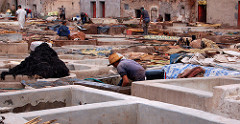
We walk into a tannery. Outside are dozens of drums filled with chemicals.
“What if it catches fire?” wonders Papad. “You’ll be roasted like a chicken.”
Inside are hundreds of clotheslines, on which are hung pieces of hide being
tanned and dried, and an ancient machine which sports the logo The Turner
Tanning Mch Co, Peabody, Mass, USA. In the back is a red, toxic chemical
mist; the drains are filled with a red chemical soup. “Is this blood?” asks
Papad. Vishal has a diploma in leather tanning, and when he sees the proscribed
chemicals, he says, “This is absolutely wrong.”
Further on, we come to the walls of an old fort, the “Black Fort” after which
this part of Dharavi is named. Boys are playing cricket against it, and trees grow
out of the ancient walls. There is a plaque: Built by order of the Honorable Ino
Horn Esq. President and Gourvernor of Bombay in 1737. We meet a real-estate
agent. I ask him how big Dharavi is. “Dharavi is between six train stations.”
It is an incomprehensibly vast area. A slum is not a slum. It is a series of neighborhoods,
of different classes. People in the Kala Killa area will speak with disgust
of the Kumbharwada area, “where you won’t be able to breathe and it’s so filthy
and men just fight everywhere on the roadside.” Papad tells me that he’s seen
a lot of Dharavi, from the times he’s come here. Vishal corrects him: “You have
not even seen point one percent. Point zero one percent.” Dharavi was a creek
all the time Vishal was growing up, and there were many more mosquitoes than
there are now, and the occupants filled up the creek and built the colony. “All
this is illegal,” he points out. “But we are all financially well off. Everybody has
a factory.” And indeed, every residence has a TV and a fridge. “But it looks bad,
because we don’t improve the inside. At any time it could be demolished; then
what would be the use?” asks Vishal. Fear of demolition makes the occupants
reluctant to upgrade the slum. It’s not as if Dharavi doesn’t have the money.
“Dharavi does one hundred crores ($25 million) of business annually,” declares
the estate agent. “More,” declares Vishal. Unimaginable is the wealth of Dharavi,
whether from legal or illegal enterprise, for those living in Asia’s largest slum.
I give my friend a ride to the bus back to Malabar Hill. Papad says he enjoys
the bus, which takes a lot more than an hour each way; he says he prefers it
to a taxi. “It would’ve been better if you hadn’t come to India,” he complains.
“You’ve come only to go back. You haven’t come here to stay.”
* * *
A couple of months earlier, he had been idly reading The Indian Express
when he came upon his horoscope. “A friend will help you,” it said. And then,
a month later, I turned up in his life and typed “leather goods wholesalers” in the
Yahoo! search engine. This led him, after he left my house, to a Usenet group
for buyers and sellers of wholesale leather goods. Papad posted a one-line
message to this group: “Our products speak for themselves.” This occasioned
eight responses, or “inquiries.” “They may speak for themselves, but please
tell us more!” wrote a dealer from Italy. Now Papad has new hope, in his business
and in the essential benevolence of destiny. “I told Amita that horoscope
turned out to be true. How, roaming, roaming, you turned up in my life now.
Why didn’t you come all these years when you came to Bombay, and why now?”
I hadn’t seen him in twelve years, because he had dropped out of the circle
of my school friends, who were making their way up in the world of medicine,
the stock market, and the diamond business. In the years since I had left, the
city had, through a boom-and-bust cycle, separated the winners from the losers.
* * *
We are at Papad’s, or rather, at Papad’s parents’ flat, for dinner. The flat is really
a one-bedroom, but the balcony has been taken in and the living room split in
two so it makes another bedroom for Papad and Amita. The parents’ bedroom
has an air conditioner in it, but Papad’s, although small, is bright and catches
the fresh sea breeze from the west.
Papad’s family are Kapol Vaniyas from Surat, the city of gourmets. We enjoy
a fine dinner, and they make it a point to serve papads. The meal is marred only
by our hosts insisting that we eat more than we really want to.
At dinner we find out that Amita’s birthday has just passed. “What did you
do that day?” I ask them.
“Nothing.” Papad spreads his palms outward. “Relaaaaaax.”
“You cheapskate. You didn’t even take her out to dinner?”
“I’ve been married to her for twelve years. We were going out for eight years
before our marriage. I used to take her out to dinner then.” We laugh, but there
is something uncomfortable in the air; we feel its presence like a fifth person
at the table.
After dinner Papad and I go up to the terrace of the building with my son
Akash and Papad’s younger daughter. It is a fine terrace, with concrete benches
built so you can sit on them and take the evening air. On one side is the lush,
thick green of Hanging Gardens, and on the other side, past tall buildings with
yellow lights—all the poorer buildings have white tube lights—is the sea. Below
us is the vast Nepean Sea Road slum, Simla Nagar. At a party at the American
consul’s, I’d met an Iranian woman who found herself, in late middle age,
in possession of this entire slum, a dying gift from her lover, a minor prince. It
is the way that Bombay, also called “Sone ki Chidiya”—the Golden Songbird,
works: it starts trilling all of a sudden for some, and stops mute for others.
There is a bright moon in the sky, and my son runs about, pointing a finger at
the glowing white orb, saying, “Moo!” After a while we sit down on the bench,
and our kids, at peace, put their heads on their fathers’ laps.
Papad explains why he couldn’t take his wife out to dinner on her birthday:
He couldn’t afford to. There had been nothing in Amita’s purse that evening
in the café in Bandra. For her last few birthdays, he hasn’t been able to give
Amita anything. “I have no income. I can’t even buy her a dress.” He would like
to go away with his friends for three days somewhere, “but then I need four,
five thousand. That’s how I like to go out of town; I should feel free.” Now, too,
I understand why he takes a bus all the way when he goes to the workshops
in Dharavi.
I listen closely. It is about all I can do, but it counts for something.
His younger daughter is sleeping with her head in his lap, her knees drawn
up, sleeping with that great concentration with which children do everything.
In the dim light I can’t make out his face, and whether there is any moisture
upon it. “I don’t go to movies anymore. I send Amita, and I stay home and work
on the Internet. The tickets cost a hundred rupees each. I would rather spend
that money in my business. This used to be nothing for me—movies, restaurants,
they were like nothing for me.” Like everyone else in the stock market,
he had done well in the boom years. The family had been able to move out of
their one-room in Gamdevi to this flat off Nepean Sea Road. Then, as Papad
succinctly puts it, “boom went bust.” He was never very good at the market
anyway; he can’t speculate, and he can’t lie. Now he wants his own business, and
he loves the process of it. “When I take a piece of leather and I make something,
a wallet, a purse, and I hold it in my hands, I feel so happy! I think, I made this!
I made a product. In the stock market I felt like a peon. I would just go into
the ring and do some work and come back.”
But the leather business hasn’t taken off. The first year he only got three
sample orders; the largest of them was for 150 wallets for four hundred dollars.
Each time he sent an order, the forwarding agent charged two thousand rupees
and the courier four thousand. The best business possibility was a Bulgarian.
After the initial samples were accepted, Papad sent him a consignment, out
of which eleven different items never reached the Bulgarian; there was a lot
of theft at the Sofia airport. At this point Papad, seeking to establish some
goodwill at the first sale, told the Bulgarian that he would replace the eleven
items at no cost to the client. The Bulgarian later wrote to him that “your goods
have been well received in the Bulgarian market.” “My goods were well received
in the Bulgarian market,” Papad repeats, savoring the sentence. Papad asked
his manufacturer about making the eleven items anew, but after he found out
what it would cost to make new dies for the varied items, and the huge cost of
sending the material via courier to Bulgaria, he realized that all his profit from
the sale would be wiped out. So he phoned the Bulgarian and told him that he
would, since his goods had been well received in the Bulgarian market, deduct
the cost of the eleven items from the next order. The Bulgarian cooled after
that, and never replied to Papad’s e-mails or faxes or phones.
The two other sample orders were to Indians abroad. One was from
Texas, and had come to Bombay, and was staying at the Hotel Centaur. Papad
went there with a cake and with Amita to greet him. “Shamed, he gave me
a small order.” But after returning to Texas, he wrote to Papad that he was now
interested in another commodity and was pulling out of the leather business.
The second was a very young Indian boy in Singapore. He too came to Bombay,
representing himself as a very big businessman, but gave a very small order.
Two other Indians crossed his way: one in Florida, who said he had a son in
Germany, and to whom Papad kept sending samples, till he got a message
saying, “Please don’t send us any more samples.” Another was a Sikh agent
in Australia, who ran off with the samples and was never heard from again.
“I hate doing business with Indians,” Papad tells me. “Indians don’t work out.”
When he lost contact with the Bulgarian and the others, Papad went crazy.
“I was constantly faxing them, constantly phoning them. One month my phone
bill was ten thousand rupees.” The courier bill for the year came to sixty thousand
rupees. Any profits he had made were wiped out. He was in the curious
position of selling wallets for other people to store their money, in the course
of which his own became progressively emptier, so his business became almost
a public service. He thought he should try his luck abroad, and he enrolled
in a computer course.
The computer course also didn’t lead to anything; no visa to America
materialized, and he felt old compared to all the young students in the class.
Although, he admits, the girls were stunned to realize that he was in his late
thirties. “I told them I’m the father of two! And they said, ‘We thought you
were twenty-seven, twenty-eight.’ I had to put on weight to appear older.” After
the computer course, he decided to try his luck again in the leather business.
His uncle had advised him that exports were a special business requiring
a special skill. “You need patience. Be patient. You’re dealing with people who
are thousands of miles away.” He had already tried the local market. “I used
to go around with my samples in a bag to all the stores in Colaba, Kemps Corner.
Always the same reply: ‘Come tomorrow.’ ‘Come today, come tomorrow; come
tomorrow, come today.’” When the owners would deign to look at his samples,
they would try to gouge him on the price. He didn’t get any business there,
even though Vishal’s goods were finding a market through other dealers, but
he got to know what a salesman feels like. No attention was paid.
Papad’s company, Artemis, is listed at the top of the leather exports council
book, since the list is alphabetized. And he is listed with the Netherlands
Embassy as a leather goods exporter; he describes happily a letter he just
got from the Embassy asking him to renew his listing. His company also has
a free advertisement in a foreign magazine. But no business. Since he restarted
his business last January, Papad has received ten inquiries from foreign buyers.
He sounds alternately hopeful and depressed about these inquiries. “Ten
inquiries! But no orders.” From the ten inquiries, he has not received a definite
“no” from the clients in London and Canada. “We will let you know,” they keep
responding. “It’s in the pipeline,” he speculates. But Papad sits in his father’s
brokerage office in the middle of the afternoon, doing nothing. “My name is
everywhere. The name has gone, but the business has not come. I was just
wondering. Sometimes I do wonder.”
The maid comes up to call us back to the flat for ice cream. But Papad sends
her back. “Tell them that we are discussing important matters.”
The sleepers have come on the terrace—the male domestics and drivers of
the building’s residents. They have stretched out their thin bedrolls near the
walls and are going to sleep in the soft night air. “Look at them. We should
also be doing this. What sleep they are enjoying,” he says. We both look at
the sleepers, not saying anything. The lights are on in the tall buildings all
around, where billionaires are still up. The moon plays hide-and-seek with
the rain clouds. But it will not rain, not tonight.
All of Papad’s friends and relatives are getting ahead, doing well, in the
share market, in paints, in leather. His father and uncles have an office
in the Stock Exchange Building, which is also the nominal headquarters of
Artemis. People come there and think, Papad must be a prosperous man—
such a big office he has. One entire wall is a sheet of glass, and it has a stupendous
view of Bombay. They have to keep it covered with a curtain, the light is so strong
there. Papad sits on a big chair there, when none of the uncles want to sit on it.
There is also the flat on Nepean Sea Road. “But I know the truth. Other
people my age are settling in their business. I’m just fighting for my family.
I’m fighting.” People have been noticing that he’s free all the time. His family is
getting restless. “My mother said, ‘You say you’re getting all these inquiries, but
how come there are never any orders?’” I imagine him sitting in that small flat
with his mother constantly around. He had made sure to invite us home only
when his parents had gone out to dinner, saying, “We’ll be more comfortable
that way. We can sit at peace.”
It is a vision straight from hell for me, for I have been there. I tell him so.
Not so long ago, I was without a job, without a source of income, with a new
baby and thirty thousand dollars in debt. No work, and no prospect of getting
any. I would wake up in the mornings knowing that all business calls would be
outgoing; nobody called me back. In our parents’ generation, I tell him, it was
enough to be educated, and anybody could get a job. “It’s very different now,”
he agrees. “Now I’m competing with the whole world.”
Not giving anything to his wife on her birthday doesn’t hurt Papad as much
as not giving anything to his daughter on her birthday. “She wants a Casio.
One of those keyboard things. For Nirali’s last four birthdays, each birthday
I’ve promised her that I’ll get it for her the next year. Each year, I tell her the
next year. I went and found out the price—2,400 rupees. I feel so bad. She is a
child, she forgets, but it stays in my mind. My daughter loves paneer. She loves
paneer. We used to go to Santoor in Cuffe Parade all the time. They make good
Punjabi food. But for the last six months we haven’t been able to go to Santoor.
I’m not getting any income. That is the greatest problem.”
The maid comes up again. It is late, and Gautama is sick, and we have to
get back so the driver can catch the last bus home. But Papad could talk all
night; I might have to get up and start walking towards the stairs. Then Amita
comes up, and Papad looks at his wife with tenderness and love. She is beautiful;
she is steadfast. She doesn’t pressure him, doesn’t needle him; never asks
why the inquiries don’t turn into orders. Ice cream, cold pink strawberry ice
cream, is waiting for us.
Suketu Mehta is the author of Maximum City: Bombay Lost and Found and teaches long-form writing at the Arthur L. Carter Journalism Institute at NYU.
[Purchase your copy of Issue 09 here.]