New poems by ALEKSANDAR HEMON and STEFAN BINDLEY-TAYLOR
This month we bring you new work by writers who also have careers in music.
Table of Contents:
—Aleksandar Hemon, “Snipers”
—Stefan Bindley-Taylor, “Naming the Wind” and “At our first house”
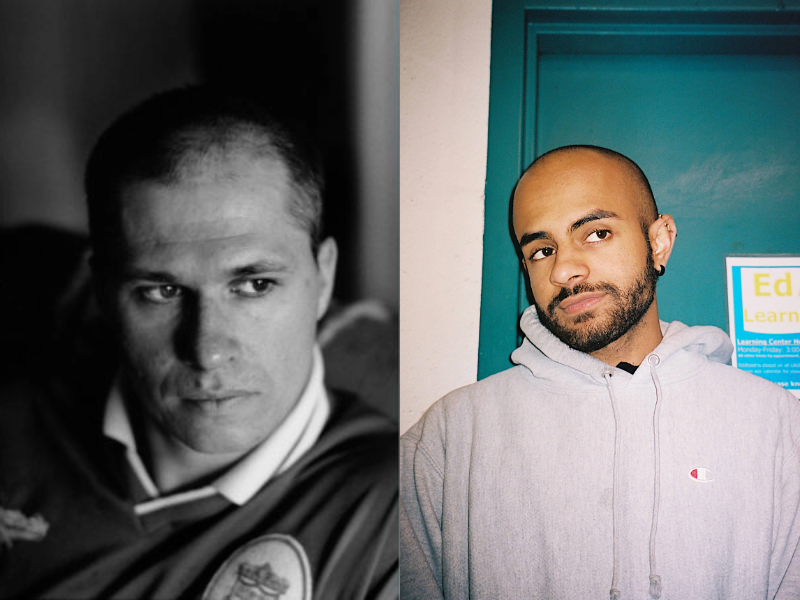
Aleksandar Hemon (left) and Stefan Bindley-Taylor (right)
Snipers
By Aleksandar Hemon
Do you ever walk down an empty street
stopping, looking up and around to see
what position would a smart sniper pick?
Do you notice plants and pane refractions,
curler-haired ladies leaning out on the sills,
watching for what will surely come to pass?
Do you ever scan a room full of good people,
read their faces and elaborate frowns to guess
who among them thinks you ought to be shot?
Do you ever have a sense this is never ending
until all that is destructible is finally perished,
and you depart armed with the long memories
of yourself strolling down an empty street to look
up at the silver-haired ladies leaned on the sills,
waving to tell you your new life will be splendid?
Naming the Wind
By Stefan Bindley-Taylor
And it was then that it came, that thing without a name, a quick caress across the check, careening from the nothing and back into the nothing it went. Whipping, I thought, but no that would never do, for whipping is a word that describes a real hell, not an imagined one, and one that I know somewhere in my blood is imprinted; though, I am so far from it as to be genuinely embarrassed.
So how to describe it then? Sight? Useless! For it was the color of air, which sounds like the title of a movie that would gain enough accolades to make it revolting to me. Is there then, the element of smell to turn to? But this too fails, if only because I do not possess a strong sense of smell. I never have. My tongue was still too sopped in dessert wine to taste anything else, and all I could hear was that cork somewhere in the sea, floating or sinking, floating or sinking. In fact, I’m not sure I am led by my senses much at all, only by the gears in my head, so flat and mechanical, grinding everything into a thick paste.
And now that you are gone, I am sure I will never get a name for the thing, the memory of which still sits at a peculiar tilt in my chest, in a way that feels different than when I think of my birthday, or my father coming home. It is the feeling that reminds you that there is unconditional love in the world, and it is all yours if you want.
The world, in its unconditional love, has already given it so many names. Yet these are imperfect to me, like a chipped moon. The Solano for example, feels like something that goes on the sandwich. The Bora sounds like an uncontacted people, the Squall like an undiscovered sea beast, the Sirocco like a flavored vodka, and for god’s sake, The Haboob. Not to mention the spin-off adjectives, psithurism, susurration, all experimental, all horrific.
Still, for a long time, this lack of name, the thing unnamed—not the thing itself but the unnamedness of the thing—has haunted me, and I have occupied myself trying to conjure it forth like a friendly specter. I want to pull an ancient monument from the sand, to stand before it, Herculean, to say this is your name, take it, take it and dance. Sometimes, at night, the crinkles of the pillow case comes close to naming it, scratching out a blurb a few syllables, maddeningly short, a long dash through some mysterious missing diphthong that should slot in just right, but is somewhere out there eluding, misshaping itself, deforming itself as to never return to where it belongs, or where others would have it belong. Though perhaps all I really want, if I think about it, which I try not to, is to ask you to name it. A task made impossible, and that is why it is the only task left that is worth anything. For I know that if you said it, somewhere from wherever you are, I’m sure I could hear, could feel, could touch, could, could see it, again, and I would think yes, that is it, that is the perfect one.
At our first house
By Stefan Bindley-Taylor
I came home to find your wings
could not fit under the bed.
So you had no choice
but to open the roof.
It was better that way.
When rain slicked the floor,
I picked bushels of mint that rose
beneath our bedsheets.
You threshed flowers to make
them go down easy.
But I wanted the dirt, the stems, the stone.
I brought my teeth to the edge of a field
and I chewed
until things became silent. At night
you pointed to the hole
above us, towards the stars you navigated so well.
I knew then nothing
could feel like your touch.
I fell silent and things became
still, like a comet or a current.
I said it.
And things became.
I say it again.
To see if they remain so.
Stefan Bindley-Taylor is a Trinidadian-American author, musician, and educator born and raised in Maryland. His stories balance absurdist humor with real emotion to showcase characters from the Caribbean diaspora through a nuanced, humorous, and humane lens. His recent and forthcoming work can be found in several outlets including Chautauqua, Adda, Brooklyn Rail, and NY Carib News. He is the winner of the 2025 Chautauqua Janus prize, the 2025 DISQUIET Flowers fellowship, a 2025 Kimbilio Fellowship, the 2024 Brooklyn Caribbean Literary Festival Prize, a short-lister for the 2024 Commonwealth Foundation Short Story Prize, and a finalist for the PEN 2023 Emerging Voices Fellowship. Outside of writing, Stefan has been a performing musician for over a decade. He writes and performs in a punk project called FISHLORD and an alternative hip-hop project called Nafets. He has amassed over 8 million streams worldwide between the two projects and landed sync placements with Netflix, HBO, Hulu, BET+, The CW, and more. He currently splits his time between New York City and Virginia and is pursuing his M.F.A at the University of Virginia.
Aleksandar Hemon’s poem is from his forthcoming collection, Godspotting, which includes work published in The New Yorker, The Yale Review, Harvard Review, and The Common. He is the author of The World and All That It Holds, The Lazarus Project, which was a finalist for the 2008 National Book Award and the National Book Critics Circle Award, and three books of short stories: The Question of Bruno; Nowhere Man, which was also a finalist for the National Book Critics Circle Award; and Love and Obstacles. He was the recipient of a 2003 Guggenheim Fellowship and a “genius grant” from the MacArthur Foundation, and the 2020 Dos Passos Prize. As a screenwriter he has worked on the Netflix show Sense8 and Lana Wachowski’sThe Matrix Resurrections. He produces music and DJs as Cielo Hemon, and Godspotting has a sonic equivalent as an album of the same name, already released: https://tidal.com/album/449872410/u. He has been Professor of Creative Writing at Princeton University since 2018.