A story is an offering—
something with a bright, burstable skin and tender flesh.
Whenever my mother gives me one of her stories, I watch her cut into it, lay it out for me in a way I can consume, in a way she can bear.
Her stories simmer in her muscles, ready to emerge at a flick of her wrist, a familiar flare of joy or pain. Sometimes they come most easily when she peels longan fruits: her thumbnails in the veiny, beige rind; her fingertips shining against the eyeball pulp. She bites into each fruit, spits out the black seed, and gives me the remaining half. Between mouthfuls, she talks.
These fruits used to grow on our roof in Bạc Liêu, she says. In Vietnamese, they are called nhãn. They’re like dragons’ eyes—see? I used to fill my pockets with the seeds and drop each one in a different place.
My mouth tingles with the sour-sweet juice. It burns slightly as I swallow, like a claw deep in my throat. Did they taste the same as this? I ask.
No, Mum says. No, not quite.
Sometimes a story stalks into view when she spots a spider on the wall or a mosquito on her arm. Her slipper bangs; her hand slaps. And again, she talks.
We used to have geckos on the ceiling and walls. They were so still that they looked like a pattern—but they could move quickly. We threw our slippers, trying to get their tails to fall off. Do you think I’m cruel, Nattie? Don’t worry—the tails always grew back.
I cup my hands without thinking, and a phantom tail thrashes against my palms.
Mum’s memories come loose in fragments, their edges too sharp for either of us to hold all at once. Throughout my childhood, she shares her early life with me carefully, piece by piece. I gather it all, afraid that if I don’t, we will both somehow feel less solid, less alive. The scenes she describes flicker at the edge of my vision: a small black pig that lived in her backyard and followed her everywhere; a market that sold green and blue fighting fish; family gatherings where she fanned guests with a palm leaf; a friend she admired with a long braid down her back.
Inheriting these memories stirs some hazy instinct—as if such stories were inside me already, ready to open at the sound of Mum’s voice. I don’t know how this can be possible. I don’t understand the way my body responds when I think about her stories—why my hairs lie flat on my arms with the heat; why I long for homegrown fruits I’ve never eaten; why my back stiffens at the thought of what comes next.
When I try to describe these reactions to Mum, she says, Of course. I’ve been telling you these things ever since you were still part of my body. You knew too much by the time you were born.
A story can be dried and kept in a tin,
until its keeper is prepared to revive its smell and flavour.
I don’t remember if I ever thought to ask how Mum came to live in England instead of Vietnam. I was somehow always aware that it was a journey with a deep ache at its centre, still tender to the touch. Maybe, as Mum suggests, I was born already knowing.
Fragments of the story often arose when she was doing something that would keep her voice even, something that would allow her to concentrate on her hands: pouring tea, cutting her nails, darning a sock.
After the war, it became harder and harder to stay in Vietnam. There were days when my dad looked so pale, and his hands shook when he tried to smoke. I had to give up studying, and I couldn’t find work either, so I couldn’t help my parents with money. We were all scared about what might happen next. So each of us packed a small bag, and we fled.
While growing up, I gradually noticed how many suitcases she kept around the house, each so full that the zips were straining. They contained clothes for all climates: puffy coats, sweaters, thin blouses, loose black trousers, packets of brand-new underwear. Perhaps without realising it, she was ready to disappear at a moment’s notice—to be exiled to any corner of the world. Part of her would always live as if in mid-flight.
Once, when I was little—after I had misbehaved and she’d told me off—Mum walked out of the house without a word. My dad was upstairs, preferring to keep out of the way whenever he heard shouting. I watched Mum through the window for a moment, panicking, then crammed on my shoes and ran after her. Even though it made no sense, even though I knew how fiercely she loved me, I wondered whether I had finally made her angry enough to leave forever. When I was a few feet from her back, I quietened my steps. I saw her run a hand through her hair and rub her neck. I waited until we reached the end of the street before I let her know I was there.
Mum?
She jumped and turned. You want to walk with me?
I nodded.
Okay. But not one word, understand?
I don’t remember where we went, but I imagine we ended up at the supermarket. It became a habit to buy something small—a cake, a pair of socks—whenever either of us was upset.
I wondered whether I’d be able to follow if she ever had to go farther away, pulling one of her suitcases behind her. I occasionally had nightmares about watching her walk along a narrow road into blue mist. I would run and catch her arm, pull at the hem of her brown coat, but she didn’t always turn around. Our bodies grew ghostly as we walked on, unable to stop.
A story must be deboned and stuffed with sweeter concoctions
to prevent bruises forming in the teller’s throat.
Every story Mum tells explains a little more of why I am alive. Why I was born in England but am not English; why my hair, why my eyes, why my skin, why I don’t know what to say when anyone asks where I’m from.
To help me understand, she gently takes me apart, shows me how to follow my blood back to every possible beginning.
Before she was my mother, she was a girl who sewed thin white blouses by hand; who bought blue hair clips and small dolls from Sóc Trăng market; who opened her mouth to sour, heavy rain. She was a young woman whose girlhood was swept away too quickly; who left her bed in the middle of the night to hide in the steaming gut of a freight ship; who learned to cover her face and roll up her shadow behind her.
Before he was my father, he was a boy who tended rabbits and chickens in his parents’ back garden; who wrenched music from a broken piano; who opened the window to hear his grandmother singing as she pegged out the washing. He was a young man who took a ferry from Wallasey to Liverpool to go to work while it was still dark; who drank shots of brandy as medicine; who travelled from town to town by steam train, remembering the class and number of every engine.
Eventually, my parents’ stories started to overlap in a small Staffordshire village, where they had each taken temporary jobs working with refugees.
When I first met your mum, my dad says, she was wearing a green trouser suit and carrying one plastic bag. That’s all she had. For months she wouldn’t say a word to me. But when she did, we suddenly found we could laugh at the same things. And she was very thin and didn’t cook much, so I started inviting her round for meals.
I had to force him to propose, you know, Mum says. I said: If you asked me to marry you, I would say yes. So ask me, quickly.
Even after learning to carry these stories, I still cannot say where I am from. I can only say what I am fleshed from: two people who have always felt most at home beside water; a cold countryside hut where their hands first touched.
A story remoulds itself each time it is bitten
and passed from mouth to mouth.
A story never fully decomposes,
even when it is only spoken by ghosts.
One of the earliest written compilations of some of Vietnam’s folktales is Lĩnh Nam Chích Quái, possibly collected by the scholar Trần Thế Pháp in the fourteenth century. These stories were gathered from Lingnan—an area of Southern China—and Northern Vietnam, and, depending on the translation of Quái, the title describes them as “strange” or “monstrous.” Either description is accurate: they are stories with teeth and scales; stories heavy with swollen fruit; stories that buckle and morph beside rivers. There is the tale of Âu Cơ and Lạc Long Quân—a fairy from the mountains and a dragon from the sea, who are said to be the ancestors of all Vietnamese people. There is the story of a sorrowing man who became an areca tree; a nine-tailed fox who lured passersby into its cave; two warrior sisters who refused to disappear into the shadows of invaders.
Growing up, Mum never read Lĩnh Nam Chích Quái or any other collection of Vietnamese folktales. She learned all the stories she knows by listening to the women who surrounded her, so, as I grew up, she gave me the versions that live under her tongue. She told me of an immortal bird who follows seafarers across the ocean; a golden-robed woman who rode into battle on an elephant; a ghost who bloated and starved after transgressing. We added our own embellishments with each retelling, imagining the colour of the sky, the hiss of blades in the wind, the bitter smell of the flames in the underworld.
Like this, Mum shows me the possibilities of preservation beyond the rigidity of the page. In oral tradition—the mode via which many Vietnamese tales survive from generation to generation—stories are not kept as embalmed specimens but take on the breath and mannerisms of the teller. They can therefore vary from area to area, and even from family to family. Each time I feel the impulse to retell such a story, I remind myself to leave enough space for it to crackle and mutate, to mark new territories.
Our family stories blur and reshape in similar ways to Vietnam’s folktales. I know that some of our ancestors shifted back and forth between Vietnam and China, but no one can agree on who went where, and for how long. Everyone’s memory moves differently, and so everyone carries their own truth, their own version of who we are. A relative once produced a hazy recollection that we might be descended from two sisters who lived on a small island, but she could not add any names or flesh to the legend. Like always, I attempted to fill the gaps myself. I pictured the sisters’ hands—small but muscular, like Mum’s. I pictured their fingertips sinking into soft fruit, or snapping the heads from prawns. I imagined the view of the sea from their windows, the shallows where they might have waded in up to their knees. I wondered which gods they prayed to during typhoons, and what offerings they left at their shrines.
As with the tale of the sisters, many of the family memories I inherit are already half lost. We do not have the privilege of extensive documentation: so much had to be left behind or destroyed during my family’s movements between countries. Therefore, speculation has become a habit. I stare at faded photographs and try to imagine what lies beyond the brief patch of light. I call into the hollows of every story, and hear only my own voice answering back.
A story may be eaten alive
or pulverised and poured into a series of identical moulds.
Like my family history, Vietnam’s national history is rife with gaps. I discovered this while trying to learn more about the country’s beginnings—its early rituals, its artefacts, its warrior women. I was searching for somewhere to lay down the fragments that I had learned to cherish, hoping to find the spaces where they would fit. Each night, I sat up in bed, framed by the hard white light of my laptop. I scoured Vietnamese museum websites—shamefully aided by Google Translate—and trawled through JSTOR for promising-looking articles. I was uncomfortably aware that the difficulty of my search was partly my own fault; since I understood very little Vietnamese, I could not take full advantage of Vietnamese resources. As I looked, I only encountered more fragments, more stories trapped in the throats of ghosts.
As a country that has so often been invaded and colonised, Vietnam’s surviving early documentation is scarce. The scholar Lê Văn Hưu completed the Đại Việt Sử Ký, the first comprehensive chronicle of Vietnamese history, in 1272. This disappeared during the Ming Invasion, when the Emperor of China ordered his commander to destroy every text written by a Vietnamese author, aiming to suppress Vietnamese customs and force mass assimilation. Many books, including the Đại Việt Sử Ký, were taken to China, and it is not known what happened to them. Shadows of Lê Văn Hưu’s work can be found in the Đại Việt Sử Ký Toàn Thư, a chronicle by the royal historian Ngô Sĩ Liên. This was completed in 1479 and survives today, though with some revisions made over the centuries.
It feels important that I know that these texts exist, or once existed, even though I would not have the language to understand either one. It feels important that I know the cost of writing things down—how, like anything else, words can be seized and erased or placed in exile. I consider how silence begets silence as I search online for more modern English-language books about Vietnam’s early history. Instead, I find book after book about the Vietnamese-American War (1955–1975)—many written by American veterans—as if Vietnam did not exist before US occupation.
The stories I am looking for feel further and further away as other voices blare over them. It seems that, in much of Anglophone publishing, Vietnam is associated only with the war that made my mother a refugee. There are some broader reference guides, but I stubbornly refuse to buy anything that does not at least have a Vietnamese co-author, and there are no full-length English translations of the Đại Việt Sử Ký Toàn Thư. At the time of searching, I could find only one English-language book that fit my criteria and was still in print: Descending Dragon, Rising Tiger: A History of Vietnam, by Vu Hong Lien and Peter D. Sharrock, which gives an overview of Vietnam from the Bronze Age to the twenty-first century. Aside from the surviving Vietnamese chronicles (translated into Romanised Vietnamese), its sources include translations of Chinese chronicles and twentieth-century archaeological studies.
I think of anyone who has ever sat down to tell a story with just a few scraps in front of them. I think about how stories survive when no air is allowed to reach them, when long shadows are cast over their pages. When you are working from handed-down memories and physical sources with burning holes in the centre, storytelling becomes an act of faith. It means restitching, drawing shapes in ash, searching the mouths of the dead. It means filling every gap with echoes and hopeful conjecture.
A story can be made more solid if mixed with a preserving agent
and left in a cool place to set.
The first time any of Mum’s stories made it onto paper—at least by my hand—was when I interviewed her about her life for school. She spoke slowly, remembering that I was a child with a child-sized body that could not be expected to shoulder too much. She did not linger on the most violent parts of her history, since, if I were to write them down, they would need to travel through my head, my muscles, my small hand. Instead, she regifted me the fragments of her childhood that I knew so well, and recited the bare facts of her journey after the war. I knelt beside a small table, writing quickly and crossing things out whenever Mum’s memories tripped and rearranged themselves. When we were finished, we added two photographs of her as a young woman. In one, she wears red lipstick and a yellow blouse, and her hair is long and thick. In the other, she is leaning back against her mother, and they are both wearing white. At school, my teacher and classmates looked at the photographs first, marvelling at Mum’s beauty before starting to flick through her story.
As I reached adolescence, I became more able to understand the heavier stories that Mum passed on to me. I was desperate to hold on to them, and yet had the feeling that if I did not find some way to put them down, I would buckle at the knees. Left untended, the stories formed knots, became a collection of burrowing threads that I was unable to follow until I could view them outside of my body. It made most sense to try and write them down, like I had done as a child, but I had come to realise that memories have no beginnings or endings, and so I did not know which parts to grasp first. Besides, the stories I usually wrote were cliché-filled fairy tales, which never featured anyone who looked like me or Mum. I sometimes felt that I did not know enough of myself to be worth writing about. The novels I had read contained an almost aggressive amount of detail and certainty—especially the English classics. I needed a form that was tender enough to embrace the absences within Mum’s stories, as well as the parts that were almost whole.
Poetry entered my life suddenly. I was in an undergraduate creative writing class at university, not quite sure what I was doing there. Someone I love was also taking creative writing classes at the time, and so I partly signed up out of a desire not to be left behind, fearing that we would no longer speak the same language. Within the first two weeks, the professor had introduced the class to the work of Sarah Howe and Mona Arshi—both living, contemporary poets. Like me, they were both women of colour who seemed to have a connection with myth and family stories. Unlike me, they had found the most beautiful way to express it.
I read Howe’s stories of her mother and felt the breaths and precipices that had been allowed to surround the words. I thought of the small movements of Mum’s body whenever she produces a particularly intense memory—the way she squeezes her eyes shut and shakes her head; the way her tongue protrudes between her teeth; the way her hands clench and flex. I thought of the mosquitos and tailless geckos of her childhood, the huge spiders with broken legs. I added my own colours to the memories—orange, sand-yellow, shiny black—learning to occupy the space between seeing and not seeing everything I had been told.
I read Arshi’s meditations on family heirlooms and considered how much of my own family’s history is anchored in small, mute objects. There is Mum’s jade bangle, which she put on as a young girl in Vietnam and didn’t take off until she began working as a nurse in England. I never knew the exact provenance of this heirloom—who made it, who first pushed it over the bones of Mum’s hand, who explained how painful it would be to remove without the aid of soap. I thought of how often I had tried to picture Mum as a young girl—her walk, the tilt of her head, her small wrists. It seemed that a poem would be accommodating enough to welcome these missing pieces.
I began to see poetry as a gateway into the realm of speculative memory—a place filled with slips, silences, and distillations. Poetry said only as much as needed to be said, or it could bear to say. Poetry did not (always) ask for a blood sacrifice. Poetry would not set fire to the faint scraps of my family history. Poetry could allow me to put myself together, and then unpick the stitching and start again. With this in mind, I began to draft a prose poem about Bà Ngoại (my maternal grandmother), and everything she had ever taught me. My professor said, Finish it. So I did.
In the last stanza, I reflected on one of the many times Bà Ngoại had tried to communicate something via a gift, something that would warm against my skin:
Some days, I am more than her infant granddaughter. When I look taller, fuller, she begins to visualise me in red. I know this when she fastens gold around my wrist. A heart and key dangle from my veins. Dainty. Easily lost. For when he asks, she says.
Once a story has been peeled open
and relieved of its seeds,
it must be replanted
according to the instructions of the person who offered it—
on death anniversaries / by moonlight / near bright moss /
in acidic conditions.
The first time Mum read my poems, she said, You were listening all the time. I can’t believe you remember all this. How did you know to say it like this?
I can’t remember what I said in response, but I know the answer: Because I had no other way to say it. Because poetry was a way of both holding on to her stories and laying them down.
I still share everything I write with her, and the details she wishes me to change or take out are often things that had not struck me as controversial.
My shirt was not pink that day. It was blue. Change it.
I never wore my gold then. Not even under my clothes. It was inside my clothes. I had to sew it there myself. Write that down.
No, not that phrase. You don’t understand, because you don’t speak Vietnamese, but it can sound very rude, especially if you’re talking about someone older than you. I shouldn’t have taught you that saying. This poem will be more precious to me if you take it out.
I understand the importance of guarding Mum’s stories in the way she asks. The telling of a story is a transfer of energy, of blood. When Mum shares a memory, she is showing me the inside of her body. She is mapping the places where it has marked my skin. There is an English idiom for sharing your story: to spill your guts. This is one I agree with.
Sometimes I remove the things she asks me to altogether, and sometimes I use visual redactions: [ ]. In this way, Mum and I create new gaps in the stories we allow to go out into the world. And now I am explaining that they exist while refusing to fill them. Because every silence throbs like a phantom limb. Because they are still part of this work, and part of me.
Mum’s care over her words and mine makes me think that perhaps it was once thought dangerous for her to commit things to paper. Perhaps, when she left Vietnam and eventually made it to England, she believed it was safer to leave no trace of herself—that silence was her best defence against potentially hostile governments, though she had done nothing wrong.
But she once surprised me by saying, You know, I used to write too. I was romantic once. She dug through a drawer and pulled out a notebook patterned with red flowers and purple fruit. My old diary, she said. You are the first to read any of this. I hid it very well. She flicked through it quickly, checking that there was nothing she would rather keep for herself. At last, she placed it between us. The pages were thin and translucent, and they stuck to my fingers as I turned them. I noticed that her handwriting had barely changed over the years—always small and curly, with pretty flourishes at the tops of her T’s. There were hundreds of entries—some written in English, some in Vietnamese—spanning from her time in a Hong Kong refugee camp to her first few years in the UK. She wrote of her health examination at the camp, her first job application in England, her desire for a child of her own. There was even a poem about a cat that had lived around her refugee accommodation, which she had composed using her Vietnamese-English dictionary. It began:
A famous cat, a famous cat.
A monotonous [ ] Hall. A monotonous [ ] Hall.
I asked her what made her want to write, and she said, I think I started because I wanted to practise my English. But maybe it was more than that. Maybe, having lost everything, she needed some part of her past that she could hold in her hands. Maybe it was no longer enough for her stories to exist as half-lit memories and vibrating air.
As a story regrows,
its shape will be determined
by the hands and light that nourish it.
The flavour of a story can be predicted
by its willingness to separate from its stem.
A story will never taste the same way twice.
However much I internalise and reimagine Mum’s stories, however much I think of myself as a consequence of what happened to her, I will never know what it is to be a person who fled and resettled. I will never know what it is to be raised in the country of her birth. And neither Mum nor I will ever know what it is to be a person who stayed—a person whose future and legacy lies in Vietnam.
I couldn’t go back to live there now, Mum often says. I’ve been here too long. But I’m still Vietnamese. Even you’re still Vietnamese.
To tell stories is to leave paths of light back to the past and into the future, to remind us of who we are. To tell stories is to tilt our bodies toward places where parts of us still belong, even when the memories lose their ripeness. Even when there is no one left to tell us what they used to taste like.
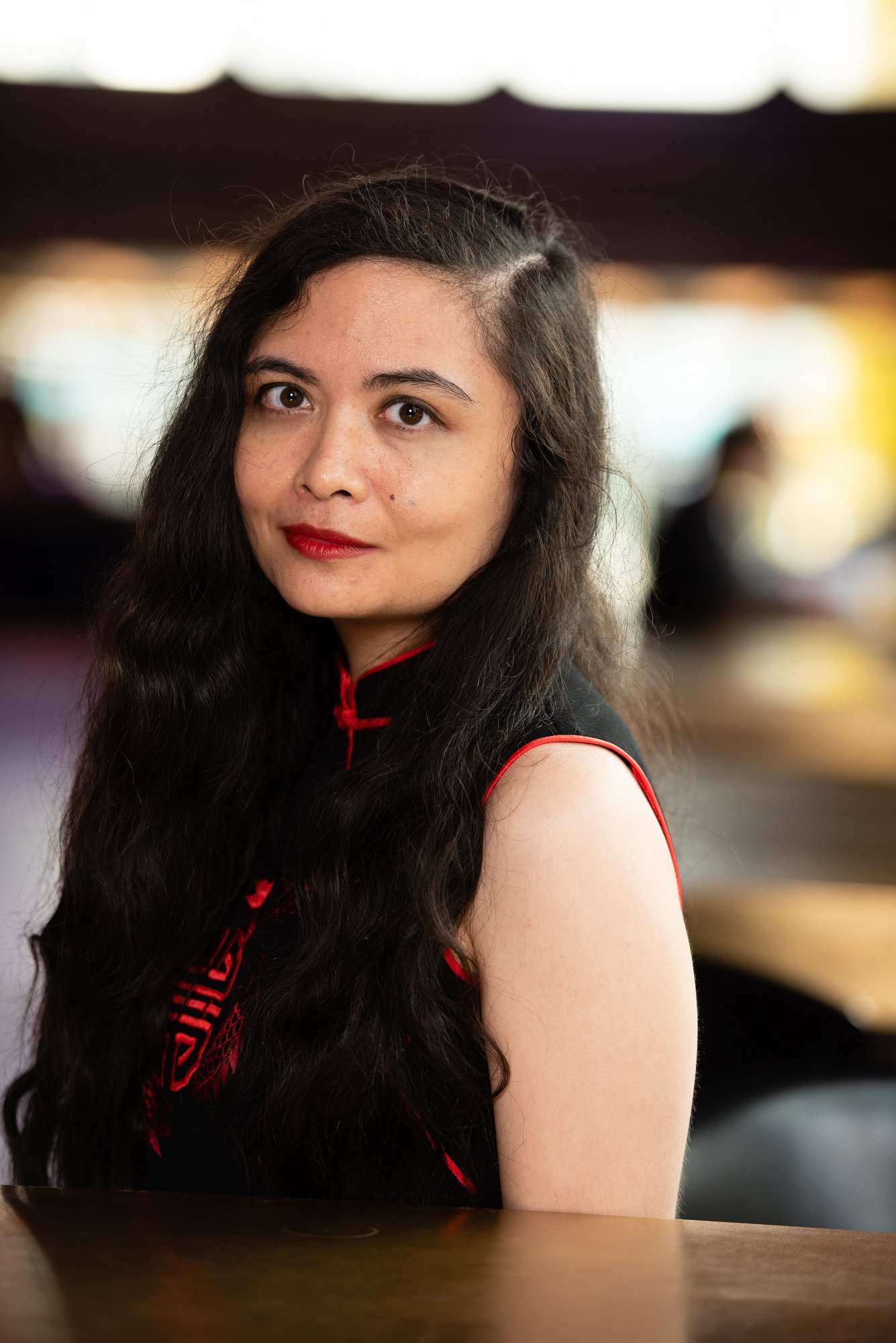
Natalie Linh Bolderston is a Vietnamese-Chinese-British writer. In 2020, she received an Eric Gregory Award and co-won the Rebecca Swift Foundation’s Women Poets’ Prize. In 2021, she was shortlisted for the Forward Prize for Best Single Poem. Her debut poetry collection is Divinations on Survival.