With JOSÉ PINTO DE SÁ, translated by Jethro Soutar
José is a contributor to our Luso portfolio coming out in the fall issue.

Your name: José Pinto de Sá
Current city or town: Maputo, Mozambique
How long have you lived here: Seventy years, albeit with periods spent abroad as a political refugee or for family reasons
Three words to describe the climate: Tropical, hot and humid
Best time of year to visit? Between May and July, when the humidity and rainfall drops considerably and the average temperature is about 20 degrees Celsius, with a few daily fluctuations
1) The most striking physical features of this city/town are . . .
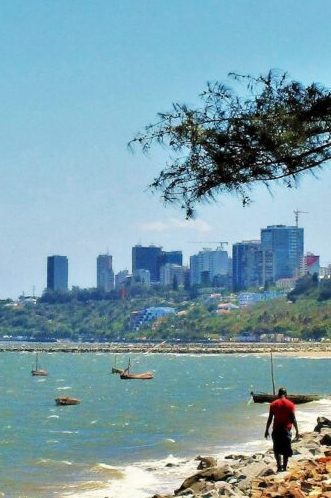
The light and the sea breeze. The city is built on a red sandstone headland that sticks out, at an average height of 80 meters, into Delagoa Bay, where five rivers from the savannah reach the sea. Up the coast to the east are beaches as far as the eye can see, while to the south the bay is home to an important port, one that is vital to southern Africa’s hinterland. Opposite the city, across the bay, are the Katembe lowlands, now connected to Maputo by the largest suspension bridge in Africa.
2) Historical context in broad strokes and the moments in which you feel this history . . .
Like hermit crabs, different inhabitants have occupied the conch shell of Maputo since the Portuguese first built the city in the late nineteenth century. Back then, the colonists lived in the “Cement” neighborhoods on the upper side overlooking the bay, in streets bordered by crimson acacias and jacarandas and with pretty houses surrounded by gardens. The black population, meanwhile, inhabited the “Reeds,” living in huts made from reeds and sheet metal, with no roads, or electricity, or drinking water, or sewage, or garbage collection etc… After 45 years of independence, this shocking state of affairs has barely changed. A scandalously rich black elite now occupies the Cement, while ordinary Matupenses live in poverty in periphery neighborhoods that grow exponentially due to a rural exodus caused by war. The Maputo metropolitan area has a population of around three million people and the vast majority live in these periphery neighborhoods.
3) Local political debates frequently seem to center on . . .
The most recent government corruption scandals. The degree of corruption is ridiculously high at every level of Mozambican society, from cabinet ministers to police patrols. The other hot topic is the worsening political-military situation in the northern province of Cabo Delgado. The region, home to the largest deposits of natural gas in the southern hemisphere, has suffered a number of terrorist attacks from alleged Islamist insurgents since 2017. The conflict, which has already caused over a thousand deaths and the displacement of 250,000 people, is well on its way to degenerating into a large-scale war and the government is clearly incapable of containing the situation.
4) Local/regional vocabulary or food?
The day-to-day lingo of Maputo is a mixture of Portuguese (the country’s official language), English (the language of business and a by-product of having a powerful neighbor in South Africa) and two Bantu languages, XiRonga and XiChangana, which are both spoken in the south of Mozambique. This linguistic variety, allied to the harmonious co-existence, in ethnic and religious terms, of Africans, Asians and Europeans, gives the city a heavy sense of Indian Ocean cosmopolitism.


 This interview is the second in a new series, Writers on Writing, which focuses on craft and process. The series is part of The Common‘s 10th anniversary celebration.
 Ama Codjoe