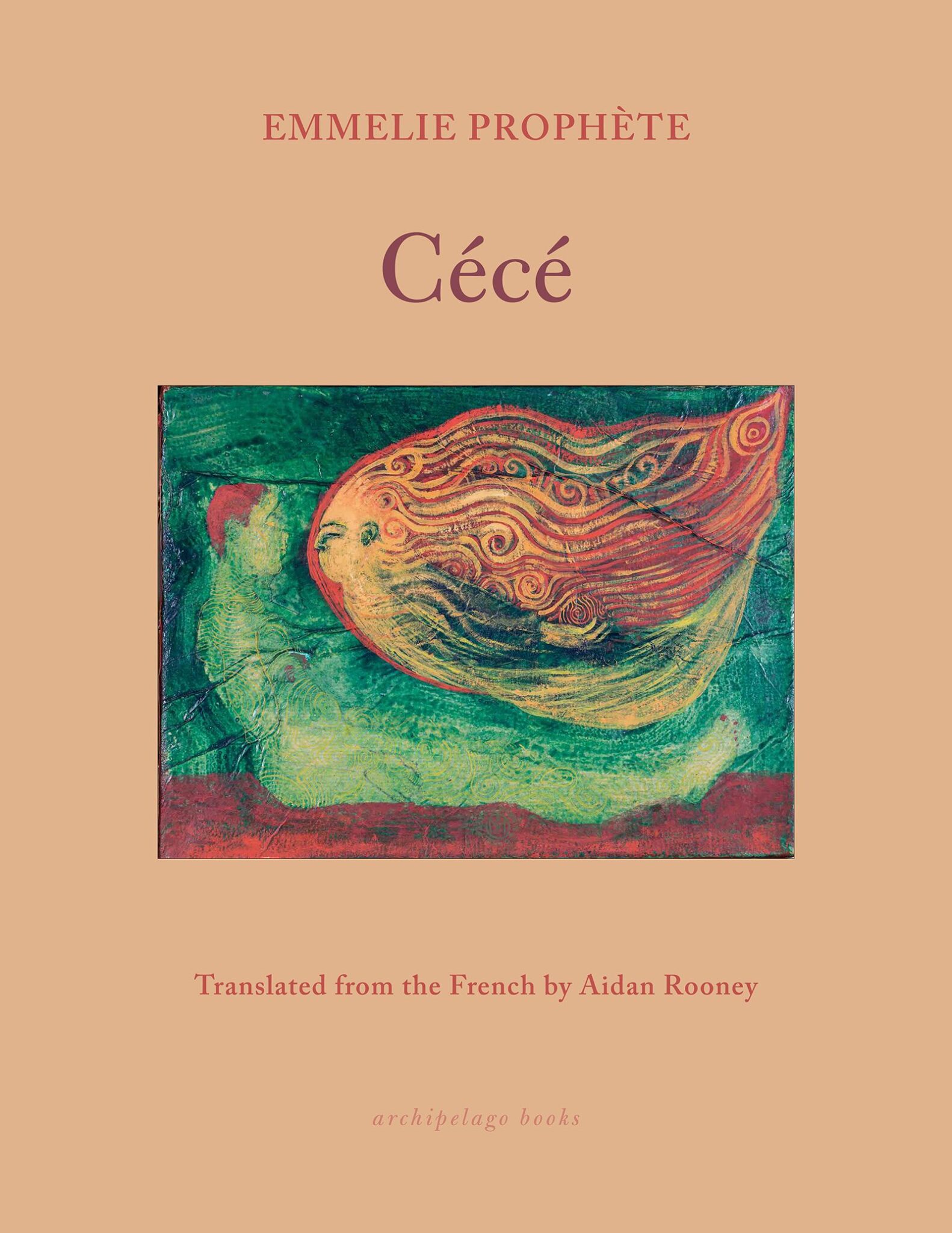
Review by SAM SPRATFORD
Book by EMMELIE PROPHÈTE
Translated from the French by AIDAN ROONEY
Uncle Frédo lies in the dark, water dripping through the sheet-metal roof. His American Dream crushed by the reality of existence as a non-white, non-citizen in the U.S., he returns to Haiti for the remainder of his life. He rarely speaks and is nearly always drunk. He spends his days in a dreamless twilight zone between sleep and wakefulness.
Cécé, his 20 year old niece and the inheritor of his psychic burden, is our real protagonist.
Cécé was born into a slum outside Port-au-Prince, a place fractured by violence. It is the recent past, in the heady early days of the digital age. Facebook was still the social platform of choice and capitalism had not yet made an industry of influencer marketing. Abandoned by a kleptocratic state, the Cité of Divine Power and its counterpart, Bethlehem, have seen gangs step in to provide structure for residents by claiming a monopoly on violence. Unlike the Hobbesian Leviathan, there is no law underwriting the circumstances under which violence can be applied. It is a lawless place—but not without an order of its own.
Emmelie Prophète’s Cécé, published by Archipelago with a translation from the French by Aidan Rooney, unspools the story of this chaotic world through the eyes of its empathetic and unfailingly honest namesake. Cécé’s interiority is overwhelmed by complex negotiations of love, ethics, and pure survival; family and community; personal integrity and the collective responsibility that living under the constant threat of violence necessitates. Along each of these axes, Cécé struggles against the the fate that befell her uncle—the annihilation of her sense of self.
Cécé’s reality is one that most of us, under the assumption that our bodies will be reasonably safe upon waking each morning, will never understand. It is also a reality that millions experience involuntarily—in Haiti, Palestine, and elsewhere. We are lucky to have Prophète’s rendering, which bears witness to a fictional world whose violence is all-too real.
Born in 1971 in Port-au-Prince, Prophète resembles her protagonist in more ways than not. In September 2025, in an interview with the Telegraph, she made clear that her writing—which totals six novels and two poetry collections—is documentarian. Ironically, she said that writing is one of the safest ways to communicate the truth about Haiti, where illiteracy is rampant.
But Prophète is also decisively not writing about her own life. Prophète is a diplomat, an acclaimed writer, and, incidentally, a spokesperson for her home country. Though written in Cécé’s first-person, Prophète’s story is as unindividualistic as the form allows. Amid a literature constrained by autofiction’s imperative to atomize, Prophète has the daring to claim that Cécé’s experience belongs to her in some way, even though she does not belong to it. Reading, one gets the sense that the sensitive Cécé’s psyche is a proxy for the collective consciousness of her community. While her uncle shut down under this burden, Cécé is a deft narrator. In her rare moments of peace, she interweaves observations, perceptions, and memories; we get the sense that Cécé is not one to forget anything. It was a skill passed on from her Grand Ma: “Grand Ma had this house built herself. She loved to talk about it given half a chance…. Her monologue could go on for several minutes, and she made sure all the neighbors heard her, Soline to her right, Fénelon and Yvrose to her left, Nestor out back, Pastor Victor and his wife Andrise a bit further on…”
But, most of the time, Cécé doesn’t have this luxury. In the opening pages, we are introduced to a flurry of neighbors and gang members while Cécé runs through the story of her Grand Ma’s death, an event that forcibly thrusts Cécé, whose uncle is essentially bed-bound, into the responsibilities of adulthood. Gunshots pierce the air over her head constantly, the pops chopping up time into discrete moments. Cécé narrates this relentless present with stark simplicity: “There was shooting everywhere. Joël had killed Freddy. Unloaded his AR15 into him”. Cécé doesn’t even have a chance to introduce herself properly until about a quarter of the way through the book.
We witness the fatalism underpinning this collapse of time in the rapid cycling of Divine Power’s gang leaders—Freddy, Joël, and a few other young men pass through the coveted post in the span of several years. Though accepting the position is essentially a death sentence, the men all vie for it anyway, each using the opportunity to mythologize themselves and their role in pulling the Cité out of poverty.
In the world of Cécé, media is where people can go to make themselves known, to narrate their selves in whatever small way they can before violence or death creates a rupture. Digital social media profiles, infinitely customizable and permanent (to the extent that any platform-based virtuality can be), tug at the root of this desire. “We were all playing out our dream lives,” Cécé says, in the only place where words and images are not interrupted by gunfire.
Prophète balances masterfully on that sinuous thread linking the local to the global by bringing in social media. When Cécé makes enough money from sex work, she buys a phone and starts a social media account under the moniker Cécé la Flamme—“Fire. Fire. For purification, a fresh start”. Her virtual avatar quickly amasses attention. Her followers are from largely outside her milieu, assuming the role of hungry voyeurs to her everyday brutality: photos of dead, mangled bodies are consistently Cécé la Flamme’s most popular fare. Cécé’s aspirations for self-fashioning are raw and political in the most fundamental way: to be listened to, looked at.
Is it enough that, now, people are at least paying attention to Cécé’s cordoned-off slum? Cécé and her neighbors are the detritus of a system that has no more use for them. When this system does intervene, it is vampiric in nature. As a younger man, Uncle Frédo was whisked off to the U.S. to train for the Olympics after a recruiter identified his track-and-field prowess. Frédo sent no word for 12 years. He returned home disheveled and nearly mute, except to communicate that he’d been deported. Céçé speculates that seeing and then losing the well-being that America promised destroyed him.
Cécé sees some version of this upon the birth of Cécé la Flamme, but—we hope—she has learned from Frédo. When she is enlisted by foreign marketing agents to help sell their beauty products, she negotiates a better contract for herself. She is calculating, transactional. She accumulates more money than she knows what to do with, gifts Soline boxes of unused product samples. She takes seriously the real social power her virtual following gives her, and she tiptoes the line between authenticity and strategy to keep from slipping out of the gang leaders’ good graces. People are paying attention, and it pays off. Still, it is not enough.
When the moment comes for Cécé to leave, she cannot psychically disentangle herself from the Cité. Her desires stay pinned to the virtual world of Cécé la Flamme, and her real body falls away.
In the book’s final pages, Cécé contrasts herself with the recently murdered gang leader Jules César, with whom she had grown up. She recounts his fiery speeches, in which, she says, “There was a nostalgia about him, the kind desperate people have. That’s actually how you can recognize them, the ones who break, kill, and burn because the future is hazy.” Cécé’s mythologized avatar is safe from death, but we get the sense that she somehow shares César’s fate. “Uncle Frédo was a shadow,” Cécé says, “and I was the shadow of his shadow”.
It is unclear what Cécé will do after Prophète’s tale ends. In that same Telegraph interview, Prophète speaks to her decision to depart government service: “I have often called myself a ‘prophet’ in my country, because of my name and what I write about. But increasingly I feel like I no longer have a place here. It has gotten too loud. It’s just too violent.” That I felt disappointed by the uncertainty of Cécé’s conclusion has more so to do with my own existential concerns about social media and politics, I think, rather than an artistic failing on Prophète’s part.
In a New Yorker article about the history of arson in the Bronx, Daniel Immerwahr writes that neglect, rather than the extractive nature of racial capitalism, is what caused many apartments in the borough to go up in flames in the late 20th-century. In Prophète’s world—and ours—it is, in fact, both.
With much of our information and discourse having migrated online, our attention is scattered and our politics are disembodied. Movements are largely replaced by seemingly autonomous trend cycles, which, on occasion, line up just enough for us to grope at a coherent political framework—the introduction of the Congo and Sudan into discourse around Palestine comes to mind as a recent example.
At the same time, just as it was the only venue in which Cécé could repoliticize herself, social media is the only channel through which we, in the U.S., can engage with the domination our government exports abroad. Empire relies on isolation, the abandonment of dominated people to the violence that it besets upon them. Social media, diffuse as its voices and impenetrable as its workings are, is the only lens through which the seemingly sourceless violence of racial capitalism becomes visible.
Of course, it would be naïve to gloss the violences that prop up this virtual world. Chips and batteries are produced by an assembly line of human and ecological horrors; data centers are potent vectors for the unequal distribution of environmental toxicity; and our scrolling lines the pockets of the tech billionaires spearheading a 21st-century fascism. There is perhaps a reading of Cécé that blames her tragedy on the by now well-documented addictive power of social media platforms—the likes and other dopamine levers that enabled her final dissociation from her material circumstances. Then again, though, Frédo met the same fate.
If we set aside the tactical questions of whether and how the internet should be used in progressive politics, we see that Cécé is making a more descriptive argument. For much if not all of the non-billionaire class and especially the Global South, social media platforms are an avenue of resistance for those subject to empire’s agenda of invisibility.
For American readers, Prophète has written her way to the new core drama of our political moment: the juxtaposition of a bloody, pervasive violence and a public who only encounters this violence as a flattened simulation. In this virtual politics, the first step is learning how to see.
Sam Spratford is a writer and editor based in Brooklyn. They currently report on the book business for Publisher’s Weekly and can be reached at sspratford@gmail.com.